Best AI Strategies & Prompts for Leather Craft Businesses
Running a leather craft business is very different from simply just making leather products.
You may start your day choosing the right piece of leather, cutting patterns, punching holes, stitching edges, burnishing leather, setting hardware, or carefully adding a customers initials. These are the parts of the business where your craftsmanship really matters.
But that is only part of the job!
Once the product is finished, you still need to photograph it, write a product description, upload it to your store, answer customer questions, promote it on social media, manage orders, calculate your costs, package products, handle shipping, collect reviews, and think about what you are going to make and sell next.
For many leather crafters, the craft is not the biggest business challenge, but the work surrounding the craft is..
And this becomes even harder when you are running the business alone.
You might be an excellent leatherworker. but suddenly find yourself spending an evening writing Instagram captions, researching product ideas, responding to five similar customer messages, or trying to figure out why a product that takes three hours to make isn’t producing enough profit.
This is where artificial intelligence can become useful.
AI can not replace the skill, patience, creativity, and hands on experience required to create a quality leather product. But it can help with many of the tasks that happen around the craftsmanship.
Think of it as an extra business assistant sitting beside you.
You make the wallet, bag, belt, journal cover, watch strap, or other leather product.
AI can help you research it, price it, describe it, market it, sell it, and build systems around it.
The Common Challenges Leather Crafters Face
A leather craft business can involve dozens of different responsibilities.
You may need to,,
- Find new product ideas
- Understand what customers want
- Research competitors and market trends
- Choose materials and suppliers
- Calculate product costs
- Set profitable prices
- Manage production
- Check product quality
- Photograph finished products
- Write product listings
- Optimize listings for search
- Create social media content
- Promote new products
- Respond to customer questions
- Manage custom orders
- Package and ship products
- Collect customer reviews
- Encourage repeat purchases
- Track sales and profitability
- Decide what products to make next
For a small business owner, that is a lot to handle.
The problem becomes particularly noticeable when your business starts getting more orders.
More orders sound great, and they are,, but increased sales can also mean more customer messages, more production planning, more inventory management, more shipping, and more administrative work.
Eventually, you can find yourself spending less time doing the work you actually enjoy.
That is one of the biggest opportunities for AI in a leather craft business.
Instead of asking:
“How can AI make leather products for me?”
A better question is:
“How can AI help me spend more of my time on making great leather products and less time on repetitive business tasks?”
That shift in thinking is important.
What You Will Learn in This Guide
This guide takes a different approach from a simple list of ChatGPT prompts.
Before getting into the prompts, we’ll look at how a leather craft business actually operates from beginning to end.
We will look at the journey from:
Product idea → Customer research → Design → Materials → Pricing → Production → Quality Control → Photography → Listings → SEO → Marketing → Sales → Customer Service → Fulfillment → Reviews → Repeat Customers → Business Growth
At each stage, we will identify the challenges a leather craft business owner can face and explore where AI can fit into the workflow.
After that, we’ll move into practical AI prompts and strategies you can use for product research, design, pricing, marketing, customer service, content creation, sales and business growth.
The goal isn’t to use AI for everything.
The goal is to identify the tasks where AI can save you time, improve your thinking, and help you grow, while keeping the craftsmanship and personality that make a leather craft business special.
1. Why AI Can Be Useful for Leather Craft Businesses
AI is most useful when it works alongside your existing skills.
For example, imagine you have just created a handmade full grain leather wallet.
You still need to decide:
- Who is most likely to buy it?
- How should you position it?
- What should you charge?
- What keywords should you use?
- How should you describe it?
- What photographs should you take?
- What should you post on Pinterest?
- What should you post on Instagram?
- What other products could you sell to the same customer?
- How could you turn customer feedback into improvements?
AI can help you work through many of these questions much faster.
You could give an AI assistant information about your product and ask it to generate potential customer profiles. Then you could use those profiles to develop marketing messages.
You could provide your actual material and labor costs and ask AI to organize different pricing scenarios.
You could give it your product specifications and ask it to create a first draft of your product description.
You could provide several customer reviews and ask AI to identify the features customers appreciate most.
You could even take one finished product and turn it into an entire content campaign.
The important point is that AI works best when you provide your expertise and real business information.
Generic prompts produce generic results.
The more context you provide: your product, materials, customers, pricing, brand style, business goals and actual customer feedback , the more useful AI becomes.
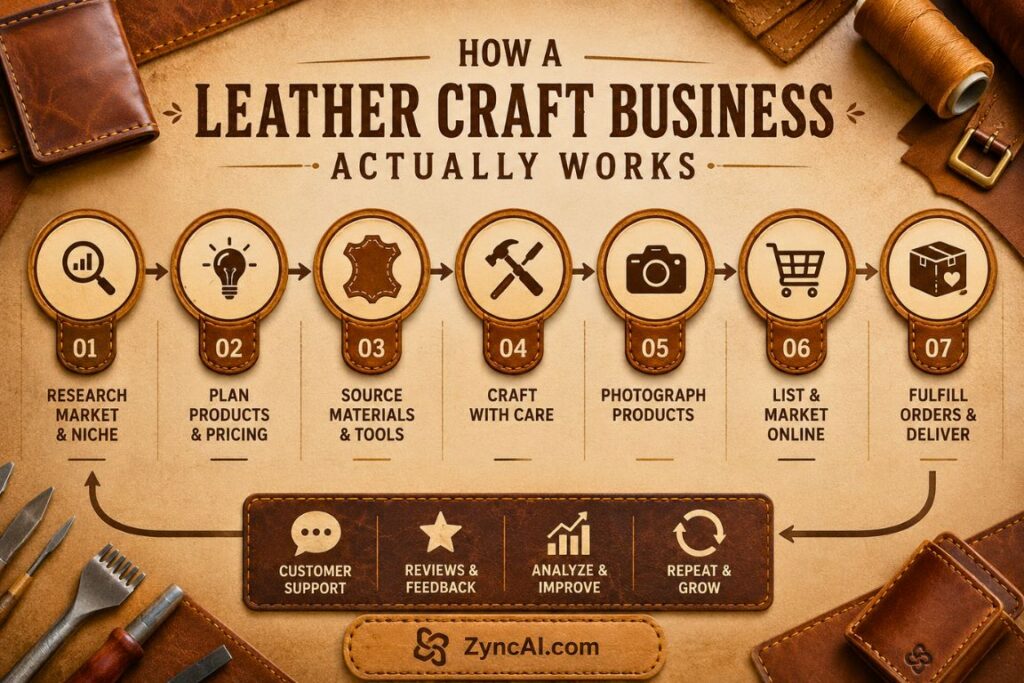
2. How a Leather Craft Business Actually Works
A successful leather craft business is more than a workshop where products are made. Behind every wallet, belt, bag, journal cover, or leather accessory is a series of business decisions.
You need to decide what to make, who to make it for, how much to charge, how to produce it efficiently, how to present it, and how to get it in front of the right customers.
AI can potentially assist at almost every one of these stages.
The key is to understand the workflow first. Once you understand where the time and effort go, you can identify the tasks where AI can genuinely add value.
2.1 Finding Leather Product Ideas
2.1.1 What Happens at This Stage
Every leather craft business starts with a product idea.
That might be something simple, such as a card holder or keychain, or something more complex, such as a leather backpack, travel bag, messenger bag, or custom motorcycle accessory.
Product ideas can come from many places,
- Customer requests
- Existing products
- Personal creativity
- Marketplace trends
- Social media
- Competitor research
- Problems customers want solved
- Seasonal demand
- Gifting occasions
- Personal interests and hobbies
The challenge is turning an idea into a product that people actually want to buy.
A beautiful product isn’t automatically a profitable product.
For example, you might spend several hours creating a highly detailed leather accessory because you enjoy making it. But if the target market is too small, the production time is too long, or customers aren’t willing to pay enough, it may not make sense as a core product.
The goal is therefore not simply to ask:
“What can I make?”
It’s to ask:
“What can I make that people want, that I can produce profitably, and that fits my brand?”
2.1.2 Common Challenges
Leather crafters commonly face questions such as:
- What leather product should I make next?
- Which products have the strongest demand?
- Should I create something completely new or improve an existing product?
- What products could complement my current best sellers?
- What products would appeal to a specific niche?
- Which products are worth the time required to make them?
- How can I stand out in a crowded marketplace?
There is also the danger of following every trend.
A product might suddenly become popular on social media, but that doesn’t necessarily mean it is suitable for your skills, equipment, brand or target customer.
Good product development requires a balance between market demand and craftsmanship.
2.1.3 How AI Can Help
AI can become a useful brainstorming and research assistant during product development.
For example, you can ask AI to generate:
- Leather product ideas for a specific customer group
- Variations of an existing product
- Product ideas based on a particular leather type
- Complementary products for an existing bestseller
- Gift-oriented leather products
- Products for specific hobbies or professions
- Ideas for leather product collections
- Potential problems that could be solved with leather products
Suppose your main product is a handmade leather wallet.
Instead of asking AI for random new product ideas, you could ask it to think about products that the same customer might purchase next.
That could lead to ideas such as card holders, key organizers, money clips, passport holders, cable organizers, watch straps or other complementary accessories.
This approach is more useful because you’re not starting from zero.
You’re building around an existing customer and product ecosystem.
2.1.4 AI Strategy: Use AI to Expand Ideas, Not Decide What You Should Make
One of the best ways to use AI at this stage is to make it generate multiple possibilities rather than asking it to give you one answer.
For example:
“Give me 20 leather product ideas for motorcycle enthusiasts. For each idea, identify the customer problem it solves, estimated production complexity, potential personalization options, and opportunities for premium positioning.”
Now you have a starting point for evaluating ideas.
You can then eliminate products that don’t fit your skills, equipment, brand or profitability requirements.
The final decision should remain yours.
AI generates possibilities. You use your craftsmanship and business knowledge to choose the opportunities worth pursuing.
2.2 Understanding Your Ideal Customer
2.2.1 What Happens at This Stage
Once you have a product idea, you need to understand who is most likely to buy it.
A leather business can serve very different types of customers.
For example:
- Professionals looking for premium accessories
- Motorcycle enthusiasts
- Travelers
- EDC enthusiasts
- Gift buyers
- Wedding customers
- Corporate buyers
- Pet owners
- Luxury shoppers
- Outdoor enthusiasts
- Handmade-product enthusiasts
- Customers looking for personalized gifts
Each group can want something different from the same product.
A professional might care about appearance and durability.
A traveler might care about functionality and organization.
A gift buyer might care more about personalization and presentation.
A motorcycle enthusiast might value ruggedness and practicality.
The product may be the same, but the reason for buying it can be completely different.
2.2.2 Common Challenges
Many small craft businesses make the mistake of trying to appeal to everyone.
Their product descriptions say things like:
“Perfect for everyone.”
Their social media content tries to speak to every possible customer.
Their website doesn’t clearly communicate who the product is designed for.
This can make marketing much harder.
A more focused approach is to understand:
- Who is the ideal customer?
- What problem are they trying to solve?
- What motivates them to purchase?
- What features matter most to them?
- What objections might stop them from buying?
- What price range feels reasonable to them?
- Where do they discover products?
- What type of content catches their attention?
2.2.3 How AI Can Help
AI can help you build detailed customer profiles and explore different buying motivations.
You can use it to generate:
- Ideal customer personas
- Customer pain points
- Buying motivations
- Common objections
- Product use cases
- Gift-buying scenarios
- Customer segments
- Marketing angles
- Frequently asked questions
For example, instead of simply asking AI:
“Who would buy my leather wallet?”
You could give it more information:
“I make handmade full-grain leather wallets priced between $80 and $120. They are minimalist, durable and customizable with initials. Identify five customer segments that could realistically be interested in this product and explain what each segment would value most.”
The resulting analysis can help you think beyond the generic idea of “people who need wallets.”
2.2.4 AI Strategy: Build Different Marketing Messages for Different Customers
One product can have several different marketing angles.
Imagine you sell a personalized leather journal.
For a professional, the message might focus on premium materials and thoughtful organization.
For a writer, it might focus on the tactile experience of writing in a handmade journal.
For a gift buyer, the focus could be personalization and emotional value.
For a traveler, the emphasis could be on documenting experiences.
AI can help you develop these different angles while keeping the underlying product the same.
This becomes particularly useful when creating advertising, social media content, email campaigns and product descriptions.
2.3 Leather Product Design & Development
2.3.1 What Happens at This Stage
Once you’ve identified an opportunity and understand the customer, the idea needs to become a physical product.
This stage can involve:
- Choosing dimensions
- Developing patterns
- Selecting leather
- Choosing hardware
- Selecting thread
- Deciding construction methods
- Choosing stitching styles
- Developing compartments
- Considering usability
- Creating prototypes
- Testing the product
- Refining the design
This is where the craftsperson’s experience becomes extremely important.
Leather isn’t simply a flat material that can be treated like paper or fabric. Thickness, flexibility, stretch, grain, finishing and construction methods can all influence the final product.
2.3.2 Common Challenges
Product development can take significant time.
You may have an idea but struggle with questions such as:
- How can I make this product more useful?
- What features should I add?
- What variations should I create?
- How can I make the product more premium?
- How can I reduce unnecessary materials?
- What personalization options could I offer?
- What products could form a collection around this design?
Another challenge is avoiding unnecessary complexity.
Adding more features doesn’t always make a product better.
Sometimes the strongest design is the simplest one.
2.3.3 How AI Can Help
AI can assist with the conceptual side of product development.
For example, it can help you:
- Brainstorm product features
- Generate design variations
- Develop product collections
- Explore personalization options
- Identify potential customer objections
- Analyze product reviews
- Suggest improvements based on customer feedback
- Create design briefs
- Develop product concepts for specific customer segments
You can also ask AI to compare different versions of the same product.
For example:
Basic wallet → Minimalist wallet → Premium wallet → Personalized gift wallet
AI can help identify how each version could be positioned and which customer might be most interested in it.
2.3.4 AI Strategy: Separate Ideas From Technical Validation
This distinction is important.
AI can suggest a product concept, but it doesn’t physically test the leather.
It can’t replace:
- Prototyping
- Measuring
- Cutting
- Stitching
- Stress testing
- Material testing
- Real-world customer testing
Use AI to expand your design thinking, then use your actual craftsmanship and prototypes to determine what works.
A useful workflow is:
AI concept → Your technical evaluation → Prototype → Test → Customer feedback → Improvement
That keeps AI in the role where it is most useful while protecting the quality of the finished product.
2.4 Materials & Production Planning
2.4.1 What Happens at This Stage
A leather craft business needs more than leather.
Depending on the product, you may need:
- Leather
- Thread
- Buckles
- Rivets
- Snaps
- Zippers
- D-rings
- Clasps
- Adhesives
- Dyes
- Finishing products
- Packaging materials
As order volume increases, managing these materials becomes increasingly important.
2.4.2 Common Challenges
You may encounter:
- Running out of essential materials
- Buying too much inventory
- Difficulty tracking different leather types
- Poor organization
- Unclear reorder points
- Unexpected material costs
- Difficulty planning larger batches
For a small business, even a relatively simple inventory system can make a significant difference.
2.4.3 How AI Can Help
AI can help structure your production and inventory information.
You could use it to create:
- Bills of materials
- Material checklists
- Production plans
- Batch-production schedules
- Inventory categories
- Reorder frameworks
- Supplier comparison criteria
- Material requirement summaries
For example, if you provide the materials required for several products, AI can help organize them into a production-oriented list.
Instead of having separate lists for every product, you can identify shared materials and plan purchases more efficiently.
2.4.4 AI Strategy: Connect Materials to Actual Orders
AI becomes more useful when you connect material planning with real demand.
For example:
10 wallet orders + 5 belts + 3 card holders
can be turned into an organized production and materials plan.
This is much more useful than simply asking:
“What leather supplies do I need for my business?”
The more specific your input data, the more practical the output becomes.
2.5 Pricing Leather Products Profitably
2.5.1 What Should Go Into the Price?
Pricing handmade leather products is one of the most important parts of the business—and one of the easiest places to make mistakes.
Your price needs to account for more than the leather.
A basic framework is:
Leather + Hardware + Thread + Packaging + Labor + Overhead + Platform Fees + Marketing Costs + Profit = Selling Price
If you leave out one or more of these costs, you may think you’re making money when you’re actually underpaying yourself.
2.5.2 Common Pricing Mistakes
Common mistakes include:
- Pricing based only on material cost
- Ignoring labor time
- Forgetting packaging
- Ignoring marketplace fees
- Ignoring payment processing costs
- Undercharging for customization
- Copying competitor prices
- Using the same margin for every product
- Forgetting overhead costs
A product that costs $20 in materials isn’t necessarily a $40 product.
If it takes three hours to make, your labor needs to be part of the equation.
2.5.3 How AI Can Help
AI can help you structure pricing calculations and compare different scenarios.
For example, you can ask it to help model:
- Retail pricing
- Wholesale pricing
- Different profit margins
- Custom-order pricing
- Bundle pricing
- Promotional pricing
- Minimum viable pricing
You can also ask AI to help identify which products may be consuming a lot of production time without generating enough profit.
2.5.4 AI Strategy: Give AI Your Real Numbers
AI should not invent your costs.
Give it actual information such as:
- Leather cost
- Hardware cost
- Packaging cost
- Labor hours
- Desired hourly rate
- Platform fees
- Shipping costs
- Overhead
- Target profit margin
Then AI can help organize the calculations and explain different scenarios.
The goal isn’t to let AI decide what your product is worth.
The goal is to use AI to make your pricing decisions more structured and informed.
2.6 Making & Production Workflow
2.6.1 What Happens at This Stage
This is the part most leather crafters naturally think of when they think about the business.
Depending on the product, production may involve:
- Cutting
- Skiving
- Punching
- Tooling
- Dyeing
- Stitching
- Assembly
- Edge finishing
- Burnishing
- Hardware installation
- Final inspection
The actual sequence will depend heavily on the product and the craftsperson’s methods.
2.6.2 Common Challenges
As the business grows, production can become difficult to manage.
You may have:
- Multiple products in progress
- Custom orders with different specifications
- Different delivery deadlines
- Material shortages
- Repeated production steps
- Bottlenecks
- Difficulty estimating completion times
The challenge isn’t always making the product.
It can be organizing the work around the products.
2.6.3 How AI Can Help
AI can help create systems around production.
For example:
- Production checklists
- Standard operating procedures
- Batch-production plans
- Order prioritization frameworks
- Time-tracking templates
- Workflow documentation
- Bottleneck analysis
- Production schedules
If you repeatedly make the same wallet, AI can help you document the process into a consistent checklist or SOP.
That becomes increasingly valuable if you eventually hire an assistant or expand your production operation.
2.6.4 AI Strategy: Document What You Already Know
One of the most powerful uses of AI for an experienced craftsperson is turning their knowledge into documented processes.
You can explain your existing workflow to AI and ask it to organize it into a clear SOP.
For example:
Your knowledge → AI organizes it → SOP → Repeatable process
This allows your craftsmanship knowledge to become a business asset rather than remaining entirely inside your head.
2.7 Quality Control
2.7.1 Common Quality Issues
Handmade products can have problems such as:
- Uneven stitching
- Scratches
- Poor edge finishing
- Misaligned hardware
- Incorrect dimensions
- Color inconsistencies
- Incorrect personalization
- Missing components
- Packaging mistakes
Even small mistakes can affect customer satisfaction.
2.7.2 How AI Can Help
AI can help create product-specific quality-control systems.
For example:
Leather Wallet QC Checklist
- Dimensions checked
- Stitching inspected
- Edges finished
- Hardware secured
- Leather inspected
- Personalization verified
- Compartments checked
- Final cleaning completed
- Packaging completed
AI can also help analyze customer complaints to identify recurring problems.
2.7.3 AI Strategy: Turn Complaints Into Process Improvements
Instead of treating every complaint as an isolated incident, collect them.
Then ask AI:
“Analyze these customer complaints and identify the most common product or production problems. Group them by frequency and suggest process improvements.”
This can help you move from simply fixing problems to preventing them.
2.8 Product Photography
2.8.1 Why Photography Matters
Customers can’t physically touch your leather products when shopping online.
Your photographs therefore need to communicate what the customer would experience in person.
Good photography can show:
- Leather texture
- Stitching
- Edges
- Hardware
- Scale
- Interior details
- Personalization
- Product use
- Packaging
- Overall craftsmanship
2.8.2 Common Challenges
Small leather businesses often struggle with:
- Choosing backgrounds
- Lighting
- Creating lifestyle images
- Showing product scale
- Creating consistent visual branding
- Producing enough images for different platforms
2.8.3 How AI Can Help
AI can help with the planning side of product photography.
You can use it to generate:
- Photography shot lists
- Lifestyle scene concepts
- Background ideas
- Social media image concepts
- Pinterest visual concepts
- Product storytelling ideas
For example, a handmade leather travel wallet might need different visual concepts for:
Product listing → Close-up detail → Lifestyle travel image → Gift image → Pinterest graphic
One product can therefore generate multiple visual opportunities.
2.8.4 AI Strategy: Plan Before You Photograph
Instead of taking random photographs and hoping you have enough useful images, use AI to create a shot plan first.
For example:
Hero image → Detail image → Size image → Interior image → Lifestyle image → Personalization image → Packaging image
This makes your photography process more systematic.
2.9 Product Listings & Descriptions
2.9.1 Where Listings Matter
Your product listing is where craftsmanship needs to become convincing written communication.
This is particularly important on platforms such as:
- Etsy
- Shopify
- Amazon Handmade
- Your own website
- Social commerce platforms
2.9.2 How AI Can Help
AI can assist with:
- Product titles
- Product descriptions
- Feature/benefit sections
- Bullet points
- FAQs
- SEO keywords
- Image alt text
- Customization instructions
- Product-care information
But simply asking:
“Write me an Etsy description for a leather wallet”
usually produces generic content.
2.9.3 AI Strategy: Give AI the Complete Product Story
A stronger prompt includes:
- Product type
- Leather type
- Leather color
- Dimensions
- Number of compartments
- Hardware
- Stitching
- Personalization options
- Target customer
- Main benefits
- Production method
- Brand personality
- Price range
- Unique selling point
The AI can then transform your real product information into clearer customer-facing content.
The craftsperson supplies the truth.
AI helps communicate it.
2.10 SEO & Keyword Research
2.10.1 Why SEO Matters
A beautiful leather product isn’t useful to your business if potential customers can’t discover it.
SEO can help your products appear when people search for things they actually want to buy.
This can apply to:
- Etsy
- Shopify stores
- Other marketplaces
2.10.2 How AI Can Help
AI can help brainstorm:
- Long-tail keywords
- Search queries
- Customer questions
- Search-intent categories
- Related topics
- Content ideas
- Product-listing variations
For example, instead of focusing only on:
“leather wallet”
you might explore:
- handmade leather wallet
- personalized leather wallet
- minimalist leather wallet
- full grain leather wallet
- leather wallet for men
- custom leather wallet gift
2.10.3 AI Strategy: Use AI for Discovery, Not Final Validation
AI can suggest keywords, but it doesn’t automatically know the latest search volume or marketplace competition.
A better process is:
AI keyword ideas → SEO tool validation → Select target keywords → Optimize content
This combination gives you the creative breadth of AI with real search data.
2.11 Social Media Marketing
2.11.1 Platforms to Consider
Different platforms can serve different purposes.
Instagram can showcase craftsmanship and finished products.
Pinterest can help customers discover products and ideas through search.
TikTok can showcase satisfying production processes and behind-the-scenes content.
Facebook can support community building and product promotion.
YouTube can provide deeper educational and behind-the-scenes content.
The goal isn’t necessarily to be everywhere.
It’s to identify the platforms where your customers are most likely to discover and engage with your products.
2.11.2 How AI Can Help
AI can help create:
- Content calendars
- Post ideas
- Reel concepts
- Video scripts
- Captions
- Pinterest titles
- Story ideas
- Educational content
- Product launch campaigns
- Seasonal campaigns
2.11.3 Content Pillars
A leather craft business has a natural advantage on social media because the making process itself is interesting.
Content can revolve around:
- The making process
- Finished products
- Leather education
- Behind-the-scenes content
- Customer stories
- Product care
- Gift ideas
- Craftsmanship
- Custom orders
- Founder stories
Instead of constantly saying “Buy my product,” you can use AI to build content around the story and expertise behind the product.
2.12 Selling & Converting Visitors
2.12.1 The Challenge
Getting someone to see your product is only the beginning.
You also need to convince them that the product is worth buying.
A customer may be asking:
“Why should I choose this leather product instead of the cheaper alternative?”
Your product presentation needs to answer that question.
2.12.2 How AI Can Help
AI can help develop:
- Value propositions
- Product positioning
- Calls to action
- Offer ideas
- Bundles
- Upsells
- Cross-sells
- Landing-page copy
- Gift-focused messaging
2.12.3 Sell the Value, Not Just the Product
Consider the difference between:
“Handmade leather wallet.”
and:
“A personalized full-grain leather wallet handcrafted for everyday carry and designed to develop a unique character over time.”
The second communicates more than what the object is.
It communicates why someone might want it.
AI can help you explore different value propositions for the same product.
2.13 Customer Communication
2.13.1 Common Customer Questions
Leather businesses can receive many repetitive questions:
- How long does shipping take?
- Can I customize it?
- What leather do you use?
- Can you add initials?
- Can I change the color?
- How should I care for it?
- Can I order in bulk?
- Can you make a different size?
- Is this suitable as a gift?
Answering these individually can consume a surprising amount of time.
2.13.2 How AI Can Help
AI can help create:
- FAQ responses
- Customer inquiry templates
- Custom-order responses
- Shipping updates
- Product-care instructions
- Complaint-response drafts
- Review-request messages
2.13.3 AI Strategy: Keep the Human Voice
The goal isn’t to make your customer service sound like a chatbot.
Your brand’s personality matters.
Use AI to create a strong first draft, then add your own tone and personal touch.
AI can make customer communication faster. You should still make it feel human.
2.14 Custom & Personalized Orders
2.14.1 Common Customizations
Personalization can be a major opportunity for leather businesses.
Customers may request:
- Initials
- Names
- Dates
- Logos
- Different colors
- Different stitching
- Custom dimensions
- Special compartments
- Corporate branding
2.14.2 How AI Can Help
AI can help turn complicated customer messages into organized production requirements.
For example:
Customer message → Required personalization → Dimensions → Color → Hardware → Deadline → Missing information
This can reduce the risk of forgetting important details.
2.14.3 AI Strategy: Create a Custom-Order Workflow
A useful system could be:
Customer inquiry → AI extracts requirements → Missing information identified → Customer confirmation → Production specification → Production checklist
This is especially valuable as the number of custom orders increases.
2.15 Packaging, Shipping & Fulfillment
2.15.1 What Happens at This Stage
Once a product is completed, the work isn’t finished.
You still need to:
- Inspect the product
- Package it
- Include relevant care information
- Prepare shipping
- Notify the customer
- Record the order
- Follow up
2.15.2 How AI Can Help
AI can create:
- Packing checklists
- Shipping messages
- Thank-you cards
- Product-care cards
- Packaging insert ideas
- Review requests
- Cross-selling messages
A simple order can therefore become an opportunity to strengthen the customer relationship.
2.16 Reviews & Customer Feedback
2.16.1 Why Reviews Matter
Reviews aren’t just social proof.
They’re a source of business intelligence.
Customers can reveal:
- What they love about your products
- What surprised them
- What they expected
- What problems they experienced
- Which features matter most
- What they would like improved
2.16.2 How AI Can Help
AI can analyze groups of reviews and identify:
- Recurring complaints
- Frequently praised features
- Common customer expectations
- Product improvement opportunities
- Potential marketing messages
2.16.3 Advanced AI Strategy
Instead of analyzing one review at a time, collect a larger set of reviews and ask AI to identify patterns.
For example:
50 reviews → AI analysis → Common praise → Common complaints → Product improvements → New marketing angles
This turns customer feedback into a continuous improvement system.
2.17 Repeat Customers & Customer Loyalty
2.17.1 Why Repeat Customers Matter
A customer who already trusts your craftsmanship can be valuable for future sales.
The opportunity is to understand what else that customer might need.
Someone who buys a leather wallet may also be interested in:
- Card holders
- Key organizers
- Belts
- Passport holders
- Watch straps
- Travel accessories
2.17.2 How AI Can Help
AI can help develop:
- Product recommendations
- Cross-selling campaigns
- Customer segments
- Post-purchase emails
- Gift reminders
- Loyalty campaigns
- Product bundles
2.17.3 Example Product Journey
Leather wallet → Card holder → Key organizer → Belt → Passport holder → Travel accessory
The objective isn’t to constantly sell more.
It’s to offer relevant products that make sense for the customer’s existing purchase.
2.18 Growing the Leather Craft Business
2.18.1 Product Expansion
Once you have a reliable customer base, AI can help brainstorm:
- New collections
- New product categories
- New colors
- Personalization options
- Gift sets
- Premium versions
- Entry-level products
2.18.2 New Sales Opportunities
Growth doesn’t always mean making more individual products.
You could explore:
- Wholesale
- Corporate gifting
- B2B orders
- Retail partnerships
- Custom corporate branding
- Online marketplaces
- Subscription or membership concepts
2.18.3 How AI Can Help
AI can support:
- Market research
- Product expansion
- Business strategy
- B2B messaging
- Corporate gifting proposals
- Content systems
- SOP creation
- Business analysis
- Growth planning
The further your leather business grows, the more useful AI can become for organizing and analyzing the business behind the craft.
3. The AI-Powered Leather Craft Business Workflow
Now let’s look at the different stages of running a leather craft business. It will be then easier to see where AI can fit into your business.
The biggest opportunity is not using AI for one isolated task.
It is creating a connected workflow where AI supports you throughout the customer and product journey.
Instead of thinking,
“I use AI to write product descriptions.”
Think,
“I use AI throughout my business workflow like to research opportunities, develop products, market them, communicate with customers, and learn from the results.”
3.1 The Complete Leather Craft Business Workflow
A typical leather craft business can follow this journey:
Research → Ideate → Design → Calculate → Make → Check → Photograph → List → Market → Sell → Fulfill → Support → Learn → Improve
Each stage has a different purpose.
Research helps you understand customers and opportunities.
Ideate turns those insights into potential products.
Design turns an idea into something that can actually be made.
Calculate determines whether the product can be profitable.
Make brings the product to life.
Check ensures the quality meets your standards.
Photograph communicates the product visually.
List presents the product to potential customers.
Market brings attention to it.
Sell converts attention into orders.
Fulfill gets the product safely to the customer.
Support creates a positive customer experience.
Learn turns customer feedback and sales data into insights.
Improve uses those insights to make the next product, process or marketing campaign better.
This creates a continuous business cycle rather than a one-time transaction.
3.2 Where AI Fits Into the Workflow
AI can potentially support every stage, but its role changes depending on the task.
| Business Stage | AI Assistance |
|---|---|
| Research | Customer and market insights |
| Ideation | Product ideas and variations |
| Design | Concepts and product development ideas |
| Costing | Pricing frameworks and calculations |
| Production | Planning and SOPs |
| Quality | QC checklists and issue analysis |
| Photography | Shot lists and visual concepts |
| Listings | Titles and descriptions |
| SEO | Keyword ideas and content planning |
| Marketing | Content and campaign ideas |
| Sales | Positioning and offers |
| Customer Service | Response drafts and FAQs |
| Fulfillment | Packing and shipping checklists |
| Reviews | Customer feedback analysis |
| Growth | Business strategy and opportunity analysis |
The important point is that AI doesn’t have to perform every task automatically.
Sometimes its role is simply to help you think.
For example, AI might generate 20 product ideas, but you choose the two worth prototyping.
It might suggest five pricing scenarios, but you decide which price makes sense for your brand.
It might draft a customer response, but you personalize it before sending.
It might identify a recurring complaint in your reviews, but you decide how to fix the underlying production problem.
3.3 The Human + AI Model
The most effective approach for a leather craft business is not:
AI replaces the artisan.
It’s:
AI supports the artisan.
Think of the roles this way:
AI
- Researches
- Brainstorms
- Organizes
- Analyzes
- Drafts
- Summarizes
- Generates
- Recommends
- Helps automate repetitive work
You
- Make the product
- Evaluate materials
- Validate designs
- Control quality
- Make business decisions
- Understand your customers
- Define your brand
- Tell your story
- Approve the final output
This distinction becomes particularly important for handmade businesses.
Customers aren’t buying a leather product simply because it exists.
They’re often buying the craftsmanship, story, quality, personalization and human connection behind it.
AI should strengthen those elements rather than hide them.
3.4 Connect AI Tasks Instead of Using Them in Isolation
One of the biggest opportunities comes from connecting several AI-assisted tasks together.
Imagine you have created a new handmade leather travel wallet.
Instead of using AI only to write its description, you could create a complete workflow:
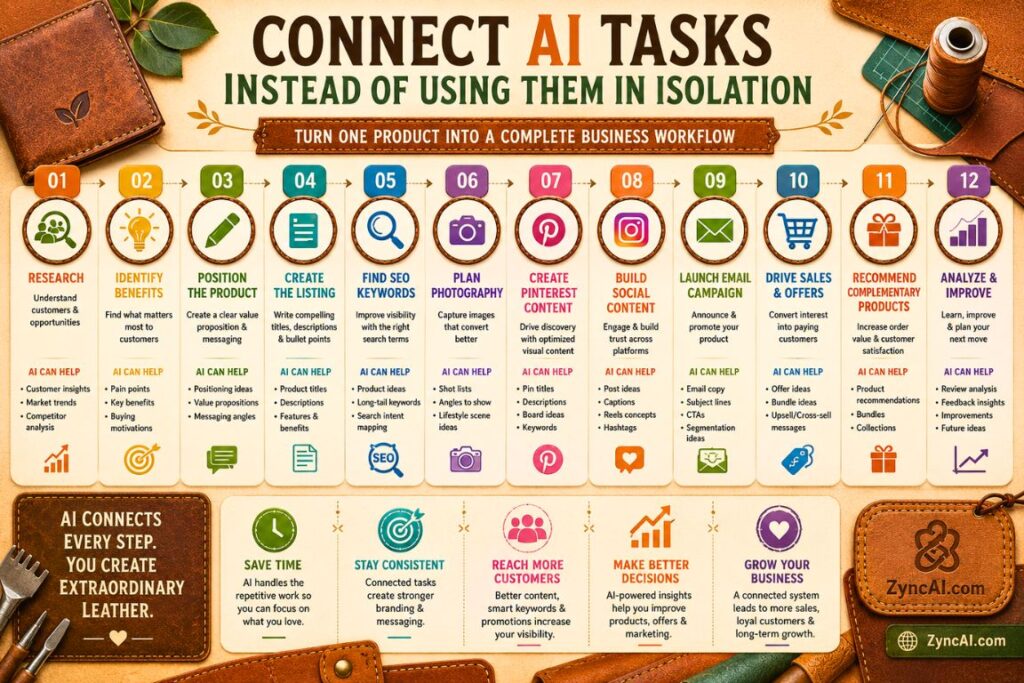
The biggest opportunity comes from connecting several AI-assisted tasks into one continuous workflow instead of using AI for isolated activities. For example, when launching a new handmade leather travel wallet, you could use AI to research potential customer segments, identify the strongest customer benefits, develop product positioning, create the product listing, and generate SEO keyword ideas. The same workflow can then continue into creating a photography shot list and developing Pinterest, Instagram, and Facebook content tailored to the product.
The workflow does not have to stop at promotion. AI can help create an email announcement, suggest complementary products, and analyze customer feedback after launch. Those insights can then be used to improve the product, positioning, or marketing strategy. In this way, a single handmade leather product can become the starting point for an entire AI-assisted business workflow, helping you connect research, creation, marketing, sales, and continuous improvement rather than treating each AI task as a separate activity.
One product can therefore generate an entire AI-assisted business workflow.
3.5 Use One Source of Truth for Your AI Prompts
Another useful strategy is to maintain a basic business profile that you can reuse whenever you work with AI.
For example, keep information about:
- Your brand name
- Brand personality
- Target customers
- Product categories
- Leather types
- Materials
- Product prices
- Key differentiators
- Customization options
- Shipping policies
- Product-care information
- Brand story
- Preferred writing style
This prevents you from repeatedly explaining your business from scratch.
It also helps reduce inconsistent AI-generated content.
For example, if you always describe your brand as premium, handcrafted and minimalist, your AI-assisted product descriptions and marketing content should consistently reflect those characteristics.
3.6 Start Small Instead of Trying to AI-Power Everything
You don’t need to introduce AI into every part of your business immediately.
Start with tasks that are:
- Repetitive
- Time-consuming
- Easy to review
- Low-risk
- Frequent
Good starting points include:
Product descriptions → Customer replies → Social media ideas → Content calendars → FAQs
Once you’re comfortable with those, you can move into more advanced applications such as:
Pricing analysis → Customer review analysis → Product development → Sales analysis → Business planning
This gradual approach is much more practical than trying to transform your entire business overnight.
3.7 The Goal: More Time for the Craft
Ultimately, the purpose of AI isn’t simply to produce more content or complete more tasks.
The real goal is to create a better business around your craftsmanship.
If AI can reduce the time you spend writing repetitive customer responses, organizing ideas, creating marketing drafts and analyzing feedback, you can redirect that time toward:
- Creating better products
- Experimenting with new designs
- Improving craftsmanship
- Building customer relationships
- Developing your brand
- Growing the business
That is where AI becomes genuinely valuable to a leather craft business.
The best AI workflow isn’t the one that uses the most AI. It’s the one that gives the craftsperson more time to do the work that only the craftsperson can do.
4. Best AI Prompts for Leather Craft Businesses
Now that we have mapped the entire leather craft business workflow, we can start applying AI to specific tasks.
The key to getting useful results from AI is not simply asking for a prompt and copying the response. The quality of the output depends heavily on the context you provide.
A leather craft business owner should think of an AI prompt as a brief given to a business assistant.
Instead of:
“Give me leather product ideas.”
Give AI information about your customer, materials, market, price range, production capabilities and business goals.
The sections below organize prompts around the actual needs of a leather craft business.
4.1 Product Research Prompts
Product research is one of the best places to use AI because it can help you explore many possibilities before spending time and materials on prototypes.
4.1.1 Leather Product Idea Generator
Use AI to brainstorm product opportunities based on your existing skills and target market.
Prompt strategy:
Tell AI:
- What type of leather products you currently make
- Your target customer
- Your price range
- Your production capabilities
- Your preferred leather types
- Your business positioning
Then ask it to generate ideas and explain the reasoning behind each one.
A useful prompt could ask AI to provide:
- Product idea
- Target customer
- Customer problem solved
- Production complexity
- Personalization opportunities
- Potential selling angle
- Complementary products
This is much more useful than receiving a simple list of product names.
4.1.2 Product Variation Prompt
You don’t always need an entirely new product.
Sometimes your existing bestseller can become several products.
For example:
Basic leather wallet → Minimalist wallet → Travel wallet → Personalized wallet → Premium wallet
AI can help identify variations based on:
- Size
- Material
- Color
- Function
- Customer segment
- Price level
- Personalization
This can help you build a broader product range without starting from scratch every time.
4.1.3 Market Gap Discovery Prompt
Ask AI to examine a leather product category and brainstorm underserved customer needs.
For example:
“Analyze the common features, limitations and customer complaints associated with handmade leather wallets. Identify potential product gaps that a small leather craft business could explore.”
The output can help you think about opportunities beyond simply copying popular products.
4.2 Customer Research Prompts
Understanding your customer makes almost every other business activity easier.
4.2.1 Ideal Customer Persona Prompt
Give AI information about:
- Product
- Price
- Materials
- Brand positioning
- Sales channel
- Location or target market
Then ask it to create several realistic customer profiles.
Ask AI to include:
- Age range
- Occupation or lifestyle
- Buying motivation
- Problems
- Desired benefits
- Purchase objections
- Preferred content
- Potential gift occasions
The purpose isn’t to treat an AI-generated persona as factual research.
Instead, use it as a framework for thinking about your customers.
4.2.2 Customer Pain Point Prompt
Ask AI to think from the customer’s perspective.
For example:
“List the problems a customer might experience with mass-produced wallets that could be addressed by a well-made handmade leather wallet.”
This can reveal marketing opportunities.
Instead of marketing only:
“Handmade leather wallet.”
You might communicate:
“Designed for people who want a durable everyday wallet that develops character over time.”
4.2.3 Buyer Motivation Prompt
Ask AI to identify different reasons customers might purchase the same leather product.
For example, a leather journal could be purchased because of:
- Personal use
- Writing
- Travel
- Gifting
- Professional use
- Collecting
- Personalization
- Craft appreciation
You can then develop different marketing campaigns around these motivations.
4.3 Product Design Prompts
4.3.1 Product Concept Development Prompt
Describe an existing product idea and ask AI to help expand the concept.
Ask it to consider:
- Functionality
- Customer needs
- Appearance
- Materials
- Personalization
- Premium features
- Production complexity
The goal is to generate possibilities for you to evaluate.
4.3.2 Product Collection Prompt
Instead of creating individual products, ask AI to develop an entire collection.
For example:
“Create a cohesive leather travel collection.”
The resulting concept might include:
- Passport holder
- Travel wallet
- Luggage tag
- Cable organizer
- Card holder
- Travel journal
- Key organizer
The benefit is that your products can feel like part of a cohesive brand ecosystem rather than unrelated items.
4.3.3 Product Improvement Prompt
Customer reviews can become valuable design input.
Give AI a collection of genuine customer comments and ask:
“Identify recurring requests, complaints and praised features. Suggest product improvements based on these patterns.”
This gives you a structured way to turn customer feedback into product-development ideas.
4.4 Pricing Prompts
Pricing requires real numbers, but AI can help organize the thinking.
4.4.1 Product Costing Prompt
Provide:
- Leather cost
- Hardware cost
- Thread cost
- Packaging cost
- Labor time
- Hourly labor rate
- Overhead
- Platform fees
- Payment fees
Ask AI to organize the information into a complete cost structure.
4.4.2 Profit Margin Analysis Prompt
Give AI your current selling price and costs.
Ask it to calculate different scenarios, such as:
- 20% profit margin
- 30% profit margin
- 40% profit margin
- Premium positioning
- Wholesale pricing
This can help you understand how small pricing changes affect profitability.
4.4.3 Custom-Order Pricing Prompt
Custom products often take more time than standard products.
AI can help create a pricing framework that accounts for:
- Design time
- Additional materials
- Personalization
- Communication time
- Prototype work
- Additional production time
- Rush orders
This helps prevent custom work from quietly becoming less profitable than standard products.
4.5 Production Prompts
4.5.1 Production Checklist Prompt
Explain your production process to AI and ask it to convert it into a repeatable checklist.
For example:
Material preparation → Cutting → Skiving → Punching → Stitching → Edge finishing → Hardware → Inspection → Packaging
You can then adapt the checklist to your actual workflow.
4.5.2 Batch Production Prompt
If you have multiple orders for the same product, ask AI to help organize them into batches.
For example:
15 wallets → Material preparation → Cutting batch → Punching batch → Stitching batch → Finishing batch → QC
Batching can potentially reduce unnecessary setup and switching between tasks.
4.5.3 SOP Creation Prompt
Explain exactly how you currently make a product.
Ask AI to convert your explanation into a clear SOP that another person could follow.
This becomes particularly valuable if you eventually:
- Hire an assistant
- Train a new craftsperson
- Outsource part of production
- Expand your workshop
4.6 Product Listing Prompts
4.6.1 Product Title Prompt
Give AI the actual product information and target keywords.
Ask it to create multiple title variations focused on:
- Search visibility
- Clarity
- Customer appeal
- Product benefits
- Target customer
Then review the suggestions and choose the one that accurately represents the product.
4.6.2 Product Description Prompt
A strong product-description prompt should include:
- Product name
- Leather type
- Dimensions
- Color
- Features
- Construction
- Personalization
- Target customer
- Use cases
- Brand voice
- Care information
AI can then turn these details into a structured product description.
4.6.3 Product Benefits Prompt
Instead of asking AI to list features, ask it to translate features into customer benefits.
For example:
Feature: Full-grain leather
Potential benefit: A durable material that can develop a distinctive patina with use.
This helps shift your listing from simply describing the product to explaining why the product matters to the buyer.
4.7 Marketing Prompts
4.7.1 Social Media Content Prompt
Give AI information about:
- Product
- Customer
- Platform
- Brand voice
- Marketing goal
Then ask for content ideas.
For example:
One leather wallet → 10 Instagram posts → 5 Reel concepts → 5 Stories
This can dramatically reduce the effort required to maintain consistent content.
4.7.2 Pinterest Content Prompt
Pinterest can be particularly useful for visually appealing handmade products.
AI can help generate:
- Pinterest titles
- Descriptions
- Content angles
- Pin ideas
- Blog topics
- Keyword variations
Instead of promoting the product from only one angle, you can create different content around:
- Gift ideas
- Leather craftsmanship
- Product care
- Everyday carry
- Men’s accessories
- Personalized gifts
- Travel accessories
4.7.3 Product Launch Prompt
When launching a new product, ask AI to create a coordinated campaign.
For example:
Teaser → Behind the scenes → Product reveal → Product benefits → Customer problem → Launch announcement → Reminder → Follow-up
This gives your launch a story rather than one isolated promotional post.
4.8 Sales Prompts
4.8.1 Product Positioning Prompt
Ask AI to create different ways to position the same product.
For example, a leather bag could be positioned around:
- Craftsmanship
- Durability
- Luxury
- Travel
- Professional use
- Sustainability
- Personalization
- Heritage
You can then determine which positioning best fits your product and customers.
4.8.2 Bundle Idea Prompt
Ask AI to identify products that naturally belong together.
For example:
Leather wallet + Card holder + Key organizer
could become an everyday-carry bundle.
Or:
Passport holder + Luggage tag + Travel wallet
could become a travel gift set.
Bundles can increase perceived value while encouraging customers to purchase multiple products.
4.8.3 Upselling & Cross-Selling Prompt
AI can analyze your product catalog and suggest logical complementary products.
The key is relevance.
A good cross-sell feels helpful:
“Complete your travel set with a matching passport holder.”
A poor cross-sell simply pushes another unrelated product.
4.9 Customer Service Prompts
4.9.1 Customer Inquiry Prompt
Give AI:
- Customer’s question
- Product information
- Store policies
- Brand voice
Ask it to create a helpful response.
Always review the response before sending it, especially when the customer is asking about pricing, customization, delivery or policies.
4.9.2 Complaint Response Prompt
Customer complaints require extra care.
AI can help structure a response that:
- Acknowledges the customer’s concern.
- Shows empathy.
- Clarifies the situation.
- Explains the available solution.
- Provides the next step.
The final message should still sound like you, not like an automated customer-service department.
4.9.3 Review Request Prompt
AI can create polite review-request messages that don’t feel overly pushy.
For example, you can ask AI to create different versions for:
- First-time customers
- Personalized orders
- Gift purchases
- Repeat customers
4.10 Business Growth Prompts
4.10.1 Product Expansion Prompt
Give AI your current product catalog and ask:
“Identify logical product categories I could add that appeal to the same customer base and can be produced using similar materials, skills or equipment.”
This is a better approach than simply asking for random new product ideas.
4.10.2 Wholesale Strategy Prompt
AI can help brainstorm how a leather craft business could approach:
- Boutique stores
- Gift shops
- Corporate buyers
- Hotels
- Wedding businesses
- Lifestyle retailers
It can help create outreach messages, product presentations and wholesale offer structures.
4.10.3 Corporate Gifting Prompt
Leather products can potentially work well as premium corporate gifts.
AI can help develop:
- Corporate gift packages
- Personalization options
- Bulk-order offers
- Corporate messaging
- Proposal structures
- Seasonal gifting campaigns
4.11 The Most Important Prompt Strategy: Give AI Context
The difference between a weak prompt and a strong prompt often comes down to context.
Weak prompt:
“Write a product description for my leather wallet.”
Stronger prompt:
“Act as an experienced e-commerce copywriter. I sell handmade full-grain leather wallets to professionals who value minimalist design and durability. The wallet measures [dimensions], has [features], is available in [colors], and can be personalized with initials. My brand is positioned as premium but approachable. Write an SEO-friendly product description that emphasizes craftsmanship, practical benefits, personalization and gifting. Do not make claims that aren’t supported by the information provided.”
The second prompt gives AI a much clearer brief.
And that principle applies throughout this entire guide:
More relevant context → Better AI output → Less editing → More useful results.
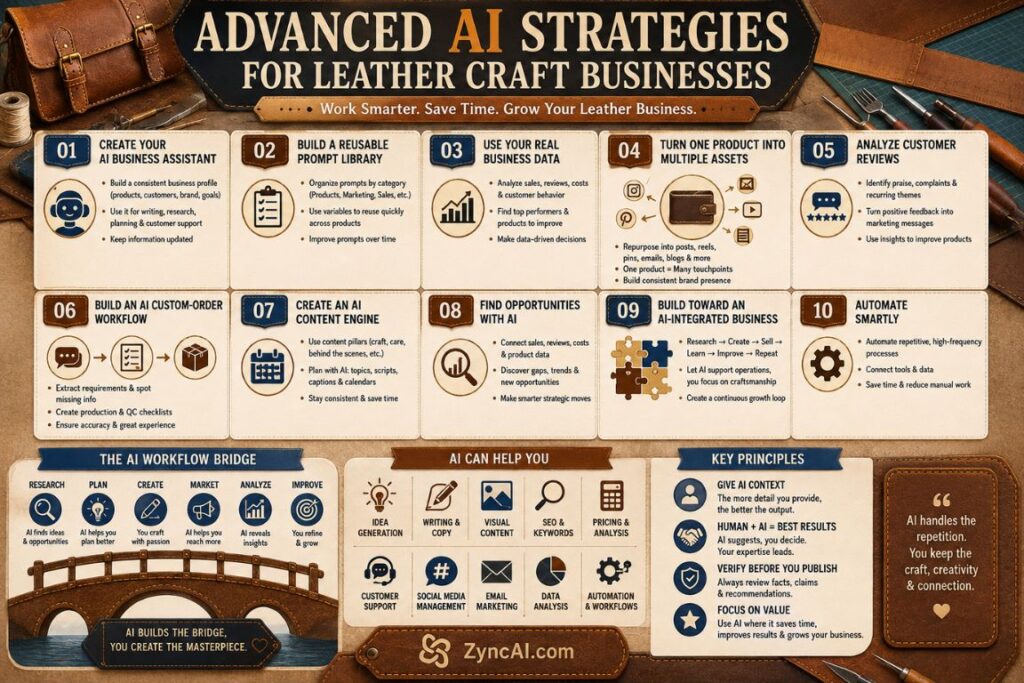
5. Advanced AI Strategies for Leather Craft Businesses
Basic AI prompts can save time, but the bigger opportunity comes from building repeatable AI systems around your leather craft business.
Instead of asking AI a different question every time you need help, you can create workflows, reusable prompts and business context that make AI increasingly useful.
The goal is to move from:
“I occasionally use AI.”
to:
“AI is part of how I run my business.”
5.1 Create Your AI Leather Business Assistant
One of the simplest ways to get better results from AI is to create a consistent business context.
Instead of explaining your business every time, prepare a basic profile containing information such as:
- Business name
- Brand story
- Product categories
- Target customers
- Price range
- Leather types
- Materials
- Customization options
- Brand personality
- Writing style
- Unique selling points
- Shipping policies
- Product-care information
- Business goals
This becomes the foundation for many future AI tasks.
For example, if your brand is positioned as a premium handmade leather business, you don’t want AI producing casual, discount-oriented marketing copy.
Likewise, if your brand focuses on minimalist products, AI shouldn’t repeatedly suggest overly complicated designs.
5.1.1 What Your AI Business Assistant Can Help With
Once the context is established, you can use AI to assist with:
- Product development
- Product descriptions
- Marketing
- Customer service
- Pricing
- Content planning
- Customer research
- Product analysis
- Business planning
You can essentially treat AI as a digital business assistant that understands your business context.
5.1.2 Keep Your Business Information Updated
Your business will change.
You may introduce new products, change prices, target a new customer segment or introduce a new brand style.
Update your AI business context when important information changes.
This helps prevent outdated information from appearing in product descriptions, customer messages or marketing campaigns.
5.2 Build a Reusable Prompt Library
If you find yourself asking AI the same type of question repeatedly, you shouldn’t have to start from zero every time.
Create a personal prompt library.
You might organize it into folders such as:
Product Development
- Product idea generator
- Product variation prompt
- Product improvement prompt
- Collection development prompt
Marketing
- Instagram content
- Pinterest content
- Product launch
- Email campaign
Sales
- Product positioning
- Bundle creation
- Upselling
- Cross-selling
Customer Service
- Customer inquiry
- Complaint response
- Shipping update
- Review request
Business Management
- Pricing analysis
- Sales analysis
- Customer feedback
- Business planning
5.2.1 Add Variables to Your Prompts
Make your prompts reusable by leaving specific fields that can be changed.
For example:
Product: [PRODUCT NAME]
Customer: [TARGET CUSTOMER]
Price: [PRICE]
Materials: [MATERIALS]
Platform: [PLATFORM]
Marketing Goal: [GOAL]
This means the same prompt can be used for multiple products.
Instead of creating a new prompt every time you launch something, you simply replace the relevant information.
5.2.2 Improve Prompts Over Time
Your prompt library should not remain static.
When you discover that a particular prompt consistently produces better results, improve the template.
For example, you might realize that product-description prompts work better when you provide:
- Customer pain points
- Product dimensions
- Material details
- Brand voice
- Specific keywords
- Product use cases
Add those requirements to your standard prompt.
Over time, your prompt library becomes a business knowledge system rather than a collection of random AI questions.
5.3 Give AI Your Real Business Data
Generic AI advice can only take you so far.
The biggest improvement happens when you start giving AI information from your actual business.
For example:
- Sales data
- Product costs
- Customer reviews
- Product margins
- Best-selling products
- Slow-moving products
- Customer questions
- Order information
- Marketing performance
- Website analytics
Instead of asking:
“What leather products are popular?”
you can ask:
“Here are my sales results from the past six months. Analyze which products are selling most consistently, identify products with weak performance, and suggest what I should investigate before deciding what to make next.”
That’s a completely different level of analysis.
5.3.1 Analyze Your Best Sellers
Give AI information about your best-selling products and ask it to identify patterns.
It might help you explore:
- Common price ranges
- Popular materials
- Popular colors
- Popular product types
- Personalization preferences
- Customer segments
- Seasonal patterns
You can then use those insights when developing future products.
5.3.2 Analyze Slow-Moving Products
A product that isn’t selling doesn’t automatically mean the product itself is bad.
The problem could be:
- Pricing
- Photography
- Product positioning
- Product description
- Search visibility
- Target customer
- Lack of marketing
- Product features
AI can help you create a structured analysis before you decide to discontinue the product.
5.4 Turn One Product Into Multiple Marketing Assets
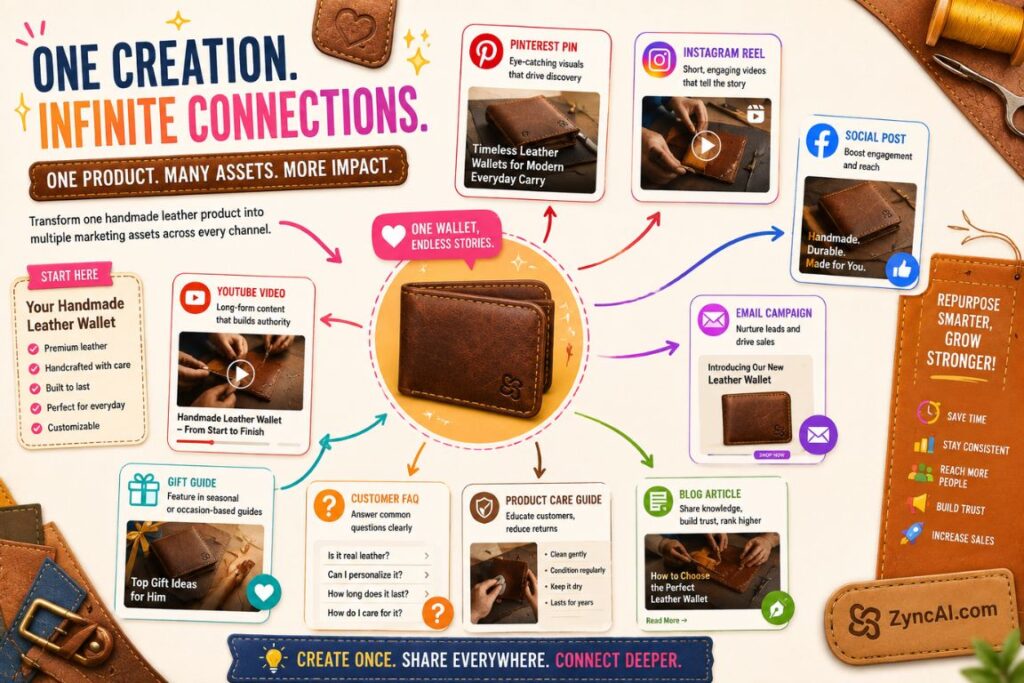
One of the most practical AI strategies for a small leather business is content repurposing. You may spend hours designing and creating a beautiful leather product, but its marketing potential should not end with a single product photograph and listing. The same leather wallet can become an Instagram post, Reel, Pinterest Pin, Facebook post, email campaign, blog article, product-care guide, customer FAQ, behind-the-scenes post, gift guide, or video script.
AI makes this process much easier by transforming the same core product information into different content formats for different platforms. Instead of starting from scratch for every piece of content, you can give AI the product details, key features, customer benefits, and brand voice, then ask it to adapt that information for each channel. This allows a small leather business to create a much larger content library from every product while saving time and maintaining a consistent marketing message.
5.4.1 Example Content System
Suppose you have created a handmade leather travel wallet.
Start with your core product information:
- Materials
- Dimensions
- Features
- Crafting process
- Customer
- Price
- Personalization
- Main benefit
Then ask AI to transform that information into:
Educational content:
“5 Things to Look for in a Quality Leather Travel Wallet”
Pinterest content:
“Handmade Leather Travel Accessories for Your Next Trip”
Instagram Reel:
“From Raw Leather to Finished Travel Wallet”
Email:
“Meet Our New Handmade Travel Wallet”
Blog content:
“How to Choose a Leather Travel Wallet”
The product stays the same.
The story surrounding the product changes.
5.5 Use AI to Analyze Customer Reviews
Customer reviews contain some of the most valuable information available to a handmade business.
But reading dozens or hundreds of reviews manually can take time.
AI can help identify patterns.
Give it a collection of reviews and ask it to identify:
- Most frequently praised features
- Most common complaints
- Customer expectations
- Common use cases
- Reasons customers purchased
- Reasons customers recommend the product
- Product improvement opportunities
- Frequently mentioned words or themes
5.5.1 Turn Positive Feedback Into Marketing
Imagine customers repeatedly mention:
- Excellent stitching
- Beautiful packaging
- Premium leather
- Personalization
- Fast communication
Those aren’t just compliments.
They can become marketing themes.
For example:
Customer feedback → Marketing message
“Beautiful stitching”
→ Emphasize craftsmanship.
“Great gift packaging”
→ Promote the product as a gift.
“Loved the initials”
→ Highlight personalization.
“Leather feels premium”
→ Explain the material and craftsmanship.
This allows your marketing to reflect what real customers already appreciate.
5.5.2 Turn Negative Feedback Into Product Improvements
Negative reviews can be uncomfortable, but they can also be valuable.
Suppose multiple customers mention that:
- A pocket is too tight.
- A strap is difficult to adjust.
- Packaging gets damaged.
- A particular color looks different from the photographs.
AI can help group these complaints and identify recurring problems.
You can then decide which issues are worth fixing.
5.6 Build an AI Custom-Order Workflow
Custom orders can be highly profitable, but they can also create additional administrative work.
A customer might send a long message containing:
- Product type
- Leather color
- Dimensions
- Initials
- Logo
- Hardware preference
- Delivery date
- Special instructions
Important details can easily be missed.
AI can help convert the conversation into a structured specification.
5.6.1 The Workflow
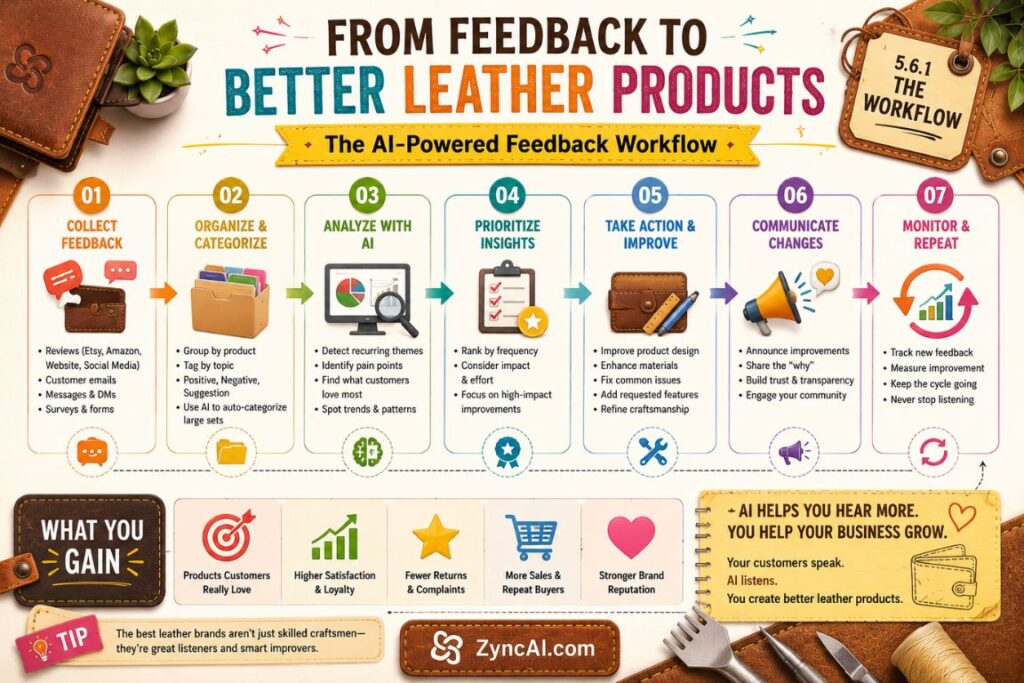
A simple AI-assisted workflow can turn a customer inquiry into a structured production process: AI first extracts the customer’s requirements, identifies any missing information, and prepares questions for confirmation. Once the customer confirms the details, AI can convert them into a clear production specification, followed by a production checklist and a quality-control checklist. This creates a consistent process from the initial inquiry through production and final quality checking, helping reduce misunderstandings, missed details, and avoidable errors.
This creates a consistent process from the initial inquiry to production.
5.6.2 Keep Human Approval in the Workflow
Don’t allow AI to automatically assume information that the customer hasn’t provided.
For example, if the customer hasn’t specified a leather color, AI should identify that as missing information, not invent one.
For custom products, accuracy is more important than speed.
5.7 Create an AI Content Engine
Many small businesses struggle with consistency.
They may post regularly for two weeks and then disappear for a month because they run out of ideas.
AI can help create a repeatable content system.
5.7.1 Start With Content Pillars
For a leather craft business, useful content pillars could include:
- Craftsmanship
- Leather education
- Product showcases
- Behind the scenes
- Customer stories
- Product care
- Gift ideas
- Customization
- Founder stories
- Workshop life
5.7.2 Turn One Theme Into Multiple Posts
Take one topic:
“How to care for a leather wallet.”
AI could help turn it into:
- Instagram carousel
- Reel script
- Pinterest Pin
- Blog post
- FAQ
- Product-care card
This gives you more content without constantly inventing completely new subjects.
5.7.3 Create a Content Calendar
You can also ask AI to organize content into a weekly schedule.
For example:
Monday: Behind the scenes
Tuesday: Product education
Wednesday: Customer story
Thursday: Craftsmanship
Friday: Product showcase
Saturday: Gift idea
Sunday: Founder story
The exact schedule can be adapted to your audience and platform.
The purpose is to create consistency without making content creation feel like a full-time job.
5.8 Use AI to Find Opportunities Across Your Business
One of the more advanced uses of AI is asking it to connect information that you normally analyze separately.
For example, give AI:
Sales data + customer reviews + product costs + product catalog
and ask:
“Identify products that have strong customer satisfaction, healthy margins and potential for expansion. Also identify products that receive positive feedback but have weak sales, and suggest possible reasons.”
This can reveal opportunities that aren’t obvious when looking at one dataset at a time.
You might discover:
High sales + high margin → Invest more
High sales + low margin → Review pricing
Low sales + strong reviews → Improve marketing
Low sales + weak reviews → Consider redesigning
High demand + long production time → Explore workflow improvements
AI doesn’t make the final business decision.
But it can help you see the business more clearly.
5.9 Build Toward an AI-Integrated Business
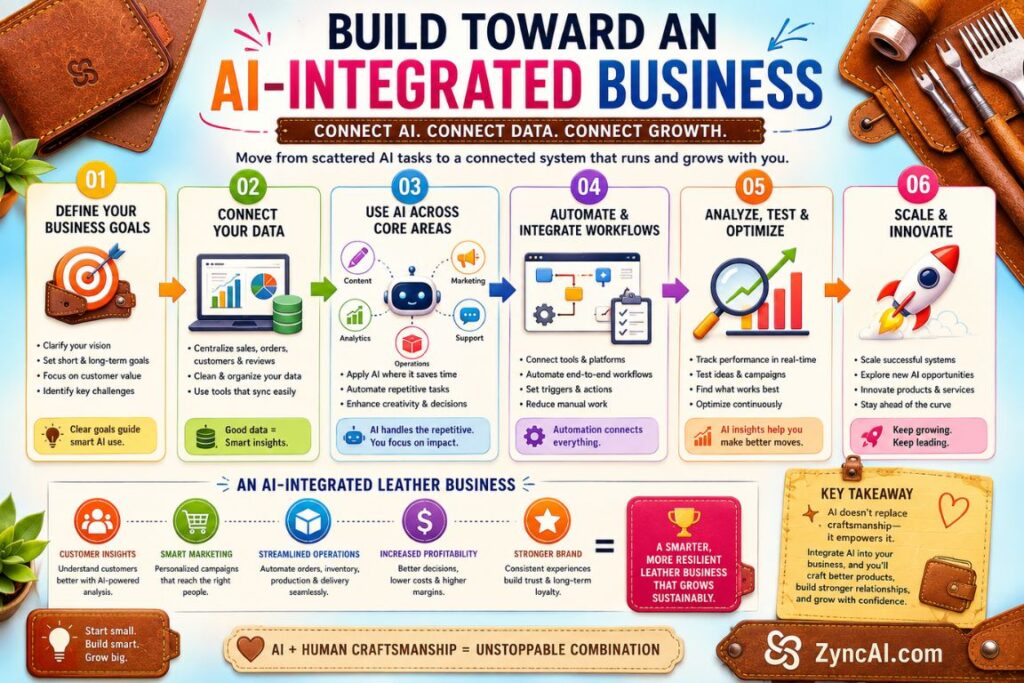
The long-term goal of AI integration is not to automate everything, but to build a business where AI handles repetitive, time-consuming, and information-heavy tasks while you remain focused on the craftsmanship, creativity, product decisions, and personal touches that make your leather brand unique. AI can research market opportunities, help develop product concepts, calculate and communicate value, create marketing content, organize customer feedback, and identify useful insights. You still decide which products to create, validate the ideas, make the products, and shape the overall direction of the brand.
Over time, this creates a continuous learning cycle: Research → Create → Sell → Learn → Improve → Create Again. Each product and customer interaction provides information that can help you make better decisions for the next one. In this way, AI becomes much more than a writing or content-generation tool. It becomes part of the business operating system around your craftsmanship, supporting the activities surrounding your creative work while allowing you to spend more time on the skills and decisions that create genuine value.
It becomes part of the business operating system around your craftsmanship.
6. Mistakes to Avoid When Using AI
AI can save a leather craft business significant time, but using it without proper oversight can create new problems.
A handmade business depends heavily on trust, authenticity and product quality. A poorly written AI-generated description, inaccurate material claim or generic marketing message can weaken that trust.
The goal isn’t to avoid AI.
It’s to use it intelligently.
6.1 Publishing Generic AI Content
One of the easiest mistakes is copying an AI-generated response and publishing it without editing.
For example, imagine every leather business uses descriptions such as:
“Crafted with premium materials and exceptional attention to detail, this timeless piece is perfect for everyday use.”
There is nothing necessarily wrong with that sentence.
The problem is that it could describe hundreds of different products.
Generic AI content doesn’t communicate what makes your leather product special.
6.1.1 How to Avoid It
Give AI specific information about:
- Your actual materials
- Your production process
- Your target customer
- Your product’s unique features
- Your brand story
- Your craftsmanship
- Your personalization options
- Your customer’s actual needs
Then edit the final output to make sure it sounds like your business.
AI should help express your story, not replace your story.
6.2 Using Incorrect Leather Terminology
Leather terminology can be technical, and AI can sometimes produce information that sounds convincing but isn’t accurate.
For example, AI might incorrectly describe:
- Leather type
- Tanning method
- Material characteristics
- Durability
- Finishing methods
- Care requirements
If you publish incorrect information, customers who understand leather may immediately notice.
6.2.1 How to Avoid It
Always verify technical claims before publishing them.
If you’re describing a specific leather, provide AI with the exact information you know about the material.
For example:
Instead of:
“Tell me about this leather.”
Use:
“This product uses [specific leather type] supplied by [supplier/material source]. Based on these confirmed characteristics, explain the material in customer-friendly language without making unsupported claims.”
The more accurate your source information is, the safer and more useful the AI output becomes.
6.3 Making Unrealistic Product Claims
AI may sometimes make your marketing sound more impressive by adding claims that weren’t provided.
For example, it might describe a product as:
- “Lifetime guaranteed”
- “Waterproof”
- “Indestructible”
- “Eco-friendly”
- “Luxury-grade”
- “Handcrafted entirely by hand”
- “Sustainably sourced”
These claims may sound attractive, but they shouldn’t be published unless they’re actually true and supportable.
6.3.1 How to Avoid It
Tell AI explicitly:
“Do not invent product specifications, certifications, materials, guarantees, durability claims or sustainability claims.”
Then review the output carefully before publishing.
A slightly less impressive description that is completely accurate is far better than an impressive description that isn’t true.
6.4 Letting AI Determine Pricing Without Real Data
AI can help with pricing strategy, but it doesn’t automatically know your business costs.
It doesn’t know:
- What you paid for the leather
- Your actual labor time
- Your workshop costs
- Your local operating expenses
- Your shipping costs
- Your marketplace fees
- Your target profit
- Your customer’s willingness to pay
If you ask:
“What should I charge for this leather wallet?”
AI can only provide a general estimate unless you give it relevant information.
6.4.1 How to Avoid It
Provide actual numbers.
For example:
Leather: $18
Hardware: $4
Packaging: $3
Labor: 2.5 hours
Hourly labor rate: $25
Platform fees: 10%
Overhead allocation: $5
Now AI can help you structure the calculation and compare pricing scenarios.
AI can assist with pricing analysis, but your real business data should drive the decision.
6.5 Copying Competitor Content
AI makes it easy to ask:
“Write a product description similar to this successful leather brand.”
That can be tempting.
But copying a competitor’s positioning, wording or brand voice can make your business look derivative.
It also misses one of the biggest advantages of being a handmade business:
You have your own story.
6.5.1 A Better Approach
Instead of asking AI to imitate a competitor, provide information about:
- Your products
- Your customers
- Your craftsmanship
- Your brand story
- Your differentiators
Then ask AI:
“Develop an original positioning strategy that differentiates this leather craft business from mass-produced alternatives.”
Use competitors for market research, not as a template to copy.
6.6 Using AI Images That Misrepresent Your Products
AI-generated images can be useful for marketing concepts and creative inspiration.
But there is a major difference between:
Creating a concept image
and
Showing a customer what the actual product looks like.
If an AI-generated image makes a real leather product appear to have different:
- Dimensions
- Stitching
- Hardware
- Compartments
- Texture
- Color
- Features
customers may receive something different from what they expected.
That can create disappointment and damage trust.
6.6.1 How to Avoid It
Use actual product photographs when accurately representing the product.
AI-generated visuals can be useful for:
- Lifestyle concepts
- Background ideas
- Campaign concepts
- Mood boards
- Creative advertisements where the image is clearly conceptual
But don’t let AI create an unrealistic version of the product and present it as the actual item.
6.7 Losing the Artisan’s Personality
This may be the biggest mistake of all.
A handmade leather business has something that many mass-produced brands don’t have:
A human story.
Customers may want to know:
- Who made the product?
- Why did you start?
- Why did you choose leather?
- How is the product made?
- What makes your craftsmanship different?
- Why do you care about the details?
If AI writes everything, your content can start sounding polished but lifeless.
6.7.1 How to Avoid It
Use AI for the parts where it is strong:
- Organizing ideas
- Generating alternatives
- Structuring content
- Improving clarity
- Repurposing content
- Analyzing information
Then add your own:
- Experiences
- Stories
- Opinions
- Craft knowledge
- Product details
- Personality
The final content should sound like a leather craft business with a real person behind it, not a generic AI-generated store.
6.8 Trying to Automate Everything
More automation isn’t always better.
Some parts of the business benefit from personal attention.
For example:
- Custom-order discussions
- Customer complaints
- Product design
- Quality control
- High-value customer relationships
- Important business decisions
These are areas where human judgment matters.
6.8.1 A Better Rule
Ask:
“Does this task benefit from speed and consistency, or from human judgment and personal connection?”
Use AI heavily for the first category.
Keep yourself involved in the second.
6.9 Trusting AI Without Checking the Output
AI can produce confident-sounding information that isn’t necessarily correct.
This is particularly important for:
- Pricing calculations
- Product specifications
- Leather information
- Legal requirements
- Shipping rules
- Tax information
- Marketplace policies
- Business decisions
Always verify important information before acting on it.
A good workflow is:
AI suggestion → Human review → Verification → Final decision
not:
AI suggestion → Automatic publication
6.10 The Best Rule for Using AI in a Leather Craft Business
A simple rule can guide almost every AI decision:
Let AI handle the repetitive work. Let the artisan handle the important decisions.
AI can help you research.
You decide what matters.
AI can generate product ideas.
You decide what to make.
AI can draft the description.
You verify the facts.
AI can analyze customer feedback.
You decide what to improve.
AI can create marketing ideas.
You decide what represents your brand.
That’s how AI can become a powerful business assistant without taking away the human craftsmanship that makes a leather craft business valuable.
7. Best AI Tools for Leather Craft Businesses
AI prompts are useful, but the right AI tools can make those prompts much more practical.
A leather craft business doesn’t necessarily need dozens of AI subscriptions. In fact, starting with too many tools can create unnecessary complexity and expenses.
The better approach is to identify the specific business problems you want AI to solve and then choose tools around those problems.
7.1 AI Writing Assistants
AI writing assistants can help with many of the text-heavy tasks involved in running a leather craft business.
They can assist with:
- Product descriptions
- Product titles
- Blog posts
- Social media captions
- Email campaigns
- Customer responses
- FAQs
- Product-care instructions
- Marketing campaigns
- Business documents
For example, instead of spending an hour writing descriptions for several new products, you can provide the product information to an AI writing tool and create first drafts much faster.
The important part is to provide real product information and then review the output.
7.1.1 Best Uses for Leather Businesses
AI writing tools are particularly useful for repetitive writing tasks.
A single product could require:
Product title + description + SEO keywords + Pinterest description + Instagram caption + email copy + FAQ
AI can help turn one set of product information into all of these formats.
7.2 AI Image Generators
Visual presentation is particularly important for leather craft businesses.
AI image-generation tools can help with:
- Product concept exploration
- Lifestyle scene ideas
- Marketing concepts
- Mood boards
- Campaign concepts
- Social media visual ideas
- Packaging concepts
- New product inspiration
For example, if you’re developing a premium leather travel collection, AI can help visualize the type of lifestyle and aesthetic you want the collection to communicate before investing in a professional photoshoot.
7.2.1 Use AI Images Carefully
AI-generated images shouldn’t automatically replace actual product photography.
If you are selling a specific handmade wallet, customers should be able to see the real product.
AI is more useful for conceptual and creative applications where exact product representation isn’t required.
7.3 AI Photo Editors
You don’t always need to generate a completely new image.
AI-powered photo editing can help improve photographs you’ve already taken.
Potential uses include:
- Background removal
- Background replacement
- Lighting enhancement
- Image cleanup
- Object removal
- Image resizing
- Product-photo preparation
- Social media formatting
This can be particularly helpful for small leather businesses that photograph products themselves rather than using a professional studio.
7.3.1 Build a Consistent Product Image Style
AI editing can help create consistency across your product catalog.
For example, you might establish:
Clean background + consistent lighting + consistent product positioning + consistent image dimensions
This can make an online store look much more professional.
7.4 SEO & Keyword Tools
Getting discovered is one of the biggest challenges for online handmade businesses.
AI-powered SEO tools can help with:
- Keyword research
- Search-intent analysis
- Content ideas
- Topic clusters
- Competitor analysis
- Content optimization
- Long-tail keyword discovery
For example, instead of targeting only:
“leather bag”
you could explore more specific searches related to:
- Handmade leather travel bag
- Personalized leather bag
- Leather messenger bag for professionals
- Full-grain leather weekend bag
- Handmade leather gift
Specific searches can help you understand different customer intentions.
7.4.1 Combine AI With Real Search Data
Don’t rely entirely on AI to tell you which keywords are valuable.
A stronger process is:
AI brainstorming → SEO tool research → Search-volume/competition analysis → Keyword selection → Content optimization
AI provides breadth.
Actual search data provides validation.
7.5 Social Media AI
Social media can consume a significant amount of time for a small craft business.
AI tools can help with:
- Content ideas
- Captions
- Content calendars
- Video scripts
- Short-form video ideas
- Hashtag research
- Post variations
- Content repurposing
This is particularly useful when you have plenty of things to show but struggle to consistently turn them into content.
7.5.1 Turn the Crafting Process Into Content
Leatherworking naturally provides visual content.
For example:
Raw leather → Pattern → Cutting → Stitching → Finishing → Final product
That process can become:
- A Reel
- A TikTok
- A YouTube Short
- An Instagram carousel
- A Pinterest Pin
- A behind-the-scenes post
AI can help you turn one production process into multiple pieces of content.
7.6 Email Marketing AI
Email can become an important channel for building relationships with customers.
AI can help create:
- Welcome emails
- Product-launch campaigns
- Abandoned-cart messages
- Post-purchase emails
- Product recommendations
- Seasonal campaigns
- Customer reactivation campaigns
- Review requests
For example, after someone purchases a leather wallet, you could create a post-purchase sequence:
Order confirmation → Thank you → Care instructions → Review request → Complementary product recommendation
This creates additional opportunities to build a relationship beyond the initial sale.
7.7 Customer Service AI
As orders increase, customer communication can become repetitive.
AI-powered customer service tools can potentially help with:
- FAQs
- Shipping questions
- Product information
- Care instructions
- Store policies
- Basic order questions
- Common customization questions
7.7.1 Keep Complex Conversations Human
Not every customer interaction should be automated.
For example, a simple question such as:
“What leather colors are available?”
may be suitable for an automated response.
But a complicated custom order or complaint may require personal attention.
A good approach is:
AI handles common questions → Human handles complex situations
This provides efficiency without sacrificing the personal nature of a handmade business.
7.8 Business Analytics AI
As your business grows, you accumulate more information.
You may have data about:
- Sales
- Orders
- Product margins
- Customer purchases
- Website traffic
- Advertising
- Product reviews
- Inventory
- Marketing performance
AI can help turn this information into understandable insights.
For example:
“Which products generate the highest revenue?”
is useful.
But a more valuable question might be:
“Which products have the best combination of sales volume, profit margin, customer satisfaction and repeat-purchase potential?”
That moves AI from simple reporting into business analysis.
7.8.1 Questions AI Can Help You Explore
You could ask:
- Which products are my strongest performers?
- Which products have declining sales?
- Which products have high sales but low margins?
- Which customers buy multiple products?
- Which products are frequently purchased together?
- Which products receive the best reviews?
- Which products may be worth discontinuing?
- Which products could be expanded into a collection?
The quality of the answer depends on the quality of the data you provide.
7.9 Automation Tools
Automation can connect different parts of your business.
For example:
New order → Update spreadsheet → Create production task → Send confirmation → Prepare fulfillment checklist
Or:
New customer → Add to customer list → Send welcome email → Begin post-purchase sequence
Or:
New review → Add to review database → Analyze feedback → Identify recurring themes
AI can provide the intelligence behind some of these workflows, while automation tools connect the individual systems.
7.9.1 Don’t Automate Just Because You Can
Automation should solve a real problem.
If a process takes two minutes and happens twice a month, automating it may not be worth the effort.
If a process takes 20 minutes and happens 50 times a month, automation could make a meaningful difference.
Focus first on high-frequency, repetitive tasks.
7.10 How to Choose AI Tools for Your Leather Business
Instead of asking:
“What are the best AI tools?”
Ask:
“What is currently slowing down my business?”
If writing takes too much time → consider an AI writing assistant.
If product photography is difficult → explore AI photo editing.
If you struggle with content → explore social media AI.
If you can’t understand your sales data → explore analytics tools.
If customer questions are repetitive → consider customer-service AI.
If you’re spending too much time moving information between systems → explore automation.
This problem-first approach prevents you from collecting tools that you rarely use.
7.11 Build a Simple AI Tool Stack
You don’t need an enormous collection of AI tools.
A small leather business could potentially start with a basic stack:
One general AI assistant
For research, brainstorming, writing and analysis.
One image or photo tool
For visual content and product-photo preparation.
One SEO tool
For search and keyword research.
One marketing/content tool
For social media and content workflows.
One automation tool
Only when repetitive processes justify it.
As the business grows, you can add specialized tools where there is a clear need.
7.12 The Right Tool Is the One You Actually Use
The AI industry changes quickly, and new tools appear constantly.
It’s easy to spend more time testing AI tools than actually running your business.
For a leather craft business, the best tool isn’t necessarily the one with the longest feature list.
It’s the one that:
- Solves a real problem
- Saves meaningful time
- Produces useful results
- Fits your workflow
- Is easy to learn
- Doesn’t create unnecessary complexity
- Provides enough value to justify its cost
Ultimately, a simple AI system that you use every week is far more valuable than ten impressive tools that you rarely open.
8. A Simple AI Adoption Plan for Leather Crafters
You don’t need to transform your entire leather craft business into an AI-powered operation overnight.
In fact, trying to introduce too many tools, prompts and automations at once can make things more complicated.
A better approach is to start with a few tasks that consume time, learn what works, and gradually build AI into your existing workflow.
The objective is simple:
Use AI to remove repetitive work so you can spend more time on craftsmanship, customers and business growth.
8.1 Start With Simple Tasks
Begin with tasks that are:
- Repetitive
- Time-consuming
- Easy to review
- Low-risk
- Performed frequently
Good starting points include:
- Product descriptions
- Product titles
- Customer responses
- Social media captions
- Content ideas
- FAQs
- Product-care instructions
These tasks are relatively easy to review, which makes them ideal for learning how AI works with your business.
8.1.1 Start With One Product
Rather than creating AI systems for your entire product catalog, choose one product.
For example:
Your bestselling leather wallet
Use AI to create:
- Product description
- SEO keywords
- Instagram content
- Pinterest content
- FAQ
- Product-care instructions
- Customer response templates
- Cross-selling ideas
This gives you a practical way to see how much time AI can save.
8.1.2 Create a Before-and-After Comparison
Track how long a task takes manually.
For example:
Writing one product listing manually: 45 minutes
AI-assisted workflow: 15 minutes
If you have 20 products, that difference can become significant.
This helps you focus on AI applications that produce measurable benefits rather than simply using AI because it is interesting.
8.2 Expand Into Marketing
Once you’re comfortable using AI for basic tasks, move into marketing.
Marketing is often one of the most time-consuming parts of running a small craft business because it requires continuous content.
You don’t just need one good post.
You need to consistently give potential customers reasons to discover, trust and remember your brand.
AI can help with:
- Content calendars
- Social media ideas
- Pinterest content
- Email campaigns
- Product launches
- Blog topics
- Video scripts
- Seasonal campaigns
8.2.1 Create a Content Calendar
Instead of waking up every morning wondering:
“What should I post today?”
create a content system.
For example:
Monday: Behind-the-scenes craftsmanship
Tuesday: Leather education
Wednesday: Product showcase
Thursday: Customer story
Friday: Product-care tip
Saturday: Gift idea
Sunday: Founder story
AI can help generate the individual content ideas while you provide the actual photographs, videos, experiences and product knowledge.
8.2.2 Repurpose Existing Content
You don’t always need to create something completely new.
Suppose you have a video showing how you make a leather wallet.
AI can help turn that one piece of content into:
- Short video script
- Instagram caption
- Pinterest description
- Blog topic
- Educational post
- Behind-the-scenes story
This allows a small business to get more value from the content it already creates.
8.3 Use AI for Business Decisions
Once AI becomes part of your daily workflow, you can move beyond content creation.
This is where AI can become more strategically valuable.
Instead of asking AI only to create things, start using it to analyze things.
You can provide information such as:
- Sales
- Costs
- Product margins
- Customer reviews
- Product performance
- Customer questions
- Marketing results
Then ask AI to identify patterns.
8.3.1 Analyze Your Products
You could ask:
“Analyze my product sales and identify which products have the strongest combination of sales volume and profit margin.”
Or:
“Identify products with strong customer reviews but weak sales and suggest possible reasons for their poor performance.”
These questions can help you think more strategically about your product catalog.
8.3.2 Analyze Your Customers
You could analyze:
- First-time vs repeat customers
- Average order value
- Popular products
- Common personalization requests
- Frequently purchased combinations
- Common customer questions
This can reveal opportunities for new products, bundles and marketing campaigns.
8.3.3 Analyze Your Marketing
AI can help you organize and interpret information such as:
- Website traffic
- Social engagement
- Email performance
- Product views
- Conversion rates
- Advertising results
The goal isn’t simply to produce reports.
It’s to answer questions such as:
“What should I do differently next month?”
8.4 Build Repeatable Systems
Once you’ve discovered which AI tasks are genuinely useful, turn them into repeatable processes.
Instead of manually figuring out every task each time, create systems.
For example:
New Product System
Product idea → Customer analysis → Product positioning → Pricing → Product description → SEO → Photography plan → Social content → Launch campaign
Or:
Custom Order System
Customer inquiry → Requirement extraction → Missing information → Confirmation → Production checklist → QC → Shipping → Review request
Or:
Customer Feedback System
Review collection → AI analysis → Common themes → Product improvements → Marketing opportunities
The more often a process happens, the more valuable a repeatable system becomes.
8.5 Build Your Personal Prompt Library
At this point, start saving your best prompts.
Organize them into categories:
Product Development
Pricing
Marketing
SEO
Customer Service
Content Creation
Sales
Business Analysis
Customer Feedback
Growth
Each prompt should ideally contain reusable variables.
For example:
[PRODUCT]
[TARGET CUSTOMER]
[PRICE]
[MATERIAL]
[BRAND VOICE]
[PLATFORM]
This lets you reuse the same framework for different products.
8.6 Create Your AI Business Knowledge Base
As you use AI more frequently, you can build a collection of information about your business.
This might include:
- Product specifications
- Pricing
- Materials
- Brand guidelines
- FAQs
- Customer profiles
- Product-care information
- Shipping policies
- Customer feedback
- Marketing guidelines
- Product photography guidelines
The benefit is consistency.
For example, your product descriptions, social media content and customer responses should all communicate the same core product information.
This helps prevent situations where one AI-generated response says your product has one feature while another says something different.
8.7 Automate Only After You Understand the Process
Automation should come later.
First:
Do the task manually.
Then:
Use AI to assist with it.
Then:
Improve the process.
Only after you understand the workflow should you consider automating it.
For example:
Manual:
You receive a custom-order message and manually create a production checklist.
AI-assisted:
AI extracts the requirements and creates a draft checklist.
Automated:
A new custom-order form automatically sends the information into your production workflow.
This progression reduces the risk of automating a bad process.
8.8 The Four-Stage AI Adoption Journey
Your leather craft business can gradually move through four stages.
8.8.1 Stage 1: Beginner
Use AI for simple tasks:
- Writing
- Brainstorming
- Customer replies
- Content ideas
Goal: Save time.
8.8.2 Stage 2: AI-Assisted
Use AI across multiple areas:
- Product research
- Marketing
- SEO
- Pricing
- Customer feedback
Goal: Improve productivity.
8.8.3 Stage 3: AI-Integrated
Create repeatable workflows:
- Prompt libraries
- Content systems
- Customer-service systems
- Product-development workflows
- Business-analysis processes
Goal: Make AI part of your regular operations.
8.8.4 Stage 4: AI-Powered
Connect AI with business data, automation and multiple workflows.
Goal: Build a more scalable business where repetitive information-heavy tasks require less manual effort.
8.9 Your First 30 Days With AI
You can keep the initial implementation simple.
8.9.1 Week 1: Save Time
Focus on:
- Product descriptions
- Customer responses
- FAQs
- Product-care content
8.9.2 Week 2: Improve Marketing
Focus on:
- Social media content
- Content calendar
- Video ideas
8.9.3 Week 3: Improve Business Decisions
Focus on:
- Product analysis
- Pricing
- Customer feedback
- Product ideas
8.9.4 Week 4: Build Systems
Focus on:
- Prompt library
- Business information
- Repeatable workflows
- Simple automations
By the end of the process, you should have a much clearer idea of where AI genuinely helps your business and where human involvement remains essential.
8.10 The Progression: Beginner → AI-Assisted → AI-Integrated → AI-Powered
The ultimate objective isn’t to make every part of your leather business automated.
It’s to make the business more efficient without losing its craftsmanship and personality.
Think of the progression like this:
Beginner
“I occasionally use AI when I need help.”
↓
AI-Assisted
“I use AI regularly for repetitive tasks.”
↓
AI-Integrated
“AI is built into several parts of my workflow.”
↓
AI-Powered
“AI, business data and automation work together to help me operate and grow the business.”
The further you progress, the more important it becomes to maintain human oversight.
Because the real competitive advantage of a leather craft business isn’t simply efficiency.
It’s craftsmanship + creativity + authenticity + customer connection + smart use of technology.
9. Final Takeaway: Let AI Handle the Repetition, Keep the Craft Human
AI can change the way a leather craft business operates, but it doesn’t need to change what makes the business special.
The value of a handmade leather business comes from the person behind the product—their craftsmanship, creativity, attention to detail, knowledge of materials and connection with customers.
AI should support those strengths, not replace them.
9.1 Your Craftsmanship Is Still the Core of the Business
Customers don’t choose handmade leather products simply because they need something to carry their cards, hold their belongings or organize their travel documents.
They may choose a handmade product because they value:
- Craftsmanship
- Quality
- Individuality
- Durability
- Personalization
- Materials
- Design
- The story behind the product
- Supporting an independent maker
Those qualities can’t be replaced by a prompt.
AI can help you communicate those qualities more effectively, but the craftsmanship itself remains yours.
9.2 Let AI Handle the Repetitive Work
There are many tasks surrounding leatherworking that don’t necessarily require your full creative attention.
AI can help with:
- Brainstorming
- Research
- Writing
- Content planning
- Customer-response drafts
- Product descriptions
- SEO ideas
- Review analysis
- Pricing organization
- Business analysis
- Workflow documentation
These tasks can consume hours when handled manually.
If AI can reduce that workload, you can redirect your time toward the areas where your expertise creates the most value.
9.3 Use AI to Make Better Decisions, Not Just More Content
It’s easy to think about AI as a content-generation tool.
But its value can go much further.
You can use AI to help answer questions such as:
Which products should I develop next?
Why isn’t this product selling?
Which customers are most valuable to my business?
What do customers repeatedly praise?
What problems appear in my reviews?
Which products could be bundled together?
Where are my biggest production bottlenecks?
How can I improve my product positioning?
These are business questions, not simply writing tasks.
The more useful your business information becomes, the more valuable AI can become as an analytical assistant.
9.4 Don’t Try to Use AI Everywhere
More AI doesn’t automatically mean a better business.
Some tasks should remain highly personal.
For example:
- Designing the final product
- Choosing materials
- Inspecting craftsmanship
- Handling sensitive customer complaints
- Discussing complex custom orders
- Making important business decisions
- Telling your brand story
Use AI where it provides a clear advantage.
Keep the human touch where it creates value.
9.5 Start With One Problem
You don’t need to subscribe to ten AI tools or create complicated automation systems.
Start with one problem.
Perhaps you spend too much time writing product descriptions.
Use AI to improve that process.
Then perhaps customer communication is taking too much time.
Create reusable response prompts.
Then perhaps you’re struggling to maintain social media.
Build a content system.
Then start using customer reviews and sales data to make better decisions.
Over time, these small improvements can become a much larger AI-assisted business system.
9.6 The AI-Powered Leather Craft Business
The ideal future isn’t a leather business where AI does everything.
It’s a business where the relationship between technology and craftsmanship is balanced.
You research the opportunity.
AI helps you explore it.
You choose the product.
AI helps you develop variations.
You make the product.
AI helps you organize the process.
You photograph the product.
AI helps you plan and repurpose the content.
You sell the product.
AI helps you market and communicate it.
Customers provide feedback.
AI helps you identify patterns.
You improve the product.
AI helps you analyze the results.
This creates a continuous cycle:
Research → Create → Sell → Learn → Improve → Create Again
9.7 The Biggest Opportunity for Leather Craft Businesses
The biggest opportunity isn’t simply saving a few minutes writing a product description.
It’s gradually removing the repetitive tasks that prevent a craftsperson from focusing on the things that matter most.
Imagine spending less time:
- Writing repetitive messages
- Creating content from scratch
- Organizing product information
- Analyzing reviews manually
- Brainstorming from a blank page
- Building repetitive documents
- Sorting through business data
And more time:
- Designing new products
- Improving your craftsmanship
- Experimenting with materials
- Creating collections
- Talking to customers
- Building your brand
- Growing your business
That’s the real promise of AI for a leather craft business.
9.8 You Make the Leather. AI Helps You Run the Business Around It.
Your craftsmanship is what makes the product unique.
AI can help you build the business around that craftsmanship.
It can help you find opportunities, understand customers, develop ideas, communicate value, create marketing content, organize operations and learn from your customers.
But the leather, the hands, the creativity and the story behind the product are still yours.
You make the leather. AI helps you run the business around it.