How AI Can Help Handmade Crafters Discover Trending Ideas
Coming up with a new handmade product sounds exciting, only till you stared at Etsy, Pinterest, Instagram, and your own craft supplies for an hour and still do not know what to make next.
And there is another problem.. An idea can sound great in your head but turn out to be too generic, too competitive, difficult to make, or simply something people are not actually looking for.
This is something I have seen repeatedly in my work as an Information Technology professional in technology & business consulting with more than 14 years of industry experience. Technology can make it much easier to explore possibilities and organize information, but the useful part is not simply generating more ideas. It is using the technology to ask better questions, spot patterns, and turn a rough idea into something you can actually evaluate.
This is where AI can be surprisingly useful..
You can use AI tools to brainstorm product ideas, explore styles and colour combinations, organize customer feedback, develop product names, create rough marketing copy, and even get a starting point for technical instructions. AI should be mainly used as a brainstorming and time saving assistant rather than a replacement for their own creative judgment.
And that distinction matters. AI can give you 50 ideas in seconds, but you are still the person who knows whether an idea is practical to make, fits your style, and is something your customers would actually want to buy.
But there is an important distinction.
Using AI to generate 50 craft ideas is not the same thing as discovering a useful craft trend.
If you want to use AI to grow a handmade business, the more interesting question is what happens after the first list of ideas.
Can you spot a growing theme? Can you turn it into a specific niche? Can you find an underserved customer? Can you check whether the market is already crowded? And can you test the idea before spending weeks making inventory?
That is where AI becomes really much more useful…
1. Overview – What Can AI Actually Do for a Handmade Business?
AI does not have to be involved in every part of your creative process. In fact, based on my experience I do argue that it should not be!
One thing I have learned from working with technology is that a tool is most valuable when it supports good decision making. The same principle applies to a handmade craft business. AI can give you more ideas, help you organize information, identify patterns, and take some of the repetitive work off your plate. But it does not know your craft the way you do.
Your knowledge of materials, your personal taste, your craft skills, and your understanding of why customers choose your work are things that should not be handed over to AI. Those are part of what makes your products yours in the first place.
I see AI as more of a thinking partner than a creative director. You can use it to explore possibilities, challenge your first idea, work through a business problem, or get unstuck when you’re staring at a blank page. But the final judgment should still come from the person who understands the craft, the customer, and the business.
Here are some of the ways AI can realistically fit into a handmade business.
Brainstorm new product ideas
You can give AI a specific craft, audience, occasion, material, or design style and ask it to generate product ideas.
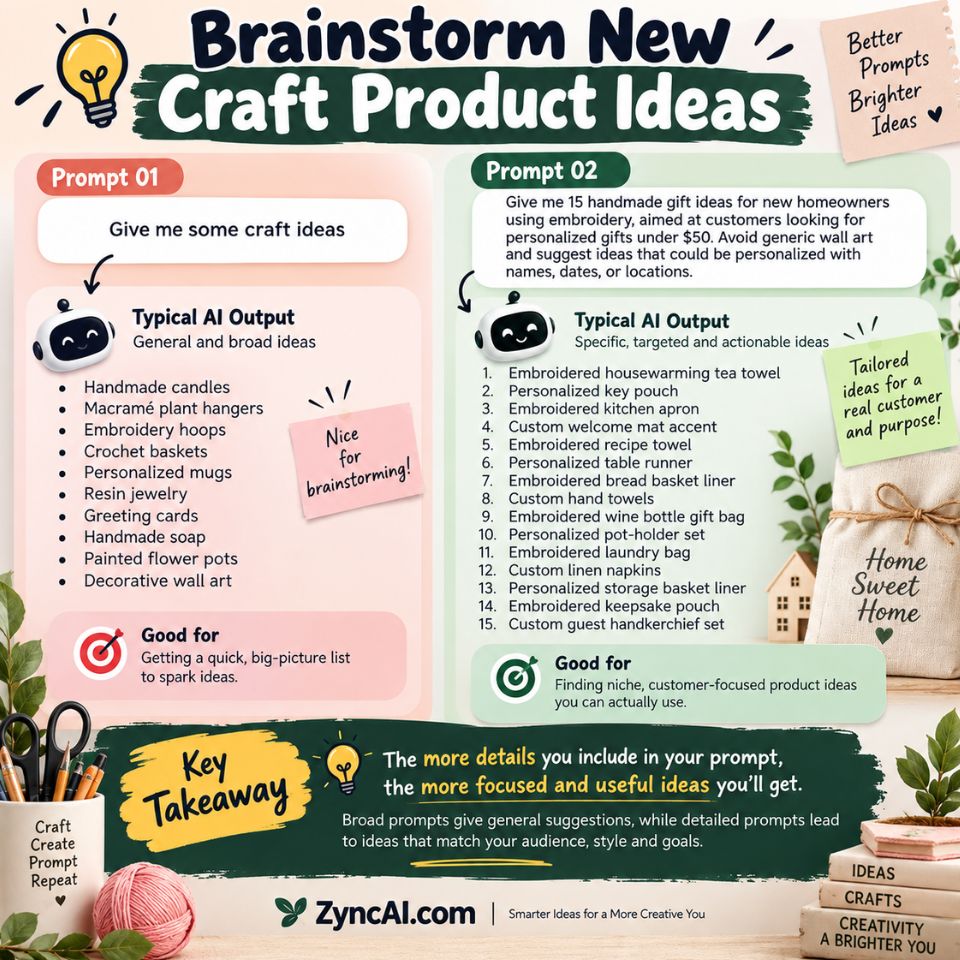
For example, instead of asking,
“Give me some craft ideas.”
You could ask:
“Give me 15 handmade gift ideas for new homeowners using embroidery, aimed at customers looking for personalized gifts under $50. Avoid generic wall art and suggest ideas that could be personalized with names, dates, or locations.”
The second prompt gives the AI something to work with.
Broad prompts tend to produce generic product suggestions, while more specific prompts give you more relevant ideas.
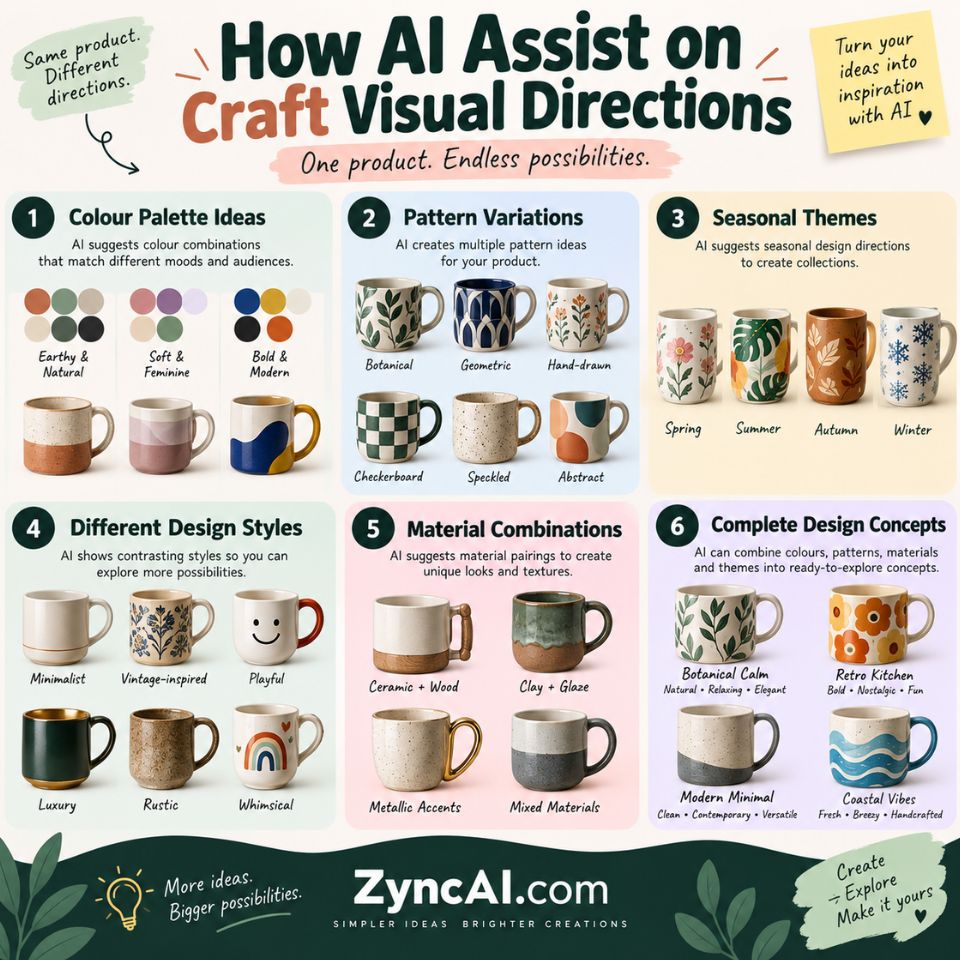
Explore styles, colours, and design directions
AI can also help when you have a product category in mind but don’t know what visual direction to take.
You might ask for,
- colour palette ideas
- pattern variations
- seasonal themes
- vintage inspired directions
- minimalist versions
- playful or whimsical styles
- material combinations
- different design concepts for the same product
This can be particularly useful when you are stuck between several directions and want to see more possibilities before committing to one.
Turn one idea into several products
Suppose you are interested in a botanical theme.
Instead of making one botanical product and stopping there, you could ask AI to help you explore related products for the same customer.
For example,
- embroidered botanical wall art
- personalized birth flower hoops
- botanical greeting cards
- fabric bookmarks
- floral ornaments
- wedding keepsakes
- personalized botanical gift sets
You still decide which products make sense for your business. AI simply helps you explore the territory.
Come up with product and collection names
Naming can be harder than it looks.
You might have a beautiful yarn colourway, candle scent, jewellery collection, or seasonal range sitting in front of you and absolutely no idea what to call it.
You could use the same approach for,
- product names
- collection names
- colourways
- seasonal ranges
- craft kits
- workshops
- digital patterns
The trick is to treat the suggestions as a shortlist, not a final decision.
Get a starting point for product descriptions
Writing product descriptions is one of those jobs that can quietly eat up a lot of time.
AI can create a rough draft based on information you provide, which you can then edit to make it accurate and sound like you.
The important part is that you provide the real product details.
AI shouldn’t be inventing the material, dimensions, care instructions, production method, or story behind your product.
Find patterns in customer feedback
This is one of the more interesting uses of AI.
Imagine you have dozens of Etsy reviews, customer messages, Instagram comments, or emails. Reading them individually can tell you what individual customers think. Looking at them together can reveal repeated themes.
AI can help organize that information.
You could ask,
“Review these 40 customer comments and identify the five most common requests, complaints, occasions, and product features customers mention. Then suggest possible handmade products that address those patterns.”
That’s a much more interesting starting point for product research than simply asking an AI chatbot to invent random products.
Help with social media and content ideas
Running a handmade business often means you’re also running a tiny publishing company.
You need product posts, behind the scenes content, videos, captions, emails, blog ideas, launch announcements, and sometimes content for several platforms.
AI can help turn one product or trend into multiple content angles.
For example, you could give it one new crochet collection and ask for,
- five Instagram post ideas
- three short-form video concepts
- a behind-the-scenes post
- a product launch email
- five educational posts
- three customer-question posts
Again, the useful part is not handing your entire brand over to AI. It is getting past the blank page.
Let’s go deep into these in next chapters below,,
2. AI-Generated Ideas vs. Actual Craft Trends
This distinction matters if your goal is to discover trending craft ideas, rather than simply generate craft ideas.
From the experience I gained throughout with technology and business problems, I have found that the quality of the answer often depends less on the tool itself and more on the question you give it. If you ask AI to simply generate ideas, it will usually do exactly that, which is just generate ideas!!
Ask an AI,
“What handmade products should I sell?”
You will probably get a long list.
Some ideas may be interesting. Others may be incredibly predictable.
That does not necessarily mean the AI is bad at brainstorming. It means you have asked it to brainstorm. There is an important difference between asking AI for ideas and asking it to help you investigate an opportunity.
So instead, try changing the question,
“What emerging themes, styles, customer preferences, seasonal occasions, and product categories could create opportunities for personalized handmade gifts? For each theme, explain why it might interest buyers, what types of products could fit it, and what information I should check before deciding whether to make it.”
Now the role of AI changes. You are not asking it to decide what you should make. You are asking it to help you explore the possibilities, organize your thinking, and identify what you should investigate further.
In my view, that is where AI becomes much more useful for a handmade business. It gives you a starting point for research and discussion, while the final judgment still comes from your understanding of the craft, your customers, and the market.
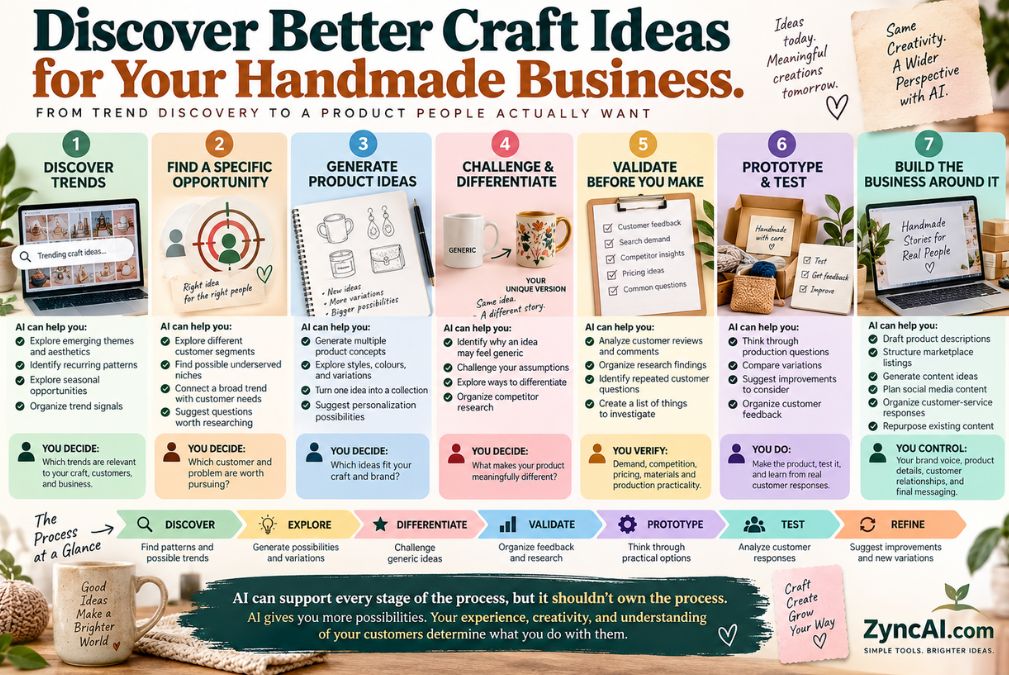
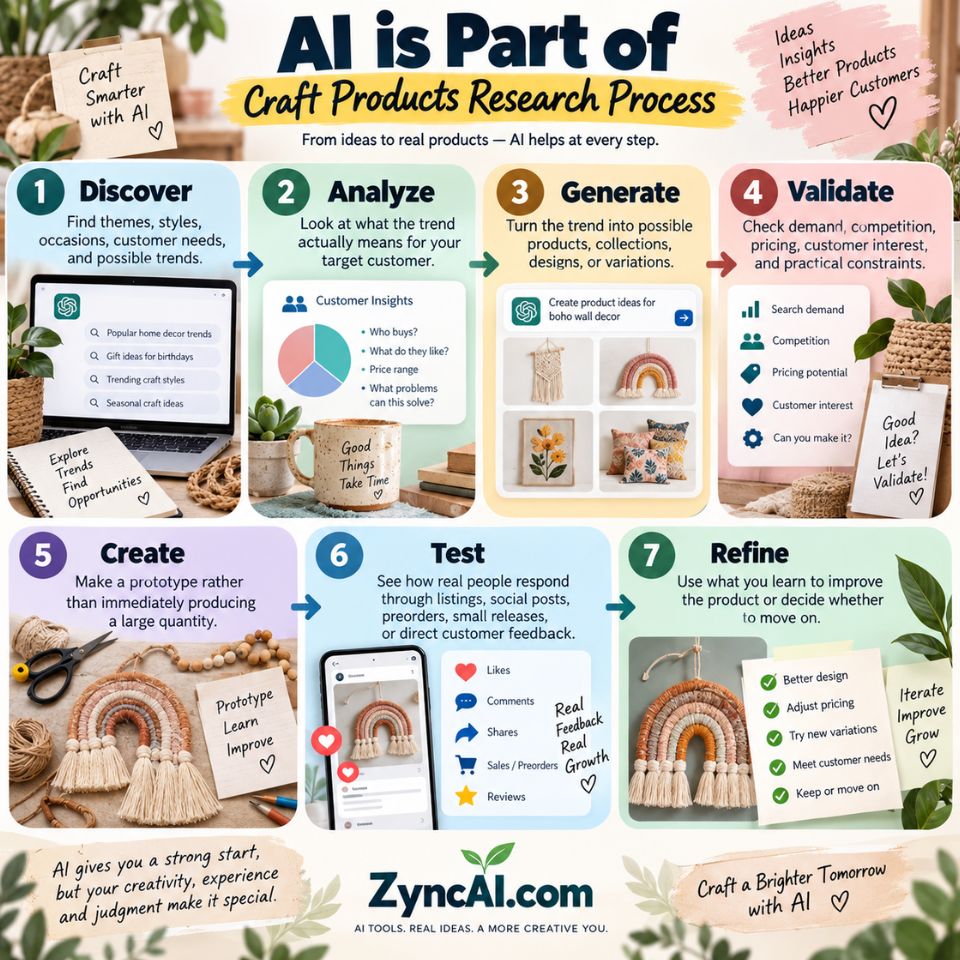
Think of AI as part of a research process
A useful way to approach craft trend discovery is,
Discover → Analyze → Generate → Validate → Create → Test → Refine
Each stage has a different job.
Discover
Find themes, styles, occasions, customer needs, and possible trends.
Analyze
Look at what the trend actually means for your target customer.
Generate
Turn the trend into possible products, collections, designs, or variations.
Validate
Check demand, competition, pricing, customer interest, and practical constraints.
Create
Make a prototype rather than immediately producing a large quantity.
Test
See how real people respond through listings, social posts, preorders, small releases, or direct customer feedback.
Refine
Use what you learn to improve the product or decide whether to move on.
3. Why “Give Me Craft Ideas” Usually Isn’t Enough
Let’s say you make handmade jewellery.
You open any AI tool like Gemini, Claude, ChatGPT, or Deepseek, and type,
“Give me 20 jewellery product ideas.”
You might get,
- minimalist necklaces
- personalised bracelets
- birthstone jewellery
- charm earrings
- layered necklaces
- friendship bracelets
- statement earrings
There is nothing particularly wrong with these ideas.
The problem is that they do not tell you much about where the opportunity is.
They do not tell you,
- which customer you’re targeting
- why that customer might buy
- what occasion the product is for
- how crowded the category might be
- what makes the product different
- whether the idea fits your production skills
- whether the trend is growing or fading
- whether customers are already asking for something similar
This is why prompt specificity matters.
Specific prompts produce more useful results, while generic prompts tend to produce generic answers.
Try giving AI a real business problem instead
Instead of,
“Give me craft ideas.”
Try,
“I sell handmade polymer clay earrings on Etsy. My main customers are women buying affordable gifts for birthdays, bridesmaids, and teachers. Give me 15 product ideas based on current gift-buying occasions and visual styles. For each idea, explain the target customer, occasion, personalization option, likely production difficulty, and how I could make the idea feel less generic.”
Now you have something you can actually work with.
You can take the strongest three ideas and ask another question,
“Which of these ideas could be developed into a small collection rather than a single product?”
Then:
“What would make each collection different from a typical Etsy product?”
Then:
“What information should I research before investing time and materials into these products?”
That conversation is far more useful than asking AI for one giant list and choosing the first thing that sounds nice.
4. The Real Opportunity: Use AI to Find the Space Between a Trend and a Product
A trend by itself is not a product.
“Botanical,” “coastal,” “personalized,” “retro,” or “minimalist” are broad directions.
Your expertise is needed to figure out what those themes could mean for your particular customer.
Think of the process like this:
Broad trend → Specific audience → Customer need → Product category → Product idea → Differentiation
For example,
Botanical trend
↓
Customers looking for meaningful housewarming gifts
↓
Something personalized rather than mass-produced
↓
Embroidered home décor
↓
Personalized birth-flower wall hanging
↓
Add the recipient’s name, house date, or meaningful flower
That final product is much more specific than simply saying, “Botanical products are trending.”
And that is the part AI can help you explore.
Throughout my experience I have realized that the real value of AI is not in making the decision for you, but in helping you explore more possibilities, ask better questions, and make a more informed decision about what is actually worth creating.
AI can give you dozens of possible routes between the broad trend and the finished product. You still decide which route is worth taking.
5. A Simple Rule: Don’t Let AI Make the Product Decision for You
There’s a temptation to treat AI like a very fast creative director.
Give it a niche.
Get 100 ideas.
Pick one.
Start making.
That can work occasionally, but it is not a particularly strong way to build a handmade product business.
Your experience matters !!!
You know which materials are expensive. You know which techniques take three hours instead of thirty minutes. You know which products are difficult to photograph, package, ship, personalize, or reproduce consistently.
AI does not automatically know those things.
And even when it gives you an interesting idea, you still need to ask to yourself,
Would I actually want to make this?
That question is surprisingly important.
A product can look commercially interesting on paper and still be completely wrong for your creative business.
The strongest use of AI is often not,
“Tell me what to make.”
It is,
“Show me possibilities I might not have considered, then help me think through them.”
That keeps the creative decision where it belongs with you.
6. How to Use AI to Find Emerging Craft Trends
Now we get to the part that can make AI genuinely useful for product research.
Instead of asking AI to invent products from scratch, you can use it to explore what people are interested in, which styles are appearing repeatedly, what occasions are creating buying opportunities, and where a broad trend might fit your particular handmade business.
There is one important catch, though.
AI is not a crystal ball.
A chatbot can help you organize ideas, compare themes, and think through possibilities. It does not automatically know what is selling today in your particular Etsy category, and it should not be treated as proof that a trend will become profitable.
To avoid the confusion of how to place AI, the simple thinking in my opinion is to see AI as a research assistant sitting beside you, not someone who has already done the research for you..
Start With a Broad Trend Question
If you already have a craft category, start there.
For example, if you make handmade home décor, you could ask,
“I sell handmade home décor products. Help me identify 10 emerging design themes that could be relevant to handmade home décor over the next season. For each theme, suggest the types of customers it may appeal to, possible product categories, colour directions, and occasions where people might buy these products. Clearly separate established themes from ideas that would need further validation.”
Notice the wording.
You are not asking:
“What will be the biggest trend?”
That question encourages false certainty.
Instead, you’re asking AI to give you possibilities worth investigating.
Once you have those possibilities, you can take the interesting ones and do further research.
Ask AI to Look for Patterns, Not Just Products
This is a small change in the way you think about prompts, but it can make a big difference.
Instead of asking,
“What handmade products are trending?”
Try,
“What recurring themes, colours, styles, customer preferences, gifting occasions, and design aesthetics should a handmade seller watch when researching new product opportunities?”
The second question gives you a broader view.
You might discover that the interesting opportunity isn’t a particular product at all.
It might be a colour combination.
Or a gifting occasion.
Or a personalization trend.
Or a particular customer group.
Or a style that could be applied across several different products.
That gives you much more room to create something that fits your own craft.
Use Several Sources Before Calling Something a Trend
If AI suggests that a particular style or product category is becoming popular, do not immediately order materials and start making 100 pieces.
Look for supporting signals.
Below are some ways that I think you can check,
- Etsy search suggestions and marketplace results
- Pinterest searches and visual trends
- Instagram posts and creator conversations
- TikTok content
- YouTube searches
- customer reviews
- comments and questions
- seasonal buying patterns
- products appearing repeatedly across different marketplaces
AI can help you organize what you find.
For example, you could collect notes from several sources and ask,
“I found these product themes across Etsy, Pinterest, Instagram, and customer comments. Group the observations into recurring trends. Identify which themes appear across multiple sources and which appear only once. Then suggest three product opportunities worth researching further.”
That is much stronger than relying on a single AI generated prediction.
7. Turn a Broad Trend Into a Handmade Product Opportunity
Finding a trend is only the beginning.
The real creative work starts when you ask,
“What could this trend mean for my customers?”
A broad trend can be turned into a specific product by narrowing it down step by step.
Use the Trend → Niche → Product Framework
Try this simple framework,
Broad trend → Audience → Need or occasion → Product category → Specific product → Differentiation
Let’s take a fictional example.
Suppose AI suggests that botanical-inspired designs could be worth exploring.
That is far too broad.
You could narrow it like this:
Botanical designs
↓
People buying meaningful housewarming gifts
↓
They want something personal rather than mass-produced
↓
Handmade wall décor
↓
Personalized botanical embroidery
↓
Add the recipient’s name, home date, location, or meaningful flower
Now you have a much clearer product concept.
You could then ask AI,
“Take the botanical trend and focus specifically on personalized housewarming gifts. Give me 15 handmade product concepts that could fit this audience. Prioritize ideas that allow personalization and could be produced in small batches. For each idea, explain what makes it different from a generic botanical product.”
This is where I think that AI starts becoming more interesting and helpful.
It is not deciding what you should sell.
It is helping you explore the space between a broad trend and a product you could actually make.
8. Ask AI for Craft Ideas Around a Specific Trend
Once you have a trend worth investigating, you can use AI for a more focused brainstorming session.
The important thing is to give it enough information.
A Better Craft Product Prompt
Suppose you make handmade candles.
Instead of,
“Give me candle ideas based on current trends.”
Try,
“I make small-batch handmade candles and sell primarily as gifts. I’m interested in exploring nostalgic and vintage-inspired aesthetics. Give me 15 product concepts aimed at customers buying birthday, housewarming, and self-care gifts. Include possible scents, packaging directions, product names, and personalization ideas. Avoid generic candle suggestions and focus on concepts that could become a cohesive collection.”
The above prompt gives AI several useful boundaries as below,
- what you make
- who you sell to
- why customers buy
- the visual direction
- the occasions
- the type of output you want
- what you don’t want
With my experience, I can confidently say that this is one of the simplest ways to get more practical results from AI. Give it enough context to understand the problem you are trying to solve, rather than expecting it to figure out the problem for you.
Ask for Variations Instead of Starting From Scratch
You do not always need 50 completely different products.
Sometimes you already have one promising idea.
That is when AI can help you explore variations.
For example,
“I’m considering a personalized embroidered birth-flower hoop. Give me 12 ways to develop this idea for different customers and occasions without changing the basic production method.”
You might explore,
- wedding gifts
- anniversary gifts
- new baby gifts
- Mother’s Day
- birthday gifts
- memorial pieces
- housewarming gifts
- bridesmaid gifts
The basic craft stays the same.
The customer, occasion, story, or personalization changes.
That can be much more practical for a small handmade business than constantly inventing completely new products.
9. Use AI to Explore Different Craft Styles and Aesthetics
Sometimes you know what you want to make but not how you want it to look.
This is something I have come across often. When working through an unclear business or product problem, I rarely find that the first idea is the one worth going with. A better approach is usually to explore a few different directions, understand the trade offs, and then narrow things down.
I find the same approach works surprisingly well with AI and craft product ideas.
Instead of asking AI to simply “give me some design ideas,” you can use it to explore different creative directions around:
- colour combinations
- textures
- patterns
- shapes
- materials
- visual themes
- packaging styles
- seasonal aesthetics
- vintage or modern directions
- minimalist or maximalist approaches
For example, imagine you make handmade fabric bags.
You could ask,
“I make handmade fabric tote bags. Give me six different visual directions for a new collection inspired by coastal design. For each direction, suggest a colour palette, pattern ideas, fabric texture, suitable customer, and overall mood. Avoid obvious nautical clichés such as anchors and ship wheels.”
Remember that the quality of the output often depends on how clearly the problem has been framed. Giving someone a broad problem and expecting a useful solution usually leads to a broad answer. Adding context, constraints and the outcome you’re looking for gives everyone a better starting point.
The same thing happens with AI.
The instruction to avoid obvious nautical clichés, for example, gives the AI a boundary. Without it, “coastal” could easily turn into anchors, seashells, blue-and-white stripes and other predictable ideas.
You can take this even further by asking AI to produce several directions that are deliberately different from each other. One could be minimalist and contemporary, another could take a rustic approach, while another could use softer coastal colours with subtle textures.
You don’t have to use any of the suggestions exactly as they are.
The real value is in having several directions to react to. You might discover that you prefer one colour palette from one concept, the texture from another, and the packaging idea from a third.
That makes AI less of a “design generator” and more of a creative exploration tool.
And ultimately, the craft maker still makes the decision.
Ask AI to Push Past the First Idea
The first answer is not always the interesting one.
If the AI gives you predictable suggestions, challenge it.
Try,
“These ideas are too generic. Give me another 10 directions that feel more subtle and contemporary.”
Or,
“Avoid common Etsy-style interpretations of this trend. Give me ideas that use the same underlying aesthetic but approach it from a less obvious angle.”
Or,
“Which of these ideas feels most overused? Which ones give me more room to develop a distinctive product?”
This is where the conversation becomes more useful than a single prompt.
The proven way to get the best output from AI is that to use it as a brainstorming partner and asking it to critique its own first attempt.
10. Turn One Trend Into an Entire Product Collection
One of the easiest mistakes to make when discovering a new trend is to think about individual products one at a time.
Instead, ask whether the trend could become a collection.
Imagine you discover that a particular floral aesthetic fits your target customers.
You could create one product.
Or you could build a small collection around the same visual language.
For example,
A Botanical Gift Collection
Lower-priced products
- botanical bookmarks
- personalized gift tags
- small floral ornaments
Mid-range products
- embroidered hoops
- personalized pouches
- framed botanical artwork
Higher-priced products
- large family botanical portraits
- custom wedding keepsakes
- detailed personalized wall art
The products don’t need to be identical.
They simply need to feel like they belong together.
That gives you more options for different budgets and occasions.
Someone might not spend $70 on a large handmade wall hanging, but they may happily buy a $15 bookmark as a small gift.
Ask AI to Build the Collection
You could prompt,
“I’m developing a handmade collection around botanical illustrations and personalized gifting. Suggest 10 complementary products using the same visual theme. Include three lower-priced items, four mid-range products, and three premium products. Keep the production methods realistic for a small handmade business and avoid ideas that require completely different equipment.”
That last sentence is particularly useful.
You don’t want AI designing a collection that requires you to suddenly become a ceramicist, jeweller, woodworker, and textile artist by next Tuesday.
Your production reality matters.
11. Use AI to Find Seasonal Craft Opportunities
Seasonality is another area where I find AI particularly useful for brainstorming.
One thing I have learned is that a good starting point often comes from understanding the customer need behind the occasion, rather than jumping straight to a list of products.
The same thinking can be applied to handmade businesses.
People do not necessarily buy handmade products simply because it’s Christmas, Valentine’s Day or Mother’s Day. They buy because they are looking for a gift, decoration, personal keepsake or way to celebrate a particular moment. That distinction can lead to much more interesting product ideas.
You could use occasions such as,
- Valentine’s Day
- Mother’s Day
- Father’s Day
- Easter
- Halloween
- Christmas
- weddings
- birthdays
- anniversaries
- baby showers
- graduations
- housewarmings
- teacher gifts
- seasonal home décor
The obvious approach would be to ask AI,
“Give me Christmas craft ideas.”
I’ve used broad prompts like this in other types of business problem solving, and the limitation is usually the same: you get a collection of perfectly reasonable ideas, but not necessarily ideas that are particularly relevant to your customer or your business.
A better approach is to give AI some commercial context.
For example,
“I sell handmade fabric home décor products to customers who prefer minimalist, neutral interiors. I’m looking for Christmas products that can be made in small batches and sold as gifts. Give me 10 product concepts. For each, suggest the customer need it addresses, approximate price positioning, materials, personalisation opportunities, and what could make the product different from typical Christmas décor.”
Now the AI has something more useful to work with.
You are not simply asking it to generate Christmas crafts. You are asking it to explore product opportunities within a specific customer, market and business context.
This is an approach I have seen repeatedly: the better you define the problem, the more useful the options become.
You can also ask AI to look at the same occasion from different customer perspectives.
For example, Christmas could be explored through,
- gifts for people who are difficult to buy for
- personalised gifts for family members
- small gifts under a specific price point
- handmade décor for minimalist homes
- sustainable alternatives to mass-produced decorations
- corporate or team gifts
- last-minute gift ideas
This can uncover directions that are not immediately obvious when you start with the occasion alone.
AI isn’t going to tell you which product will definitely sell. That is where actual market research, customer feedback and testing still matter.
But it can help you move from “What could I make for Christmas?” to “What customer problems or buying occasions could I explore within the Christmas market?”
That is a much more useful starting point for product research.
Example: Seasonal Product Research
“I sell handmade personalised gifts on Etsy. Help me brainstorm product opportunities for Halloween. Focus on customers buying gifts for adults rather than children. Give me 15 ideas that can be personalized, explain the likely buyer and occasion for each, and separate ideas that could work as seasonal gifts from ideas that are likely to be useful only for Halloween.”
That last distinction is useful.
A seasonal product can sometimes be more valuable if part of the design remains useful beyond one specific date.
Think About Timing, Not Just the Occasion
There’s another practical issue with seasonal products.
You need time to make them.
If Halloween is two weeks away and you’ve just discovered an interesting Halloween product idea, you may already be late.
A better seasonal workflow looks something like:
Research → Prototype → Photograph → List → Promote → Sell → Review
AI can help you brainstorm and organize each stage, but it can’t change the calendar.
This is one reason it’s useful to explore seasonal opportunities well before the buying period begins.
12. Use Customer Comments to Discover Product Ideas
This may be one of the most overlooked sources of product inspiration.
Your customers are already telling you what they want.
You just need to pay attention.
Look through:
- Etsy reviews
- customer messages
- Instagram comments
- Facebook comments
- product questions
- emails
- survey responses
- social media polls
- questions people ask before purchasing
You may start noticing phrases that appear again and again.
For example:
“Do you make this in a larger size?”
“Can I get this with a different colour?”
“Would you be able to add a name?”
“I wish this came in…”
“I bought this as a gift for…”
Those comments can contain product opportunities.
Ask AI to Analyze Your Customer Feedback
If you have a collection of comments, you can ask AI to organize them.
For example,
“I’m going to give you 50 customer comments from my handmade business. Identify repeated requests, complaints, questions, occasions, desired features, and personalization requests. Group similar comments together and rank the themes by how frequently they appear. Then suggest product or product-improvement opportunities based only on the information in the comments.”
This is different from asking AI to invent products.
You’re giving it real customer information and asking it to find patterns.
That distinction matters.
Look for the “I Wish You Made…” Comments
Pay particular attention to requests that appear repeatedly.
If several customers ask for:
- different colours
- larger sizes
- smaller versions
- personalization
- gift packaging
- matching products
- different occasions
- alternative materials
you may have found something worth investigating.
It doesn’t automatically mean you should make it.
But it gives you a reason to investigate.
And that is exactly what good product research should do which is to help you decide what deserves your attention next.
13. Find Gaps Instead of Chasing the Biggest Trend
Here is an idea that can save a lot of wasted effort,
The biggest trend is not automatically the best opportunity for your business.
If everyone is selling the same style of product, jumping into the category simply because it is popular can put you into a crowded market.
Sometimes the more interesting opportunity is sitting slightly to the side.
You might find,
Popular trend
→ lots of sellers
→ lots of similar products
→ difficult to stand out
But perhaps,
Popular trend + overlooked customer
→ fewer direct competitors
→ more specific product requirements
→ clearer differentiation
That second opportunity may be worth investigating.
Ask AI to Help You Look for Underserved Niches
For example,
“I’m interested in the handmade wedding gift market. Instead of giving me the most popular product ideas, identify customer groups, occasions, personalization needs, or buying situations that may be less well served. For each opportunity, explain the customer problem and suggest five handmade product concepts.”
You can do the same thing with almost any category.
You can try,
- handmade gifts for new homeowners
- gifts for gardeners
- products for book lovers
- wedding keepsakes
- handmade products for pet owners
- teacher gifts
- personalized baby gifts
- craft products for small spaces
The goal is not to avoid popular markets completely.
It is to ask a better question
Where can I create something relevant without simply copying what everyone else is already making?
14. Don’t Confuse a Trend With a Fad
Having spent years with technology and business consulting, I have learned that we really needs to look beyond the initial attention something receives. A surge in interest does not always translate into a sustainable opportunity, and the same principle applies when researching craft trends with AI.
AI may happily tell you that something is “trending.”
That doesn’t necessarily tell you how long the interest will last.
There is a difference between,
An established trend
A broader preference that can influence products for months or years.
An emerging trend
A newer pattern that appears to be gaining attention but still needs validation.
A fad
A short lived burst of attention that may disappear quickly.
For a handmade seller like you, this distinction matters because your products take time to design, make, photograph, list, and promote.
Ask Better Questions About a Trend
Instead of asking,
“Is this trending?”
Ask,
“What evidence would I need to determine whether this is an emerging trend or a short-lived fad?”
Then investigate questions such as,
- Is the theme appearing across multiple platforms?
- Are people creating products around it?
- Are customers actually searching for related products?
- Is there evidence of buying intent?
- Does the interest connect to a recurring occasion?
- Is the trend compatible with my target customer?
- Is competition increasing rapidly?
- Can I make something distinctive around it?
- Can the product remain relevant after the trend peaks?
You do not need to predict the future perfectly.
You need enough information to decide whether an idea deserves a small experiment.
15. A Better Way to Think About Craft Trends
At this point, you might notice that the process is not really about asking AI,
“What should I make?”
It’s more about asking,
“What should I investigate?”
That’s a much healthier way to use AI for a handmade business.
AI can help you move from,
“I need a new product.”
to,
“Here are five themes worth investigating.”
Then from,
“This theme looks interesting.”
to,
“Here are three customer groups who might care about it.”
Then,
“Here are 15 possible products.”
And finally,
“Here are the questions I need to answer before I spend money making them.”
That last step is where many AI-generated craft ideas stop being useful—and where your own judgment starts becoming much more important.
16. How to Turn a Trend Into Products People Might Actually Buy
Finding an interesting trend is the fun part.
The harder question is what to do with it.
You might discover a style that looks promising, generate twenty product ideas, and then realize that fifteen are too similar to what everyone else is selling, three would take six hours each to make, and the remaining two don’t fit your brand.
This is where you need to slow down.
AI can help you move from “This looks interesting” to “This might be worth testing.”
It can help you compare ideas, find variations, think about differentiation, organize competition research, and turn one promising direction into a small product collection.
But you still need to do the real-world checking.
Find Gaps Instead of Simply Following the Crowd
A popular trend can be useful.
It can also be crowded.
If a particular product is suddenly everywhere on Etsy, Pinterest, Instagram, and TikTok, you may be looking at genuine customer interest. But you’re also likely looking at plenty of other sellers who have noticed the same thing.
That creates an important question,
Where can you participate in the trend without making another version of exactly what already exists?
Look for the Overlooked Customer
One way to find an opening is to narrow the audience.
Imagine you notice strong interest in personalized wedding products.
“Personalized wedding products” is still a huge category.
You could narrow it to,
- wedding gifts for second marriages
- small wedding keepsakes
- gifts for destination weddings
- personalized gifts for bridesmaids
- gifts for newly engaged couples
- wedding keepsakes featuring pets
- minimalist wedding décor
- handmade gifts for couples who prefer non-traditional weddings
The point isn’t that any one of these is automatically a good opportunity.
The point is that specific customers often have more specific needs.
That gives you more room to create something distinctive.
Ask AI to Find Possible Gaps
Try a prompt like,
“I’m researching handmade wedding products. Instead of suggesting the most obvious products, identify 10 customer groups, occasions, or specific needs that may be less well served. For each one, explain the customer need and suggest three handmade products that could address it. Mark each idea as something I should research further rather than assuming it has proven demand.”
That last sentence is worth keeping.
You’re reminding the AI that you’re looking for research directions, not guaranteed business opportunities.
Use AI to Check Whether an Idea Is Too Generic
Before making something, ask a slightly uncomfortable question:
“What makes this different?”
If you can’t answer that, you may have a problem.
Consider these two ideas:
Handmade floral wall art
and
Personalized embroidered birth-flower wall hanging featuring the flowers associated with each family member
The second idea has more definition.
It has,
- a specific product
- a specific visual theme
- personalization
- a reason for the personalization
- a potential gifting angle
It may still face competition, of course. But you have something more specific to evaluate.
Ask AI to Critique Your Idea
One of best learning that I got is that the good decisions rarely come from asking a tool to confirm what you already believe. They become stronger when you use the tool to challenge your assumptions, uncover potential weaknesses, and give you more information to consider before making the decision yourself.
Instead of asking AI whether your idea is “good,” ask it to challenge the idea.
For example,
“Act as a critical product researcher for my handmade business. I’m considering selling personalized botanical embroidery hoops. Identify the reasons this idea could feel generic, the types of competitors I should research, possible ways to differentiate the product, and questions I should answer before making inventory. Don’t assume the idea will succeed.”
This is much more useful than,
“Is this a good product idea?”
AI tends to be quite agreeable when you ask broad questions.
A critical prompt gives you a better chance of seeing the weaknesses.
17. Check Competition and Market Saturation
AI generated keyword suggestions can be saturated and my recommendations is to do analysis with your experience and judgement, rather than blindly using them.
The same principle applies to product ideas.
AI might suggest,
“Personalized minimalist necklace”
That sounds perfectly reasonable.
But perhaps thousands of very similar products already exist.
The AI does not magically solve that problem.
What to Look at When Researching Competition
When you search a marketplace such as Etsy, pay attention to more than the number of results.
You should look at,
- how similar the products actually are
- the visual styles sellers are using
- personalization options
- price ranges
- materials
- product sizes
- customer reviews
- common complaints
- what customers praise
- how sellers photograph the products
- how products are packaged
- whether sellers target specific occasions
- whether most products look interchangeable
You are trying to understand the market, not simply count competitors.
Use AI to Organize Your Research
Suppose you manually collect information from ten competing listings.
You could give AI a table or notes and ask,
“Analyze these 10 competing handmade products. Group them by design style, price range, personalization options, target occasion, materials, and major selling points. Identify features that appear repeatedly and areas where the products seem very similar. Then suggest questions I should investigate before developing my own version.”
Now AI is helping with analysis, rather than pretending to have perfect market knowledge.
That distinction is important.
18. Look at Customer Reviews, Not Just Competitor Listings
Competitor listings show you what sellers say they offer.
Customer reviews show you what buyers actually experienced.
That difference can be useful.
Suppose you’re researching handmade personalized gifts and notice customers repeatedly saying things like,
- “Beautiful, but I wish it arrived faster.”
- “The personalization was smaller than expected.”
- “I wanted more colour choices.”
- “The packaging was lovely.”
- “I bought this for my sister and she loved it.”
- “I wish there was an option for three names instead of two.”
Those comments can tell you more than the product title alone.
Ask AI to Find Repeated Problems
You could collect a group of public reviews and ask,
“Analyze these customer reviews of handmade personalized gifts. Identify repeated positive comments, complaints, missing features, personalization requests, and buying occasions. Separate frequently mentioned themes from one-off comments. Then suggest product improvements or opportunities based only on the information provided.”
This is one of the areas where AI can be genuinely helpful because it’s good at organizing a large amount of text into themes.
19. Use AI to Decide Which Ideas Deserve a Prototype
At this stage, you may still have several ideas.
Don’t make all of them.
That can get expensive very quickly.
Instead, create a shortlist.
For example,
| Idea | Customer fit | Differentiation | Production difficulty | Research needed |
|---|---|---|---|---|
| Product A | High | Medium | Low | Medium |
| Product B | High | High | Medium | High |
| Product C | Medium | Low | Low | Low |
| Product D | High | Medium | High | High |
You do not have to ask AI to score these and tell you which one “wins.”
A better approach is to ask it to surface the trade-offs.
For example,
“Compare these four handmade product ideas based on target customer fit, production complexity, differentiation potential, personalization opportunities, seasonal relevance, and questions that still need to be researched. Do not choose the product for me. Explain the trade-offs so I can decide which one to prototype.”
That is a much more useful role for AI.
It helps you think.
It doesn’t make the business decision for you.
20. Prototype Before You Commit to Inventory
This is where all the research eventually has to meet reality.
An AI generated product concept might sound fantastic until you actually try making it.
I’ve seen that most of crafters face similar challenges like below when trying to build the idea,
- the material costs too much
- the production time is unreasonable
- personalization takes too long
- shipping is complicated
- the product photographs poorly
- the design doesn’t look as good in real life
- customers don’t understand what it is
- the finished product feels too similar to competitors
That is why a prototype is so valuable.
You do not need to make 50.
Make one.
Then you should ask yourself,
- Can I make this consistently?
- Do I enjoy making it?
- Can I price it profitably?
- Does it look good in photographs?
- Is it easy to explain?
- Would someone actually want to give this as a gift?
- Can I make it different enough from what is already available?
AI can help you think through these questions, but your hands have the final say.
21. Use AI to Think Through Production Problems
AI can also help once you start developing the prototype.
For example, you could ask,
“I’m making a personalized embroidered wall hanging. The design currently takes about four hours to complete. Suggest ways I could simplify the design without making the finished product look cheap or generic. Focus on reducing production time while keeping the handmade character.”
Or
“I want to offer three sizes of this handmade product. What factors should I consider when deciding which sizes are practical for production, pricing, packaging, and shipping?”
These are not questions where AI needs to provide the final answer.
You are using it to generate considerations you might otherwise overlook.
22. Use AI for Craft Patterns and Technical Starting Points
Depending on your craft and your expertise, AI may help you,
- brainstorm pattern concepts
- structure instructions
- explore variations
- organize measurements
- generate a first draft
- think through different sizes
- identify questions that need checking
But a draft is not a tested pattern.
If the instructions involve precise measurements, garment fitting, sizing, construction, safety, or technical calculations, you should make sure it needs proper human review and testing.
23. Use AI to Name Products and Collections
Once you have a product, you still need to name it.
This sounds easy until you have twenty products and you’ve already used every combination of “Meadow,” “Bloom,” “Dream,” and “Willow” you can think of.
AI can be useful as a naming brainstormer.
For example,
“I’m launching a handmade embroidery collection inspired by wildflower meadows. Generate 30 product names that feel warm, poetic, and modern. Avoid generic names containing words like ‘dream,’ ‘magic,’ or ‘whisper.’ Keep names between two and four words.”
You can then ask,
“Give me 20 alternatives that feel more playful and less romantic.”
Or
“Which of these names sound too similar to each other? Group them by mood.”
The final name should still fit your brand.
And before using a name commercially, you should do your own checks for existing brands, products, trademarks, and marketplace conflicts.
Don’t Let AI Flatten Your Brand Voice
A name generator can give you possibilities.
It can’t know exactly why one word feels right for your brand.
The same applies to product descriptions, social posts, and other writing.
That distinction is important.
AI can help you find the words. You still need to decide whether they sound like you.
24. The Goal Isn’t to Find a “Perfect” Product Idea
At this point, you might be tempted to keep researching until AI gives you an idea that feels completely safe.
That probably isn’t going to happen.
There is no prompt that can guarantee:
- customer demand
- low competition
- profitability
- originality
- easy production
- viral growth
- long-term popularity
And that’s okay.
The goal of trend research isn’t certainty.
It’s to reduce unnecessary guesswork.
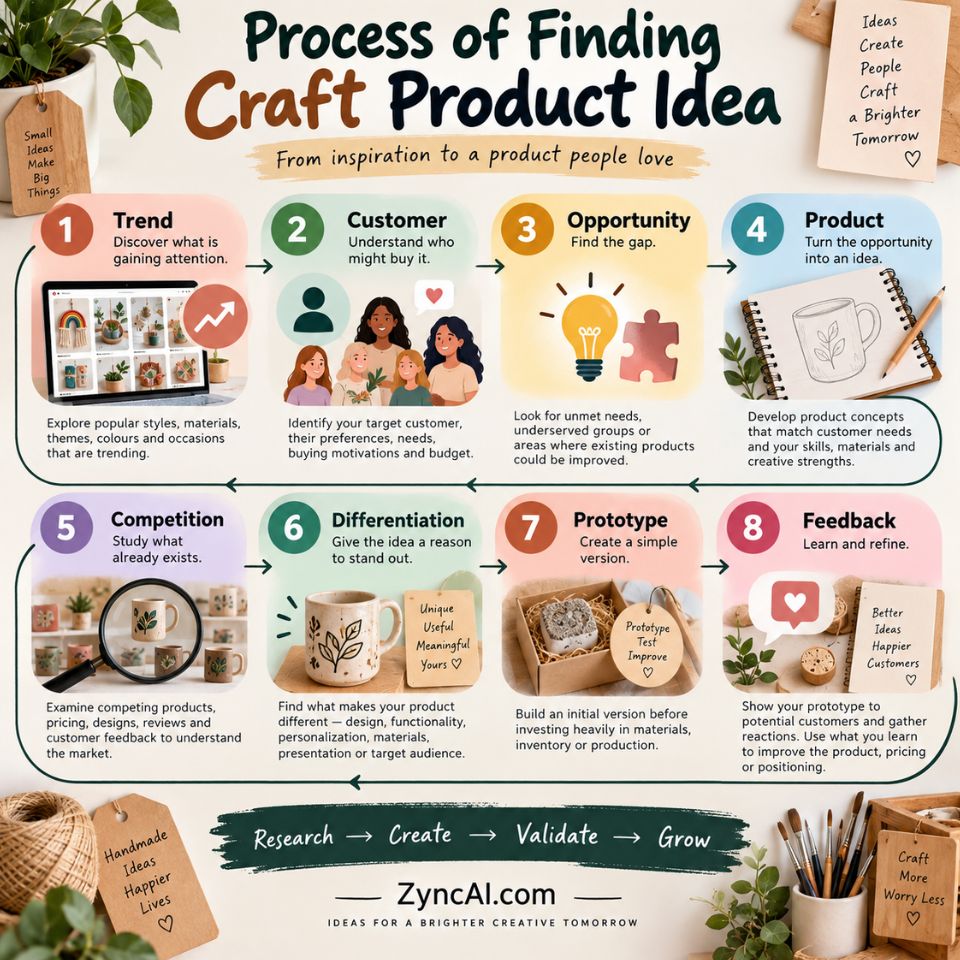
Instead of making something completely at random, you can move through a more informed process:
Trend → Customer → Opportunity → Product → Competition → Differentiation → Prototype → Feedback
That gives you something much more valuable than a list of 100 AI-generated craft ideas.
It gives you a reason to make one particular thing first.
25. What I’ve Learned About Using AI in a Handmade Business
In recent years I’ve come to see that technology, including AI, delivers the most value when it helps people make better decisions rather than trying to make those decisions for them.
For a handmade business, I’d look at AI as another tool in your workshop. It can help you explore ideas, organize information, challenge your assumptions, and reduce some of the repetitive work that comes with running a business. But your craft knowledge, understanding of your customers, creative judgment, and personal taste still need to be at the center of the process.
What You Should Do
The first recommendation I should make is to start with the problem you are trying to solve, rather than starting with the AI tool. If you are struggling to come up with product variations, ask AI to explore variations. If you have dozens of customer comments and don’t know what patterns are hiding in them, ask AI to organize and analyze them. If you’re unsure whether a product idea is too generic, ask it to challenge the idea.
The more context you provide, the more useful the conversation tends to become. Think about what you already know about your business and give AI that information before asking it to make suggestions.
A few practices I like to recommend are,
- Give AI context about your business. Explain what you make, who your customers are, your price range, your materials, and the type of products you want to explore.
- Ask specific questions. Instead of “Give me craft ideas,” explain the customer problem, occasion, trend, or business challenge you’re investigating.
- Use AI to explore several possibilities. Ask for variations, alternative approaches, or different customer segments rather than accepting the first suggestion.
- Ask AI to challenge your ideas. Finding weaknesses can be just as useful as generating new ideas.
- Use your own information whenever possible. Customer comments, reviews, product questions, sales observations, and previous product performance can give AI much better context.
- Verify important information before acting on it. Treat AI output as a starting point for investigation, particularly when a decision could affect your products, customers, or money.
- Edit AI-generated content before publishing it. Make sure the wording sounds like your brand and accurately describes the actual product.
- Start small. You don’t need to introduce AI into every part of your business at once. Find one repetitive or difficult task where it can genuinely save you time.
What You Should Not Do
The biggest mistake you should avoid is treating AI as if it understands your business simply because it can produce a confident answer. In technology consulting, I’ve seen that a tool can produce a technically convincing output while still missing the context that matters to the person making the decision. AI can have the same problem.
Also you should avoid handing over the parts of your business that depend heavily on your personal judgment. Your customers may choose your products because of your particular style, craftsmanship, material choices, story, or the way you personalize an item. Those are difficult things to reduce to a prompt, and they’re often exactly what differentiates a handmade business.
Here are some things you should be careful about,
- Don’t assume the first AI answer is the right answer. Use it as a starting point, not a final decision.
- Don’t blindly follow AI-generated trends. A suggestion that sounds like a trend still needs to be investigated before you invest time or money in it.
- Don’t copy AI-generated ideas without thinking about originality. Use suggestions as inspiration and develop them through your own creative process.
- Don’t publish AI-generated content without reviewing it. Check product details, measurements, materials, claims, and tone.
- Don’t let AI replace your understanding of your customers. AI can help identify patterns, but you’re still closer to the people actually buying your products.
- Don’t use AI simply because you can. If a task is already easy, enjoyable, and central to your creative process, there may be little benefit in handing it over to a tool.
- Don’t let AI make every creative decision. Your taste and craft expertise are part of the value customers are buying.
- Don’t confuse a polished answer with a validated business opportunity. An idea can sound excellent in a conversation with AI and still fail when you consider demand, competition, production time, pricing, or your actual customers.
The way I think you should approach AI is fairly simple -> let AI expand your thinking, but keep the important decisions in your hands. That gives you the efficiency of technology without losing the judgment and personality that make a handmade business different in the first place.