How to Use AI to Find Profitable Craft Niches With Low Competition
Finding a profitable craft niche is no longer just about following what is popular on Etsy, Pinterest, Instagram, or other online marketplaces.
A craft product can be beautifully designed, professionally photographed, and well made, and still struggle to generate consistent sales if you are competing in an overcrowded niche.
The bigger opportunity is often found one level deeper.
Instead of asking, “What crafts are popular?”, a better question is:
“Which specific customers have a strong reason to buy a craft product, but are not being served particularly well by existing sellers?”
This is where AI becomes extremely useful.
AI can help you brainstorm hundreds of niche possibilities, break broad craft categories into specific micro niches, analyze customer problems, identify product gaps, study competitors, generate keyword opportunities, compare potential niches, and build a structured system for evaluating profitability.
But there is an important distinction.
AI should not be treated as a machine that tells you which craft niche will definitely make money.. It is much more powerful when you use it as a research and analysis partner that helps you discover opportunities and form hypotheses that you then validate with real world data.
In this guide, you will learn how to build that process from the ground up.
What Makes a Craft Niche Profitable and Low Competition?
Before asking AI for niche ideas, you need to define what a good opportunity actually looks like.
A profitable, low competition craft niche generally combines several characteristics, as follows,
- A clearly identifiable customer
- A real customer need or desire
- Evidence of demand
- Manageable competition
- A price customers are willing to pay
- Reasonable production costs
- Opportunities for differentiation
- Practical shipping and fulfillment
- Potential for multiple related products
The ideal combination is something like,
Specific customer + clear demand + manageable competition + healthy margins + strong differentiation
Finding all five is not easy.. That is why niche research matters.
Low Competition Does Not Mean No Competition
This is one of the most important concepts to understand.
If you search for a niche and find absolutely no competitors, you should not immediately assume you have discovered an incredible opportunity.
You may instead have discovered a market where nobody wants the product.
Some competition is actually evidence that customers exist.
The objective isn’t necessarily to find a niche with zero competition. Your objective is to find a niche where:
Demand is strong enough to support sales, but competition isn’t so strong that a new seller has no realistic way to stand out.
A niche with 20 competent competitors and growing demand may be much more attractive than a niche with two sellers and almost no customers.
Understand the Difference Between a Craft Category, Niche and Micro-Niche
AI becomes much more useful when you understand how to narrow a market.
Consider this progression:
Jewelry
→ Polymer clay jewelry
→ Minimalist polymer clay earrings
→ Minimalist polymer clay earrings for professionals
→ Personalized minimalist polymer clay earrings for professional gifts
Each step makes the target market more specific.
Another example:
Woodworking
→ Home organization
→ Desk organization
→ Home office desk organization
→ Personalized wooden desk organizers for professionals
This is the basic principle behind micro niche research.
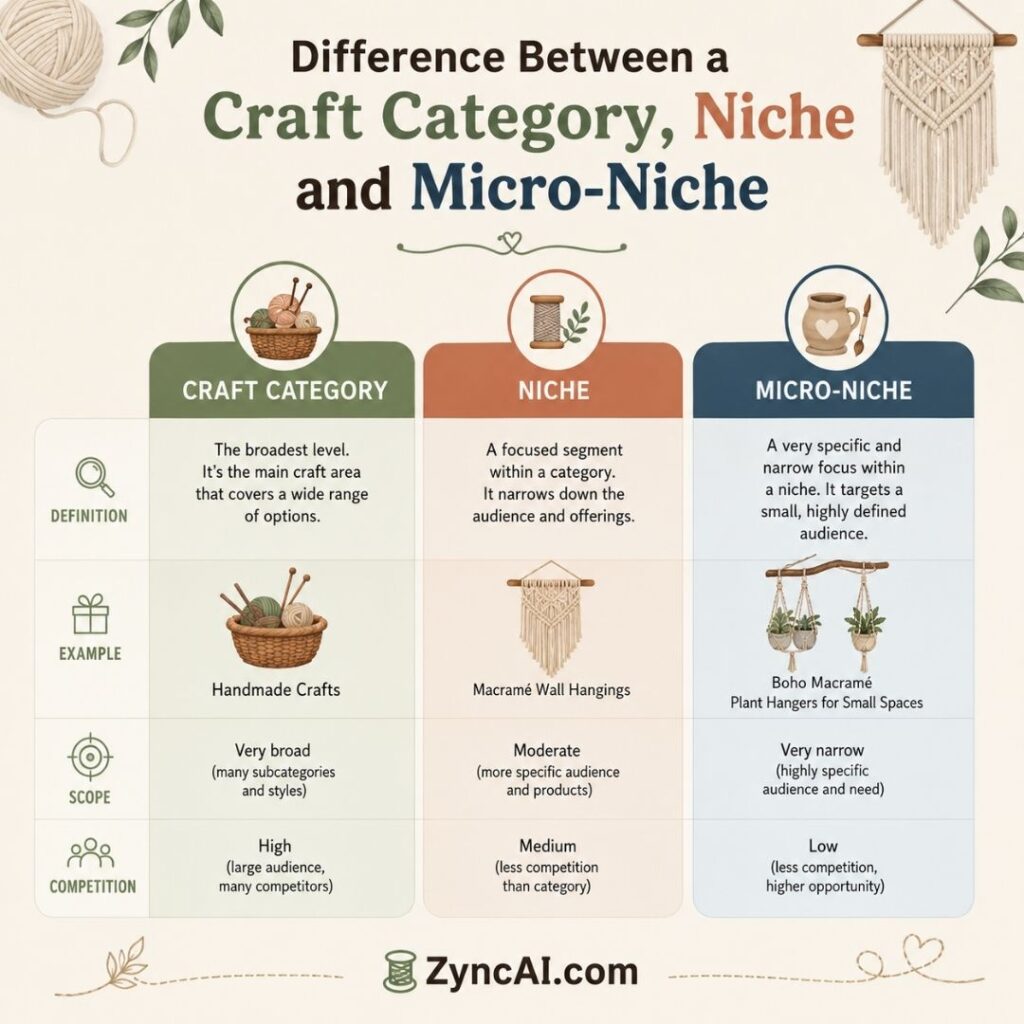
You do not necessarily need to invent an entirely new type of craft. You can take an existing product category and identify a more specific audience, occasion, aesthetic, problem, or use case.
Why AI Is Useful for Craft Niche Research
Traditional niche research can involve hours of manually searching marketplaces, reading reviews, checking competitors, researching keywords, and documenting ideas.
AI can dramatically accelerate the process.
For example, you can give an AI model your craft skills and constraints and ask it to generate potential markets.
Then you can ask it to do following for you,
- Break those markets into subcategories
- Identify specific audiences
- Find customer problems
- Generate micro niches
- Identify product opportunities
- Analyze competitor weaknesses
- Extract themes from customer reviews
- Generate long-tail keywords
- Compare niches
- Create an opportunity scoring system
The real advantage is not simply that AI generates ideas quickly.
The advantage is that you can iterate on your research much faster.
You can take one idea and repeatedly ask:
“Make this more specific.”
Then:
“Now identify underserved customers.”
Then:
“What problems does this customer have?”
Then:
“What products could solve those problems?”
Then:
“What existing products are likely to compete with these?”
This creates a much deeper research process than simply asking an AI chatbot for “50 profitable craft ideas.”
Start With Your Own Craft Skills and Constraints
One mistake most crafters do is that they frequently see with AI assisted idea generation is starting with an unrestricted prompt.
If you ask,
“Give me profitable craft business ideas.”
AI can produce an impressive list.
But impressive is not necessarily useful.
Some suggestions may require equipment you do not have, materials you ca not source easily, skills you do not possess, or production processes that are not practical for a one person business.
Start by defining your constraints.
Consider,
- What craft skills do you already have?
- What materials do you have access to?
- What equipment do you own?
- How much can you invest?
- How many hours can you produce each week?
- Can you customize products?
- Do you want to sell locally or internationally?
- What product sizes can you realistically ship?
- What selling price are you targeting?
The more context AI has, the more useful its suggestions become.
Example AI Prompt
You can start with a prompt like this:
I create handmade products using [CRAFT TYPE]. My current skills include [SKILLS]. I have access to [MATERIALS/EQUIPMENT]. My approximate startup budget is [BUDGET], and I can spend around [HOURS] hours per week producing products. I want to sell products online and target a selling price of approximately [PRICE RANGE].
Based on these constraints, identify 10–20 craft markets where I could potentially build a specialized niche. For each market, explain the target customer, potential customer need, product possibilities, differentiation opportunities, likely production challenges, and why the market may or may not be attractive for a small handmade business.
Do not simply list popular crafts. Focus on specific customer problems, underserved audiences, and opportunities where a small seller could realistically differentiate.
Notice the difference.
You are not asking AI to guess what will become popular.
You’re asking it to think within your actual business constraints.
Use AI to Turn Broad Craft Categories Into Micro Niches
Once you identified broad markets, start narrowing them.
Suppose you make crochet products.
“Crochet” is far too broad to be a useful niche by itself.
You could investigate:
- Crochet home décor
- Crochet baby products
- Crochet gifts
- Crochet accessories
- Crochet pet products
- Crochet wedding products
- Crochet hobby accessories
Then narrow further.
For example:
Crochet → Baby products → Nursery décor → Personalized nursery décor
Now you have a much more specific market to investigate.
You can go even further:
Crochet → Baby products → Nursery décor → Personalized nursery décor → Specific theme or customer segment
This is where AI is particularly effective.
Ask AI to Narrow a Craft Category
Try:
Take [CRAFT CATEGORY] and progressively break it into subcategories, niches, and micro-niches. For each level, identify the target customer, buying motivation, potential products, competition considerations, personalization opportunities, and possible customer problems. Focus on niches that are specific enough for a small handmade business to differentiate without becoming so narrow that there is insufficient demand.
The objective is not to accept every suggestion.
The objective is to build a market map that shows you where potential opportunities exist.
Look for Underserved Customers Instead of Just Popular Products
This is one of the most powerful changes you can make to your research approach.
Most beginners start with the product.
For example,
“What handmade products should I sell?”
A more sophisticated approach starts with the customer.
Ask,
“Who has a specific need that existing craft sellers aren’t serving particularly well?”
This can uncover opportunities that aren’t obvious from looking at bestseller lists.
Potential customer groups include,
- Specific professions
- Specific hobbies
- Pet owners
- Parents
- Travelers
- Gardeners
- Readers
- Gamers
- Photographers
- Bakers
- Teachers
- Small business owners
- Collectors
- Home-office users
The important part isn’t the demographic itself.
It’s the specific need associated with that audience.
For example, “gardeners” is still a large audience.
But “people who grow plants in small apartments” represents a more specific problem space.
That can lead to products related to:
- Organization
- Storage
- Plant labeling
- Décor
- Gifts
- Tools
- Displays
Now you are researching a customer problem rather than randomly inventing products.
Use AI to Discover Customer Problems
A profitable niche often begins with a problem.
Ask AI to analyze a particular audience and identify,
- Frustrations
- Inconveniences
- Existing solutions
- Complaints about existing products
- Desired features
- Products customers struggle to find
- Personalization needs
- Reasons customers might pay a premium
For example:
Analyze the needs and frustrations of [TARGET CUSTOMER] when purchasing handmade products related to [CATEGORY]. Identify recurring problems with existing products, features customers may want but struggle to find, customization opportunities, price-related frustrations, aesthetic preferences, and situations where existing products don’t adequately meet their needs. Turn the strongest problems into potential craft product opportunities.
This changes the question from:
“What should I make?”
to:
“What problem could I solve with something I can make?”
That’s a much stronger foundation for niche research.
Use Customer Reviews as a Source of Niche Ideas
Customer reviews are extremely valuable because customers tell you what competitors don’t.
A five star review can reveal what customers value.
A one star review can reveal what the market is missing.
Look for repeated comments about:
- Poor quality
- Incorrect sizing
- Limited customization
- Generic designs
- Poor packaging
- Fragility
- Lack of options
- Difficult installation
- Slow delivery
- Poor instructions
- Missing features
- Color limitations
- Lack of personalization
Imagine you find dozens of reviews complaining that similar products are beautiful but aren’t available in enough size options.
That’s potentially more interesting than simply discovering that the product sells well.
Why?
Because you’ve found evidence of demand plus dissatisfaction.
That combination can represent an opportunity.
How to Use AI for Review Mining
Collect a useful sample of customer reviews from relevant products and give them to AI.
Then ask:
Analyze these customer reviews and identify recurring themes. Separate the findings into positive feedback, negative feedback, feature requests, quality complaints, customization requests, purchasing motivations, and unmet needs. Identify problems that appear repeatedly and explain which problems could potentially be addressed by a new handmade product or an improved version of an existing product.
AI is particularly good at categorizing large amounts of text.
Instead of manually reading hundreds of reviews and trying to remember patterns, you can have AI structure the information.
You should still inspect the original reviews yourself, especially before making important business decisions.
Use AI to Find Product Gaps
A product gap doesn’t necessarily mean that a product doesn’t exist.
There are several types of gaps.
Missing Product Gap
Customers want something they can’t easily find.
Feature Gap
Existing products don’t offer an important feature.
Customization Gap
Customers want personalization that competitors don’t provide.
Design Gap
Products work but don’t appeal to a particular aesthetic.
Audience Gap
Products exist, but nobody has designed them specifically for a certain customer group.
Price Gap
Existing products are concentrated at either very low or very high price points.
Quality Gap
Customers repeatedly complain about quality.
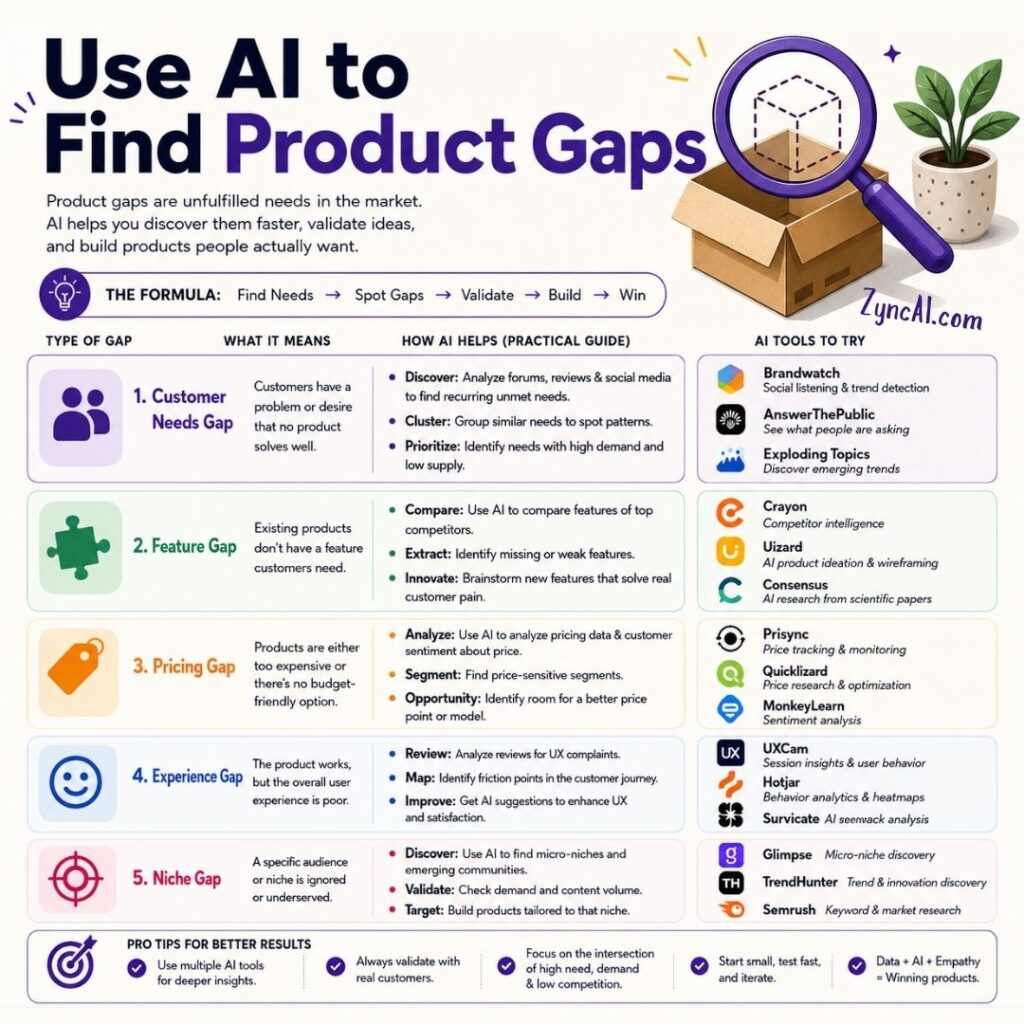
These gaps can create much stronger opportunities than simply searching for “products with no competition.”
Analyze Competition With AI
Once you find an interesting niche, investigate the competitive landscape.
You want to know more than the number of competing products.
Look at,
- Product similarity
- Pricing
- Reviews
- Customization
- Product quality
- Photography
- Branding
- Product descriptions
- Product variations
- Customer complaints
- Market positioning
Most importantly, evaluate the quality of the competition.
Imagine two niches.
Niche A
500 competitors with excellent products, strong branding, thousands of reviews, professional photography, and aggressive pricing.
Niche B
50 competitors with average products, limited customization, generic photography, and repeated customer complaints.
Niche B might actually be more attractive.
This is why simply counting competitors can produce misleading conclusions.
Ask AI to Analyze Competitor Weaknesses
A useful prompt is:
Analyze the following competitor product information. Identify common strengths, weaknesses, pricing patterns, product features, customization options, customer complaints, positioning strategies, and potential opportunities for differentiation. Do not assume that fewer competitors automatically means a better niche. Identify whether there appears to be meaningful demand and explain what a new seller could potentially do differently.
This encourages AI to think in terms of competitive positioning, rather than simply labeling a niche “low competition.”
Use AI to Evaluate Demand
After finding a niche with relatively manageable competition, the next question is:
Do enough people actually want it?
Look for real-world demand signals such as:
- Marketplace listings
- Customer reviews
- Search interest
- Search suggestions
- Pinterest activity
- Social media discussions
- Product engagement
- Repeated customer questions
- Product requests
- Existing successful sellers
AI can help organize and interpret these signals, but be careful with numbers.
If an AI model tells you:
“This niche has 20,000 monthly searches.”
don’t automatically treat that as verified data.
Unless the figure comes from a reliable, current data source, consider it a hypothesis rather than a fact.
This distinction is critical when using AI for market research.
Use Search Intent to Judge a Craft Niche
Not every search represents a potential customer.
Consider the difference between:
“How to make a crochet flower”
and
“Buy handmade crochet flower bouquet”
The first indicates informational intent.
The second is much closer to transactional intent.
When researching a niche, look for a mixture of:
- Informational searches
- Inspirational searches
- Commercial searches
- Transactional searches
A strong niche may have people searching for both information and products.
The combination can also create opportunities for content marketing.
Use AI to Find Long Tail Craft Keywords
Keyword research isn’t only useful for SEO.
It can also help you discover how customers describe what they want.
Start with a broad phrase:
handmade gifts
Then expand it,
- handmade gifts for gardeners
- handmade gifts for book lovers
- personalized handmade gifts for gardeners
- handmade gardening gifts
- custom gifts for plant lovers
The longer phrase tells you more about the customer.
This is why long-tail keyword research can be useful for niche discovery.
AI Keyword Prompt
Starting with the keyword [KEYWORD], generate highly specific long-tail keyword opportunities related to handmade and craft products. Group them into product searches, audience searches, occasion searches, problem-based searches, personalization searches, style searches, and buyer-intent searches. Prioritize phrases that reveal a specific customer need or purchasing intention. Do not invent search-volume statistics.
The final instruction is important.
Ask AI to generate keyword ideas—not to fabricate search data.
Use AI to Identify Emerging Craft Trends
Trends can create excellent opportunities, but timing matters.
If you enter after a trend has become completely saturated, you’ll be competing against many established sellers.
If you enter too early, there may not be enough demand.
A useful target is the period where you see evidence that an interest is growing but hasn’t become completely mainstream.
Ask AI to research trends around:
- Colors
- Aesthetics
- Design styles
- Hobbies
- Home décor
- Gift preferences
- Seasonal themes
- Cultural influences
- Consumer interests
Then classify opportunities as:
- Emerging
- Growing
- Established
- Saturated
- Declining
Do not treat AI’s classification as definitive. Use it to determine which trends deserve further investigation.
Combine Trends With Existing Craft Skills
A trend becomes more useful when you combine it with your existing capability.
For example,
Trend + Craft + Customer + Product
could become:
Emerging aesthetic + crochet + home décor buyers + decorative product
This is more actionable than simply knowing that an aesthetic is trending.
The question is:
How can your craft skills serve the emerging demand?
Use AI to Evaluate Profitability
A niche can have strong demand and low competition and still be a terrible business.
Why?
Because the economics may not work.
Suppose a handmade item sells for $30.
Your actual costs might include:
- Materials: $7
- Labor: $6
- Packaging: $2
- Shipping contribution: $4
- Marketplace/payment fees: $4
Your remaining amount isn’t simply $30 − $7.
Your real economics need to account for all relevant costs.
A basic calculation is:
Profit = Selling Price − Total Costs
And:
Profit Margin = Profit ÷ Selling Price × 100
AI can help you model different scenarios.
For example,
Analyze the profitability of this handmade product. Selling price: $35. Materials: $8. Labor: 25 minutes at an estimated labor rate of $18 per hour. Packaging: $2. Shipping contribution: $5. Platform and payment fees: 10% of selling price. Calculate total cost, estimated profit, profit margin, and the selling price required to achieve a 40% margin.
This is far more useful than asking AI,
“Is this product profitable?”
Give it numbers.
Consider Perceived Value, Not Just Material Cost
One of the interesting characteristics of handmade products is that the selling price isn’t determined solely by material cost.
Customers may pay more for:
- Personalization
- Beautiful design
- Emotional significance
- Gift suitability
- Uniqueness
- Quality
- Convenience
- Specialized relevance
A product costing $5 to produce doesn’t automatically have a $10 value.
Likewise, a product costing $10 to produce might support a much higher price if customers perceive it as special, personalized, or difficult to find elsewhere.
This is why niche positioning matters.
Look for Craft Niches With Differentiation Potential
A low competition niche is more attractive when you have a clear way to differentiate.
Potential differentiation strategies include:
- Personalization
- Unique designs
- Specific aesthetics
- Better materials
- Better packaging
- Custom sizing
- Audience-specific products
- Occasion-specific products
- Bundles
- Premium presentation
- Better functionality
Ask yourself:
“If five more sellers entered this niche tomorrow, what would make customers choose me?”
If you don’t have a convincing answer, the niche may not be strong enough.
Use AI to Discover Personalization Opportunities
Personalization is particularly interesting in handmade products because it can increase perceived value while making products harder to compare purely on price.
Potential personalization includes:
- Names
- Initials
- Dates
- Colors
- Sizes
- Locations
- Quotes
- Photos
- Profession-specific details
- Hobby-specific details
Ask AI,
For the niche [NICHE], identify 20 practical personalization opportunities that could increase perceived value without making production unreasonably complex. Rank them by customer appeal, production difficulty, potential price premium, and differentiation potential.
This can reveal ways to turn a generic product into a more specialized offering.
Use AI to Find Product Opportunities Within a Niche
Once you have a promising niche, do not immediately create one product and stop.
Ask AI to map the entire product ecosystem.
For example,
Core product
→ Accessories
→ Matching products
→ Gift version
→ Premium version
→ Personalized version
→ Bundle
→ Seasonal variation
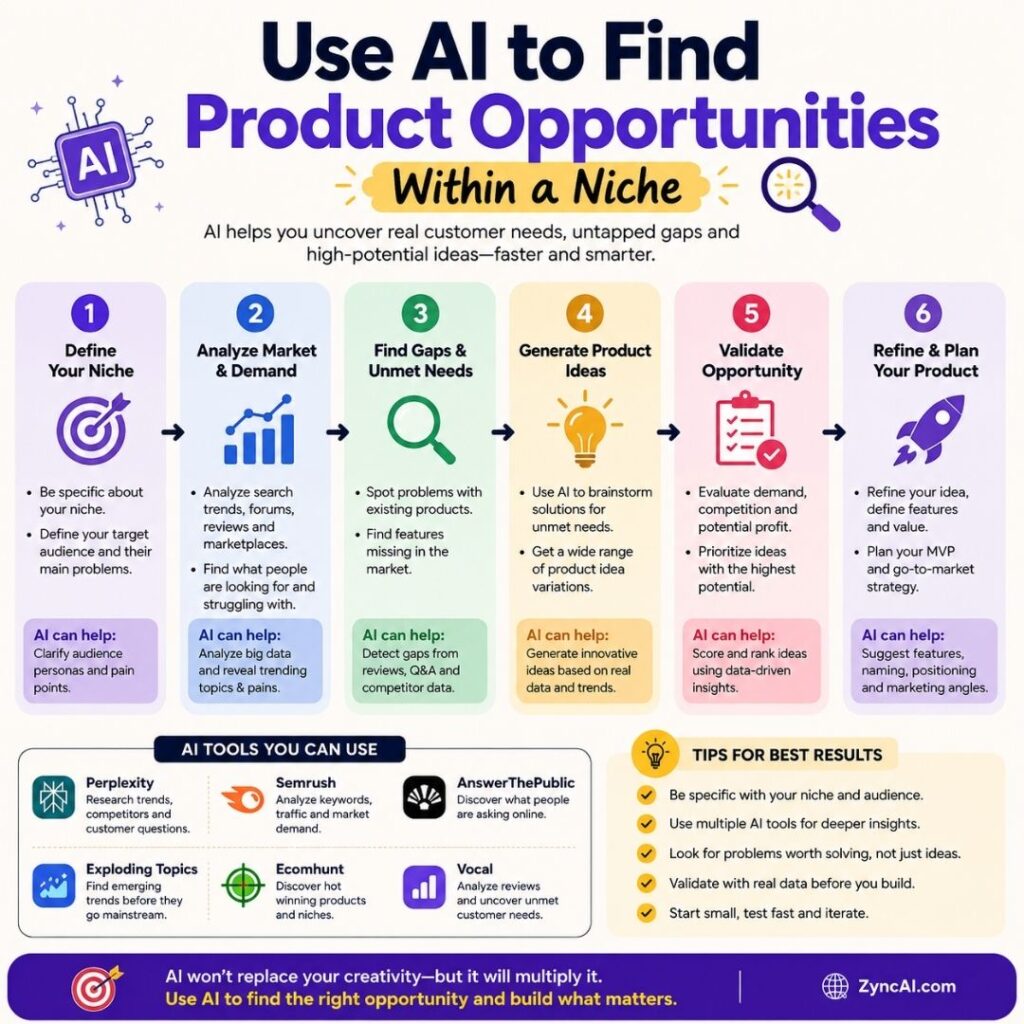
This is valuable because a strong niche should ideally provide room for a product family.
You don’t want to build an entire business around one product that has nowhere else to go.
Use AI to Score and Compare Your Niche Ideas
After research, you’ll probably have several candidates.
This is where structured scoring becomes useful.
Score each niche from 1 to 10 across factors such as,
| Factor | Score |
|---|---|
| Demand | /10 |
| Competition | /10 |
| Profit potential | /10 |
| Differentiation | /10 |
| Trend potential | /10 |
| Customer buying intent | /10 |
| Product expansion potential | /10 |
| Production difficulty | /10 |
Remember that competition and production difficulty work differently from the other factors.
- Higher demand is generally positive.
- Higher competition is generally negative.
- Higher production difficulty is generally negative.
You can create a simple opportunity score such as:
Opportunity Score = Demand + Profit Potential + Differentiation + Trend Potential + Buying Intent + Product Expansion − Competition − Production Difficulty
The score isn’t a prediction.
It’s a tool for forcing yourself to evaluate opportunities consistently.
Compare 10 to 20 Niches Instead of Falling in Love With One Idea
This is another practical AI workflow.
Don’t ask AI:
“What is the best craft niche?”
Instead, generate 20 possibilities.
Then ask AI to compare them using the same criteria.
For example:
| Niche | Demand | Competition | Profit | Differentiation | Difficulty |
|---|---|---|---|---|---|
| Niche A | 8 | 7 | 8 | 6 | 5 |
| Niche B | 7 | 4 | 8 | 9 | 4 |
| Niche C | 9 | 9 | 7 | 5 | 6 |
The numbers aren’t the answer.
The comparison process is the answer.
It forces you to consider trade offs rather than choosing an idea because it sounds exciting.
The Complete AI Prompt for Craft Niche Research
You can combine the entire process into a single master prompt.
I want to identify profitable craft niches with manageable competition.
My craft skills are: [CRAFT SKILLS].
My available materials and equipment are: [MATERIALS/EQUIPMENT].
My startup budget is: [BUDGET].
I can produce approximately [NUMBER] products per week.
My target selling price is: [PRICE RANGE].
My target customers are: [CUSTOMER TYPE, IF KNOWN].
Analyze potential craft markets and progressively narrow them into specific niches and micro-niches.
For each potential niche, identify:
- Target customer
- Customer problem or buying motivation
- Potential products
- Evidence of potential demand to investigate
- Competition characteristics
- Possible competitor weaknesses
- Product gaps
- Personalization opportunities
- Differentiation opportunities
- Potential selling-price range
- Major production considerations
- Shipping considerations
- Profitability considerations
- Relevant long-tail keywords
- Trend potential
- Opportunities to expand into related products
- Major risks
Score each niche from 1–10 for demand, competition, profitability, differentiation, trend potential, buying intent, product expansion potential, and production difficulty.
Rank the opportunities based on the overall evidence and explain the reasoning behind the ranking.
Do not invent search volume, sales figures, market-size statistics, or competitor revenue. Clearly distinguish between assumptions, hypotheses, and information that needs to be validated with real-world data.
Finally, recommend the top five niches that deserve further validation and provide a specific validation plan for each.
This type of prompt is substantially more useful than asking AI for a generic list of “profitable crafts.”
Example: Using AI to Narrow a Craft Niche
Let’s walk through a simplified example.
Suppose your craft is woodworking.
You ask AI to identify potential markets.
It might produce:
- Home décor
- Home office
- Gardening
- Pet products
- Gifts
- Hobbies
- Organization
Instead of immediately choosing one, narrow each category.
For example:
Woodworking
→ Gardening
→ Small-space gardening
→ Apartment gardeners
→ Products for organizing small gardening spaces
Now you’ve identified a much more specific customer and problem.
Next, research,
- What products already exist?
- What do customers complain about?
- What price points exist?
- How competitive is the marketplace?
- Are customers searching for these products?
- What products are missing?
- Can the products be produced efficiently?
- Can they be shipped economically?
- Can you create something meaningfully different?
The important insight is that AI didn’t discover a guaranteed winning product.
It helped you move from a huge market to a specific hypothesis that can be tested.
That is the right way to use AI.
Validate the Niche Before Investing Heavily
This is where AI-generated research meets reality.
Before purchasing large amounts of materials or building a large inventory, validate the opportunity.
Validate Demand
Look at:
- Marketplace activity
- Search behavior
- Customer discussions
- Reviews
- Social media activity
- Pinterest interest
- Existing product engagement
Validate Competition
Look at:
- Number of serious competitors
- Product quality
- Pricing
- Reviews
- Customer satisfaction
- Differentiation
Validate Profitability
Calculate actual:
- Material costs
- Labor
- Packaging
- Shipping
- Platform fees
- Advertising costs where relevant
Validate the Product
Create a small batch.
You don’t need to manufacture 100 units to learn whether customers like an idea.
A small product test can reveal:
- Whether people click
- Whether they ask questions
- Whether they save the product
- Whether they add it to carts
- Whether they purchase
- What objections they have
- What they want changed
Actual customer behavior is much more valuable than an AI’s confidence score.
Do Not Confuse Interest With Buying Intent
This is an important distinction in craft businesses.
A product might receive:
- Thousands of views
- Hundreds of likes
- Many Pinterest saves
and still generate very few sales.
Why?
Because attention and purchasing intent are different things.
When evaluating a niche, look for signals that people are willing to take a commercial action.
Examples include:
- Product searches
- Marketplace purchases
- Add-to-cart behavior
- Product reviews
- Price comparisons
- Questions about availability
- Customization inquiries
Your objective isn’t to find something people think is interesting.
It’s to find something people are willing to buy.
Watch Out for AI Hallucinations
AI can sound extremely confident even when the underlying information isn’t reliable.
Be especially careful with claims about:
- Exact search volumes
- Market sizes
- Competitor revenue
- Sales estimates
- Future trends
- Profit margins
- Customer demographics
- Marketplace rankings
If AI says:
“This niche is growing 47% year over year.”
your next question should be:
“What is the source?”
If there isn’t a reliable source, treat the claim as unverified.
This doesn’t make AI less useful.
It simply means you should use it correctly.
Think of AI as a hypothesis generator, research assistant, analyst, and thinking partner—not a guaranteed source of market truth.
Common Mistakes When Using AI to Find Craft Niches
Asking Generic Questions
“Give me profitable craft ideas” produces generic results.
Give AI context and constraints instead.
Choosing the Most Unique Idea
Uniqueness isn’t enough.
A niche needs customers.
Assuming Low Competition Means High Opportunity
Low competition can also indicate low demand.
Trusting AI-Generated Statistics
Always verify important market numbers independently.
Ignoring Customer Reviews
Reviews often contain better product insights than competitor descriptions.
Ignoring Your Production Economics
A product can sell well and still produce poor profits.
Targeting Everyone
A highly specific audience can make positioning and marketing easier.
Entering Trends Too Late
By the time everyone is selling the same trend, differentiation becomes harder.
Generating Too Many Ideas Without Testing
Twenty ideas are useless if you never test one.
A Better AI-Powered Craft Niche Research Workflow
You can turn everything discussed above into a repeatable system.
Step 1: Define your skills
Identify what you can realistically make.
↓
Step 2: Define your constraints
Budget, production capacity, materials, pricing and shipping.
↓
Step 3: Generate broad markets
Use AI to identify potential customer markets.
↓
Step 4: Narrow into micro-niches
Combine craft + customer + problem + occasion + style.
↓
Step 5: Identify customer problems
Find frustrations and unmet needs.
↓
Step 6: Analyze product gaps
Look for missing features, poor designs and underserved audiences.
↓
Step 7: Analyze competitors
Study pricing, products, reviews and weaknesses.
↓
Step 8: Investigate demand
Validate search, marketplace and community signals.
↓
Step 9: Research keywords
Identify long-tail and buyer-intent searches.
↓
Step 10: Evaluate profitability
Calculate the real economics.
↓
Step 11: Score the opportunities
Compare niches using consistent criteria.
↓
Step 12: Validate the top candidates
Test actual products with real customers.
This workflow is significantly more reliable than simply asking AI for a list of trending crafts.
How to Know When You’ve Found a Promising Craft Niche
Before committing to a niche, ask yourself:
- Do I know exactly who the customer is?
- Do I understand why they would buy?
- Is there evidence that customers want this type of product?
- Is there existing competition?
- Can I identify weaknesses in that competition?
- Can I make something meaningfully different?
- Can customers afford my target price?
- Can I produce the product efficiently?
- Have I included labor in my costs?
- Can I ship the product economically?
- Can I create multiple products for the same audience?
- Is the demand likely to be more than a temporary spike?
- Can I test the idea without a large upfront investment?
If you can answer most of these questions confidently, you have moved well beyond simply finding a “craft idea.”
You’ve started identifying a business opportunity.
Final Thoughts: Use AI to Discover Opportunities, Not Guarantees
AI has changed how quickly a craft maker can perform market research.
What once required hours of brainstorming, competitor research, review analysis, keyword exploration, and spreadsheet work can now be accelerated dramatically.
But the biggest mistake is treating AI as an oracle.
The strongest approach is to use AI throughout the research process:
AI generates possibilities.
AI organizes information.
AI identifies patterns.
AI challenges assumptions.
AI helps compare opportunities.
Real-world data validates them.
The goal isn’t to find a craft niche with absolutely no competition.
The goal is to find a niche where real customers have a meaningful reason to buy, existing competition leaves room for improvement, and the economics allow you to make a worthwhile profit.
When you combine AI-assisted research with customer reviews, marketplace research, keyword data, competitor analysis, and small-scale product testing, you can make much more informed decisions about where to invest your creative time and money.
And perhaps the biggest advantage is that this doesn’t have to be a one-time exercise.
Customer preferences change. New aesthetics emerge. New communities grow. Competitors enter markets. Products become outdated.
With an AI-assisted research workflow, you can continuously look for the next underserved customer, the next product gap, and the next opportunity before the market becomes crowded.
FAQs
Q1. How can AI help me find profitable craft niches?
A1. AI can help you generate niche ideas, narrow broad craft categories into micro-niches, identify target customers, analyze customer problems, study competitors, uncover product gaps, research keywords, and compare potential opportunities. Its greatest value is accelerating research and helping you see patterns that might otherwise take much longer to identify.
Q2. What is a craft niche?
A2. A craft niche is a specific segment of the broader craft market focused on a particular customer, product, problem, style, occasion, or combination of these factors. For example, “handmade jewelry” is a broad category, while “personalized minimalist jewelry for wedding gifts” is a more specific niche.
Q3. What is a craft micro-niche?
A3. A micro-niche is a highly specific segment within a craft niche. It usually combines a particular product with a specific audience, need, occasion, or aesthetic. Micro-niches can make it easier for small craft businesses to differentiate themselves from larger competitors.
Q4. Is low competition enough to make a craft niche profitable?
A4. No. Low competition is only one factor. A niche with almost no competition may have very little demand. A better opportunity usually combines evidence of customer demand, manageable competition, reasonable pricing, healthy margins, and a clear way to differentiate.
Q5. How do I find low-competition craft niches with AI?
A5. Start by telling AI about your craft skills, materials, budget, production capacity, target customers, and pricing goals. Ask it to generate broad markets and progressively narrow them into niches and micro-niches. Then research demand, competition, customer reviews, product gaps, keywords, and profitability before selecting a niche to test.
Q6. Can AI guarantee that a craft niche will be profitable?
A6. No. AI cannot guarantee sales or profitability. It can help identify promising opportunities and organize research, but actual results depend on customer demand, competition, pricing, costs, marketing, product quality, and execution.
Q7. What information should I give AI before asking for craft niche ideas?
A7. Provide your craft skills, materials, equipment, budget, production capacity, target selling price, preferred customer type, customization capabilities, and shipping limitations. Giving AI specific constraints helps prevent it from recommending ideas that sound attractive but are impractical for your situation.
Q8. What is a good AI prompt for finding craft niches?
A8. A good prompt should explain your skills and constraints and ask AI to generate potential markets, narrow them into micro-niches, identify customers and problems, analyze competition, find product gaps, evaluate profitability, identify differentiation opportunities, and suggest ways to validate the best ideas.
Q9. Should I ask AI for popular craft ideas?
A9. You can, but popularity alone isn’t a strong niche-selection criterion. Popular craft categories can be extremely competitive. A better approach is to ask AI to identify growing demand, underserved customers, specific problems, and areas where existing products have weaknesses.
Q10. How can AI help me find underserved craft customers?
A10. AI can help segment potential customers according to their hobbies, professions, lifestyles, interests, occasions, and specific needs. You can then investigate which groups have strong purchasing motivations but relatively few specialized products available to them.
Q11. How can AI help identify craft product gaps?
A11. Give AI information about existing products, competitor listings, and customer feedback. Ask it to identify missing features, recurring complaints, limited customization, design weaknesses, pricing gaps, and underserved audiences. These findings can become potential product opportunities.
Q12. How can customer reviews help me find profitable craft niches?
A12. Reviews provide direct insight into what customers value and dislike about existing products. Repeated complaints about quality, sizing, customization, design, functionality, or availability can reveal opportunities for creating a better or more specialized product.
Q13. Can AI analyze customer reviews for craft products?
A13. Yes. If you provide relevant review text, AI can categorize reviews into themes such as positive feedback, complaints, feature requests, purchasing motivations, and unmet needs. You should still examine the original reviews to verify important conclusions.
Q14. How can AI help analyze craft competitors?
A14. AI can organize information about competitor products, pricing, reviews, customization options, product positioning, descriptions, and customer complaints. It can then identify common strengths, weaknesses, and potential areas where a new seller could differentiate.
Q15. Should I avoid a craft niche if it already has competitors?
A15. No. Competition can actually indicate that customers are buying products in that market. The important question is whether you can offer something meaningfully different through design, quality, personalization, functionality, branding, pricing, or customer experience.
Q16. How many competitors are too many for a craft niche?
A16. There is no universal number. The strength of competitors is generally more important than simply counting them. A niche with many weak sellers may be easier to enter than one with only a few highly established brands and exceptionally strong products.
Q17. How can AI help me evaluate demand for a craft niche?
A17. AI can help identify demand signals such as marketplace activity, customer discussions, search terms, reviews, social media conversations, and product engagement. These signals should then be verified using current and reliable external data.
Q18. Can I trust AI-generated search-volume numbers?
A18. You should be cautious. Unless the AI has access to a reliable, current keyword-data source, search-volume figures may be inaccurate or outdated. Use AI to discover keyword ideas, then verify important metrics with dedicated research tools.
Q19. How can AI help with craft keyword research?
A19. AI can generate long-tail keywords, buyer-intent phrases, product searches, audience-specific terms, occasion-based keywords, problem-based searches, and personalization phrases. These keywords can also reveal how customers describe their needs.
Q20. Why are long-tail keywords useful for craft niche research?
A20. Long-tail keywords are more specific and often reveal a particular customer, product, problem, or purchasing situation. They can therefore help you discover smaller markets with clearer customer intent and potentially more manageable competition.
Q21. How can AI help identify emerging craft trends?
A21. AI can help analyze information about emerging aesthetics, design styles, customer interests, hobbies, themes, and product categories. It can organize these signals and suggest trends worth investigating, although you should independently verify whether interest is genuinely increasing.
Q22. How can I tell whether a craft trend is worth pursuing?
A22. Look for evidence that interest is growing rather than relying on a single viral moment. Consider search behavior, marketplace activity, customer discussions, social engagement, product launches, and whether the trend can be translated into products that people are willing to buy.
Q23. Is an evergreen craft niche better than a trending niche?
A23. Neither is automatically better. Evergreen niches can provide more consistent demand, while emerging trends can offer opportunities for growth. A balanced strategy can combine dependable evergreen products with carefully selected trend-based products.
Q24. How can AI help me find profitable handmade products?
A24. AI can compare potential products based on selling price, material requirements, production time, customization, shipping considerations, customer demand, competition, and differentiation. Actual material, labor, shipping, and platform costs should still be calculated separately.
Q25. How do I calculate the profitability of a handmade product?
A25. Subtract all relevant costs from the selling price. Include materials, labor, packaging, shipping, marketplace fees, payment processing, advertising, and other applicable expenses. Profit margin can then be calculated by dividing profit by selling price and multiplying by 100.
Q26. Should labor be included when calculating craft product profitability?
A26. Yes. Your time has economic value even if you work alone. Excluding labor can make a product appear profitable when you’re actually earning very little for the time required to produce each item.
Q27. Can AI help me set prices for handmade products?
A27. Yes. Provide AI with your material costs, production time, labor rate, packaging costs, shipping, fees, desired margin, and target market. AI can help model different pricing scenarios, but you should verify the calculations and ensure customers will actually accept the proposed price.
Q28. What makes a craft niche attractive to a small business?
A28. A strong niche generally has an identifiable customer, sufficient demand, manageable competition, viable production costs, reasonable selling prices, healthy margins, and opportunities for differentiation. It is also helpful if the niche allows you to develop several related products.
Q29. How can personalization help me compete in a crowded craft niche?
A29. Personalization makes a product more specific to the buyer and can reduce direct price comparisons. Names, initials, dates, colors, sizes, locations, themes, professions, hobbies, and custom designs can all provide opportunities for differentiation.
Q30. Can AI find craft niches based on hobbies?
A30. Yes. You can ask AI to explore opportunities around hobbies such as gardening, reading, camping, photography, baking, gaming, journaling, sewing, travel, or collecting. Combining a craft with a specific hobby can create a highly targeted customer segment.
Q31. Can AI help find profitable handmade gift niches?
A31. Yes. AI can analyze specific recipients, occasions, interests, personalization options, price ranges, and buying motivations. Combining a particular recipient with an occasion and interest can produce more targeted opportunities than simply targeting “handmade gifts.”
Q32. How can AI help me find seasonal craft niches?
A32. AI can generate opportunities around holidays, weddings, birthdays, baby showers, graduations, housewarmings, and other events. You should also research when customers begin searching and purchasing so that products can be prepared before peak demand.
Q33. Can AI help me find craft niches for Etsy?
A33. Yes. AI can help generate Etsy niche concepts, analyze customer needs, develop keyword ideas, identify product variations, structure competitor research, and analyze reviews. However, current Etsy demand, competition, pricing, and sales indicators should be validated separately.
Q34. How can Pinterest help with craft niche research?
A34. Pinterest can provide useful signals about visual trends, seasonal interests, craft ideas, décor styles, gifts, and customer inspiration. AI can help organize and interpret these signals, but Pinterest engagement should not automatically be treated as proof of purchasing demand.
Q35. Can social media help validate a craft niche?
A35. Yes. Social media can reveal customer conversations, emerging interests, product reactions, recurring questions, and creator trends. However, likes and views don’t necessarily translate into sales, so social signals should be combined with stronger commercial evidence.
Q36. What is the difference between a popular craft and a profitable craft niche?
A36. A popular craft has broad interest, while a profitable craft niche has a specific combination of demand, customer willingness to pay, manageable competition, viable production costs, and differentiation potential. A highly popular craft can be difficult to profit from if competition is extremely strong.
Q37. How can AI help compare different craft niches?
A37. Create a consistent scoring framework covering factors such as demand, competition, profitability, differentiation, trend potential, customer buying intent, production difficulty, and expansion potential. AI can then organize the information and compare multiple niches using the same criteria.
Q38. What factors should I include in a craft niche scoring system?
A38. Useful factors include demand, competition, profit potential, differentiation, customer intent, trend potential, production difficulty, shipping considerations, and the ability to create related products. Score each factor consistently so that different niches can be compared objectively.
Q39. Why should I research customer problems before choosing a craft product?
A39. Customer problems can reveal opportunities that aren’t obvious from bestseller lists. When you understand what customers struggle with, you can design a product around a real need instead of simply creating another version of an already crowded product.
Q40. How can AI help find craft niches based on customer problems?
A40. Give AI information about a particular audience and ask it to identify frustrations, unmet needs, purchasing obstacles, existing solutions, and desired improvements. You can then turn the strongest problems into potential craft product concepts.
Q41. How do I know if an AI-generated craft niche is worth testing?
A41. Look for multiple supporting signals: a clearly identifiable customer, evidence of demand, manageable competition, realistic pricing, viable production economics, and a meaningful differentiation opportunity. The strongest candidates should then be tested with real products.
Q42. Should I launch many products when entering a new craft niche?
A42. Usually, starting with a small selection is safer. Testing a few products lets you learn what customers respond to without committing heavily to inventory. Once you identify products with promising demand, you can expand the product line.
Q43. How can I test a craft niche without spending a lot of money?
A43. Start with a prototype or small batch and test the product through an appropriate sales or marketing channel. Track views, clicks, inquiries, saves, add-to-cart activity, conversions, and customer feedback before making a larger investment.
Q44. What metrics should I track when testing a craft niche?
A44. Useful metrics include product views, clicks, saves, favorites, inquiries, add-to-cart activity, conversion rate, average order value, profit per order, repeat purchases, and returns. Give more weight to metrics that indicate actual buying behavior.
Q45. What are the biggest mistakes when using AI for craft niche research?
A45. Common mistakes include using generic prompts, accepting AI’s first ideas, trusting unsupported statistics, assuming low competition means high demand, ignoring customer reviews, overlooking labor costs, and failing to validate AI-generated ideas with real customers.
Q46. Can AI identify a craft niche that competitors haven’t discovered?
A46. AI can generate less obvious combinations of customers, products, problems, and trends, but it cannot guarantee that an idea is completely undiscovered. You need to search marketplaces, search engines, social platforms, and other relevant sources to determine whether competitors already exist.
Q47. How can I use AI for competitor research without copying competitors?
A47. Use competitor research to understand market patterns, customer complaints, pricing, positioning, and opportunities for improvement. Your goal should be to develop your own product, design, positioning, and brand rather than reproducing another seller’s work.
Q48. How often should I research new craft niches with AI?
A48. Niche research can be an ongoing activity. Periodically reviewing customer feedback, competitors, emerging trends, keywords, and new customer interests can help you identify opportunities before your current market becomes too competitive.
Q49. How should I combine AI with traditional craft market research?
A49. Use AI for brainstorming, categorization, pattern recognition, analysis, comparison, and research planning. Use real-world sources to verify demand, competition, prices, customer feedback, search behavior, and product performance. This combination is much more reliable than depending entirely on AI.
Q50. What is the most important principle when using AI to find profitable craft niches?
A50. Use AI to discover and evaluate possibilities, not to make guaranteed predictions. Start with a specific customer and problem, use AI to identify potential opportunities, validate demand and competition with real-world evidence, calculate actual profitability, and test products with real customers before making a significant investment.