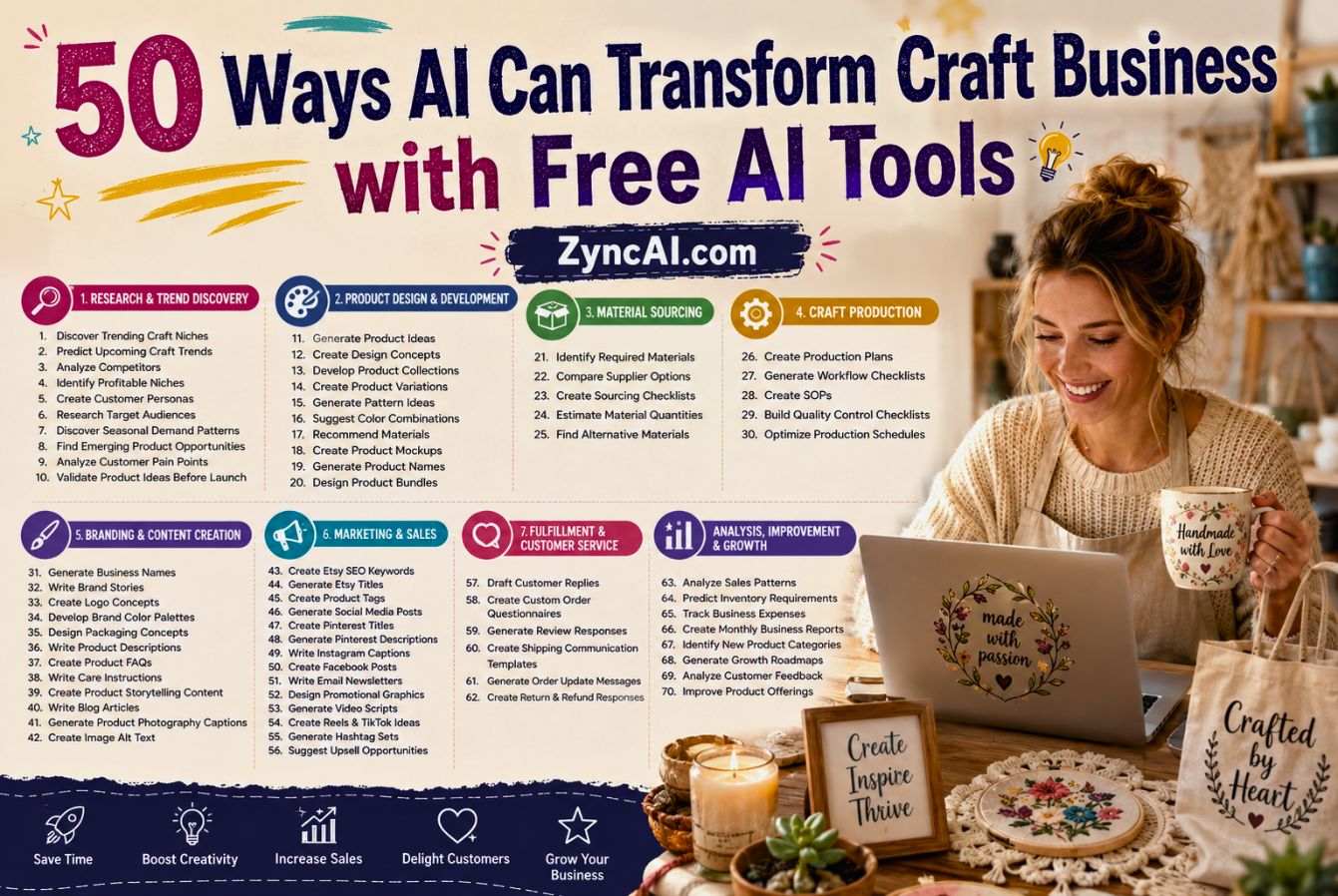
50 Ways AI Can Help Craft Business Owners with Free AI Tools
You are spending hours creating beautiful handmade products like jewelry, candles, crochet items, woodcrafts, home décor, or personalized gifts. Crafting is your passion. But running a craft business involves much more than making products.
Every day, you are balancing multiple responsibilities. Starting from designing new items, creating products, taking photos, writing product descriptions, posting on social media, to answering customer questions, managing inventory, packing orders, and tracking expenses. That’s a lot!
It can feel like there is never enough time to get everything done.
That is where Artificial Intelligence (AI) can help you.
AI can help with the repetitive and time consuming tasks that often take you away from what you love most, which is “creating”.
The best part is that you do not need a big budget or technical expertise to start using AI. Many powerful AI tools are free and can help you save time, improve your marketing, create better content, discover new product ideas, and run your business more efficiently.
In this guide, you will discover,,
• The biggest challenges craft business owners face today
• Why AI is becoming an essential business tool for makers and handmade sellers
• The 8 stages of the craft business value chain
• 50 practical ways AI can help at every stage of your business
• Free AI tools you can start using right away
• What the future of AI looks like for the craft industry
If you are looking for ways to save time, grow your sales, and spend more time creating, this guide is for you.
Let’s get started.
The Challenges Craft Business Owners Face
Running a craft business can be incredibly rewarding. There is nothing quite like seeing someone purchase and appreciate something you have made with your own hands.
But behind every successful craft business is a long list of daily responsibilities that customers rarely see.
You have probably experienced days where you spend more time managing your business than actually creating products.
Let’s look at some of the biggest challenges makers face today.
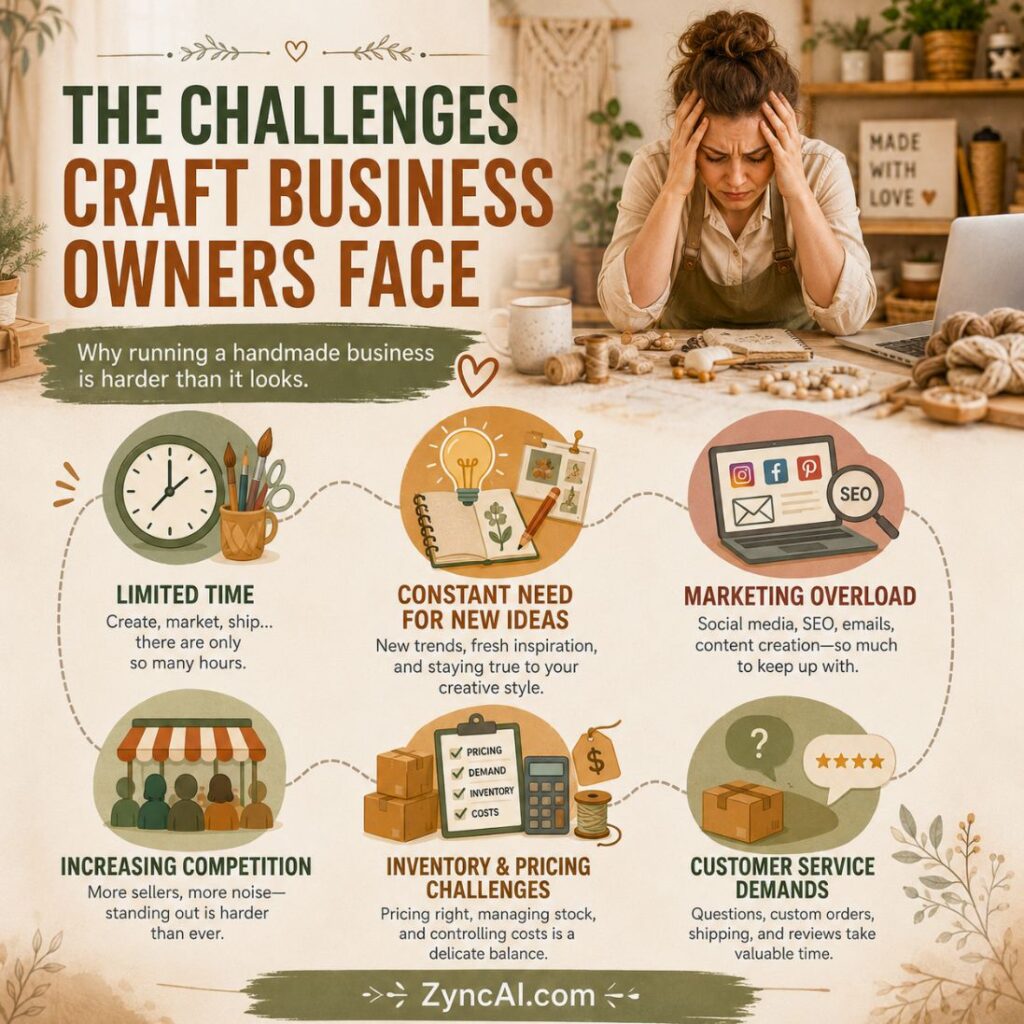
1. Limited Time
Time is one of the most valuable resources for any craft entrepreneur.
Most craft businesses are run by solo makers or very small teams. That means one person is often responsible for almost everything.
A typical day might include:
- Creating products
- Photographing new items
- Writing product descriptions
- Updating Etsy listings
- Posting on social media
- Responding to customer messages
- Packing and shipping orders
- Managing inventory
- Tracking expenses
By the end of the day, there may be little time left for the creative work that inspired you to start your business in the first place.
For example, a handmade candle maker may spend three hours creating products but another four hours answering messages, updating listings, posting on Instagram, and preparing shipments.
As a business grows, this challenge often becomes even bigger.
2. Constant Need for New Ideas
Customers love discovering new products.
What sold well six months ago may not generate the same excitement today. Trends constantly change, especially on platforms like Etsy, Pinterest, Instagram, and TikTok.
This creates ongoing pressure to:
- Develop new product ideas
- Follow emerging trends
- Create seasonal collections
- Design products for holidays and special events
- Stay ahead of competitors
The challenge is finding fresh inspiration without losing your unique style and brand identity.
For example, a crochet business owner may notice growing demand for cottagecore-themed products. At the same time, they need to make sure new designs still reflect their own creative vision rather than simply copying market trends.
Balancing creativity and market demand can be difficult.
3. Marketing Overload
Many craft business owners start their businesses because they love creating products, not because they enjoy marketing.
Unfortunately, even the most beautiful handmade products won’t sell if customers never discover them.
Today’s makers are expected to manage multiple marketing channels, including,,
- Social media marketing
- Search engine optimization (SEO)
- Etsy SEO
- Product descriptions
- Pinterest marketing
- Email marketing
- Blogging
- Video content creation
- Customer engagement
For many business owners, marketing can feel overwhelming.
For example, after spending hours making handmade jewelry, you might still need to write Instagram captions, create Pinterest pins, update product listings, send emails, and respond to comments.
The result is often burnout and inconsistent marketing efforts.
4. Increasing Competition
Selling handmade products has never been easier.
Platforms like Etsy, Shopify, Facebook Marketplace, and Instagram have made it possible for almost anyone to start a craft business from home.
While that is great for entrepreneurs to enter the business, it also means competition is growing rapidly.
Thousands of sellers may be targeting the same audience.
For example, if you sell personalized tumblers or handmade candles, you may be competing against hundreds or even thousands of similar products.
Standing out requires:
- Better product positioning
- Stronger branding
- More effective marketing
- Faster trend identification
- Better customer experiences
Simply creating great products is no longer enough.
Customers have more choices than ever before.
5. Inventory and Pricing Challenges
Many makers struggle to find the right balance between profitability and affordability.
Pricing handmade products can be especially difficult because many business owners underestimate the true cost of production.
It’s easy to account for materials.
It’s much harder to account for:
- Design time
- Product development
- Photography
- Packaging
- Marketing costs
- Shipping supplies
- Platform fees
- Your own labor
As a result, many craft business owners work long hours while earning less profit than expected.
Inventory management creates another challenge.
Producing too much inventory can tie up cash and storage space. Producing too little can lead to missed sales opportunities.
For example, a woodcraft seller preparing for the holiday season must estimate demand months in advance. Ordering too many materials can create waste. Ordering too few can result in stock shortages during peak sales periods.
6. Customer Service Demands
Excellent customer service is one of the biggest reasons customers choose handmade businesses.
People often buy from makers because they value the personal connection.
However, providing that level of service takes time.
Craft business owners frequently handle:
- Product questions
- Custom order requests
- Shipping inquiries
- Order updates
- Returns and exchanges
- Review management
- Post-purchase support
A single custom order may involve several back-and-forth conversations before production even begins.
For example, a seller creating personalized gifts might spend 20 to 30 minutes discussing colors, names, design preferences, and delivery timelines with one customer.
Multiply that across dozens of orders, and customer communication can quickly consume hours every week.
7. Keeping Up With Trends
The craft industry changes constantly.
New colors, materials, aesthetics, and product categories emerge every year.
What is trending on Pinterest today may be replaced by something completely different a few months later.
Many makers struggle to find time for:
- Trend research
- Competitor analysis
- Market monitoring
- Customer preference tracking
Missing a major trend can mean missed sales opportunities.
At the same time, chasing every trend can distract you from building a recognizable brand.
The Reality for Most Craft Business Owners
The biggest challenge is not usually creativity.
Most makers have plenty of creative ideas.
The real challenge is finding enough time to manage everything else that comes with running a business.
You’re expected to be a creator, marketer, photographer, customer support representative, inventory manager, shipping coordinator, accountant, and business strategist, all at the same time.
That is exactly why more craft business owners are turning to AI.
AI can’t replace your creativity, craftsmanship, or personal touch. But it can help automate repetitive tasks, reduce workload, uncover new opportunities, and give you back valuable time to focus on creating products and growing your business.
Why AI Is Important for Craft Business Owners
Many people assume artificial intelligence is only useful for technology companies, software developers, or large corporations with massive budgets.
In reality, AI can be one of the most valuable tools available to craft business owners. Handmade businesses often operate with limited time, small teams, and tight budgets. Whether you sell handmade jewelry, candles, soaps, pottery, woodworking products, crochet items, or personalized gifts, you are likely responsible for much more than just creating products. You also have to manage marketing, customer service, product listings, inventory, shipping, and business planning.
This is where AI can make a significant difference. Rather than replacing creativity, AI helps reduce repetitive work, improve efficiency, and support smarter business decisions. Think of AI as a digital assistant that works alongside you, helping you spend less time on administrative tasks and more time with creating.
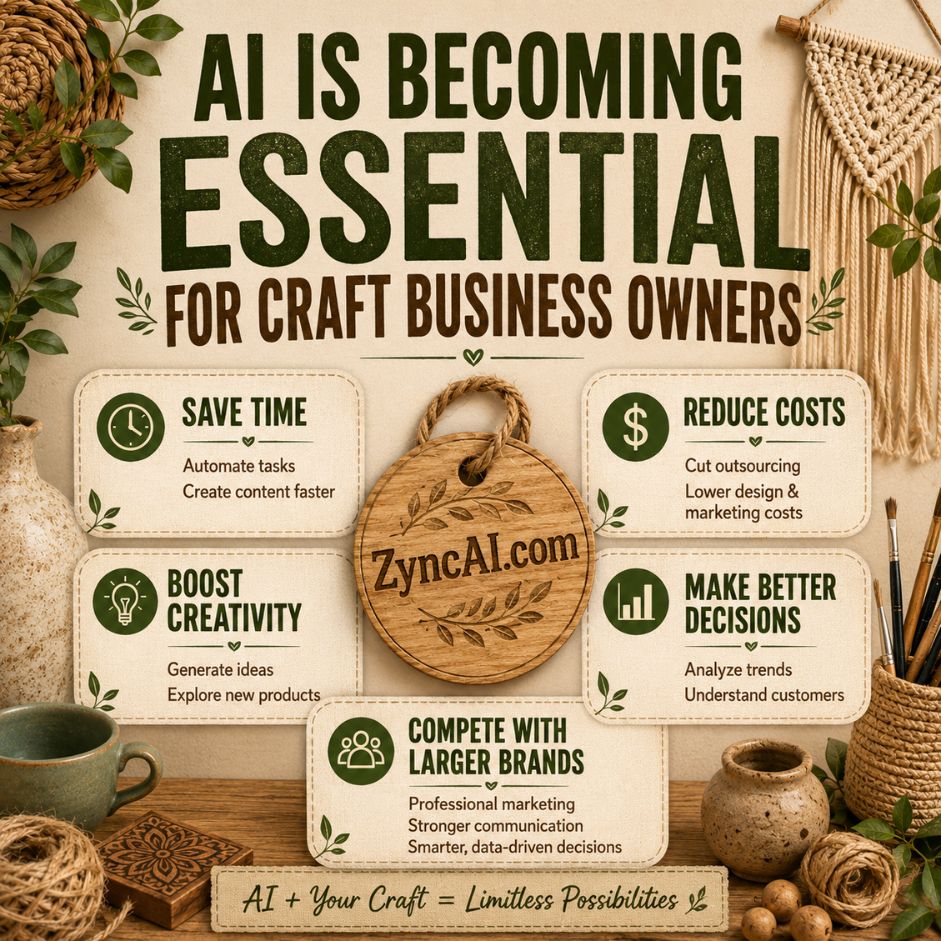
1. AI Saves Time
Time is often the biggest challenge for craft business owners. Most entrepreneurs wear multiple hats and constantly juggle creative work with business responsibilities.
Tasks such as writing product descriptions, creating social media content, responding to customer questions, researching trends, and planning marketing campaigns can easily consume several hours every week. AI can dramatically reduce the time spent on these activities by generating first drafts, organizing ideas, and automating routine tasks.
For example, instead of spending an entire evening writing descriptions for a new collection of handmade candles, AI can generate professional product copy within minutes. The business owner can then edit and personalize the content rather than starting from scratch.
AI can help save time with:
- Product descriptions
- Etsy and Shopify listings
- Social media captions
- Blog content
- Email newsletters
- Customer support responses
- FAQ creation
- Marketing campaigns
- Content calendars
The hours saved each week can be redirected toward product creation, business growth, or simply achieving a better work life balance.
2. AI Improves Creativity
Many craft business owners worry that AI might reduce originality or creativity. In practice, the opposite is often true.
Creative professionals regularly face moments when inspiration runs low. Developing fresh product ideas, seasonal collections, and marketing campaigns can become difficult when you’re deeply involved in day to day operations. AI can act as a brainstorming partner that helps generate new ideas and perspectives.
A jewelry maker looking for new collection ideas might use AI to explore trending themes, color combinations, or gift concepts. A candle maker could generate ideas for seasonal scents and packaging designs. These suggestions become starting points that the creator can refine using their own expertise and artistic vision.
AI can support creativity by helping generate:
- Product ideas
- Collection themes
- Seasonal product concepts
- Color palette inspiration
- Packaging ideas
- Product personalization options
- Marketing campaign concepts
- Gift bundle ideas
- Content topics
The creativity still comes from the maker. AI simply helps expand the possibilities.
3. AI Reduces Costs
Building and growing a craft business often requires investing in multiple areas at once. Professional marketing, content creation, branding, customer support, and market research can quickly become expensive.
AI allows small businesses to accomplish many of these tasks without immediately hiring outside help. While it may not completely replace specialists, it can significantly reduce costs by handling first drafts, research, and routine work.
A new Etsy seller, for example, may not have the budget for a copywriter or marketing agency. AI can help create product descriptions, email campaigns, social media posts, and keyword research while the business is still growing.
Areas where AI can help reduce costs include:
- Product descriptions
- Marketing copy
- Social media content
- Branding ideas
- Customer support templates
- Email marketing
- SEO research
- Content planning
- Market research
This allows craft business owners to stretch limited budgets further and invest more money into materials, equipment, and product development.
4. AI Helps You Compete with Larger Brands
Large brands often have dedicated teams handling marketing, analytics, advertising, customer service, and product development. Independent craft businesses rarely have access to these resources.
AI helps level the playing field by giving small businesses access to tools that were once available only to larger companies. A solo entrepreneur can now create professional marketing content, analyze customer feedback, and identify trends without needing a full team.
This means craft business owners can operate more efficiently while maintaining a professional and consistent brand presence across multiple channels.
AI can help small businesses compete by:
- Automating repetitive tasks
- Creating professional marketing content
- Improving customer communication
- Optimizing product listings
- Identifying trends earlier
- Supporting SEO efforts
- Generating advertising ideas
- Improving customer engagement
The result is a business that appears larger, more organized, and more responsive without requiring additional staff.
5. AI Improves Decision Making
Many business decisions are based on assumptions, personal preferences, or intuition. While experience is valuable, data-driven insights often lead to better outcomes.
AI can analyze large amounts of information much faster than humans. Customer reviews, competitor listings, social media conversations, and sales data can reveal patterns that would otherwise go unnoticed.
For instance, a handmade home décor seller may discover that customers frequently mention sustainability and eco-friendly materials in reviews. This insight could inspire new product lines and marketing messages that better align with customer interests.
AI can help analyze:
- Customer reviews
- Product feedback
- Sales performance
- Market trends
- Competitor activity
- Search demand
- Seasonal buying patterns
- Customer preferences
- Emerging opportunities
Instead of guessing what customers want, business owners can make decisions based on real market signals.
6. AI Increases Productivity Without Increasing Workload
Growth can be difficult when you’re already working at full capacity. Many craft entrepreneurs reach a point where there simply aren’t enough hours in the day to keep up with demand while also managing the business.
AI helps increase productivity by handling repetitive and administrative tasks. This allows business owners to accomplish more without working longer hours.
Rather than spending hours planning social media content, drafting customer emails, or researching product keywords, AI can complete much of the initial work in minutes. This creates more time for activities that require human creativity and craftsmanship.
AI can improve productivity through:
- Content generation
- Marketing automation
- Customer service assistance
- Research support
- Content planning
- Trend analysis
- Idea generation
- Workflow optimization
In many ways, AI functions like an additional team member that helps your business scale without significantly increasing costs.
7. AI Supports Growth at Every Stage
One of the greatest advantages of AI is that it provides value regardless of where a business is in its journey.
A new seller can use AI to brainstorm product ideas, create listings, and develop a marketing strategy. An established craft brand can use AI to analyze customer behavior, identify trends, and uncover expansion opportunities.
AI can support:
New Businesses
- Business naming ideas
- Product research
- Listing creation
- Marketing plans
- Branding concepts
Growing Businesses
- Content scaling
- Customer engagement
- Marketing optimization
- Product expansion
- Sales analysis
Established Brands
- Trend forecasting
- Customer insights
- Market expansion
- Operational improvements
- Strategic planning
As AI tools continue to evolve, they will become an increasingly important part of how successful craft businesses operate and grow.
8. The Real Advantage: More Time for What You Love
At the end of the day, most people start a craft business because they enjoy creating products, not because they enjoy writing product descriptions, researching keywords, or managing spreadsheets.
AI helps shift time away from repetitive administrative work and back toward creativity, craftsmanship, and customer relationships. A candle maker can spend more time experimenting with new scents. A potter can focus on designing new collections. A jewelry maker can dedicate more energy to custom creations and customer experiences.
The biggest benefits of AI for craft business owners include:
- Saving valuable time
- Increasing productivity
- Improving creativity
- Reducing operating costs
- Supporting better decisions
- Enhancing customer experiences
- Helping small businesses compete
- Enabling sustainable growth
The future of successful craft businesses will not be about choosing between handmade creativity and artificial intelligence. It will be about combining the best of both. AI handles repetitive tasks and data analysis, while the craft business owner provides the creativity, passion, authenticity, and personal touch that customers truly value.
The 8 Stage Craft Business Value Chain
Every successful craft business follows a journey that starts long before a product is made and continues long after a customer places an order. Many new craft entrepreneurs focus heavily on creating products, but product creation is only one part of running a profitable business.
Behind every sale are dozens of activities that happen before and after the crafting process. You need to understand market demand, design products people actually want, source materials, market your brand, manage customers, and continuously improve your business based on real data.
When these activities work together effectively, they create a value chain, a series of interconnected stages that transform a simple idea into a successful customer experience.
Understanding this value chain is important because it helps identify where time is being lost, where opportunities are being missed, and where AI can provide the greatest impact. Some business owners struggle with finding product ideas. Others spend countless hours creating content, managing customer inquiries, or analyzing sales data. AI can help reduce many of these bottlenecks while allowing you to focus on what you do best: creating unique handmade products.
Let’s explore the eight key stages that make up a modern craft business.
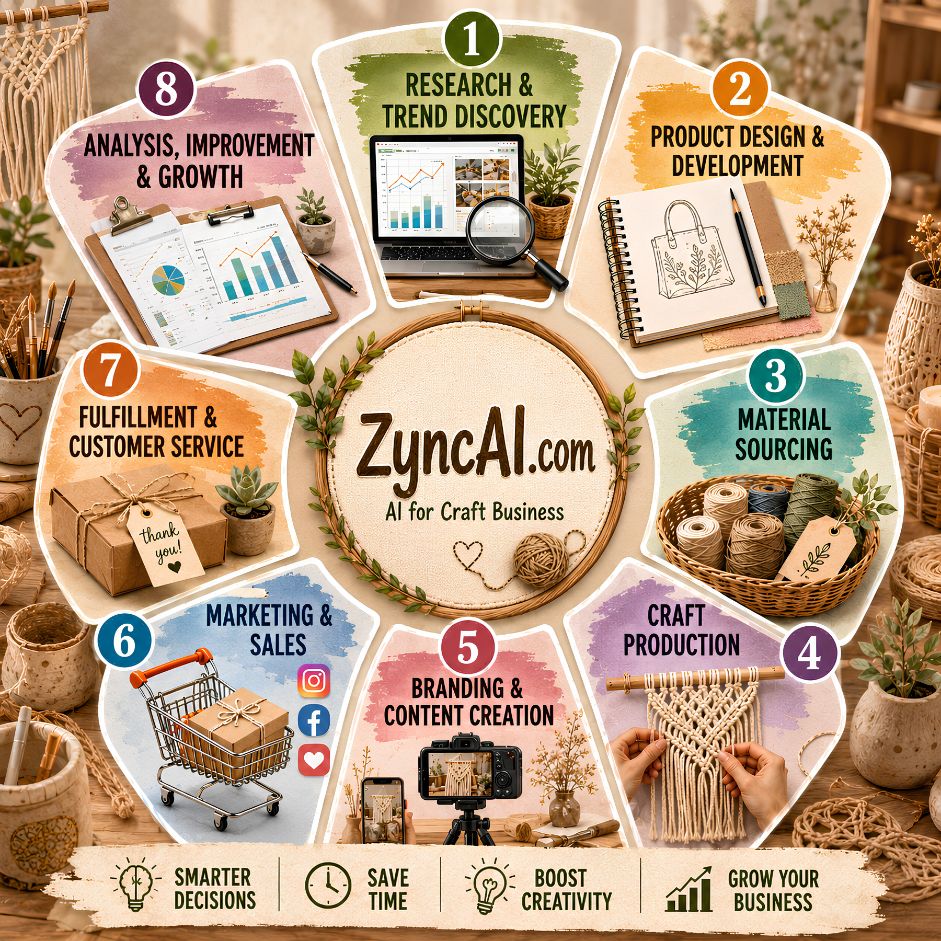
Stage 1: Research & Trend Discovery
Every profitable craft product begins with understanding what customers are actively looking for. Many craft businesses fail not because the products are poorly made, but because they are creating products that have limited demand.
Research and trend discovery involve identifying emerging customer interests, seasonal opportunities, popular design styles, pricing expectations, and market gaps. This stage helps answer important questions:
- What products are trending right now?
- What styles are becoming popular?
- What are customers searching for?
- Which niches have less competition?
- What products can generate consistent sales?
Instead of relying solely on intuition, successful craft business owners continuously monitor customer behavior and market trends. The better your research, the greater your chances of creating products that attract buyers from the start.
Stage 2: Product Design & Development
Once you identify a promising opportunity, the next step is transforming ideas into products customers will love.
This stage includes brainstorming concepts, experimenting with materials, selecting colors, refining designs, testing prototypes, and gathering feedback. For many craft entrepreneurs, this is where creativity shines.
However, creativity alone is not always enough. The most successful products often combine artistic vision with customer demand. A beautiful handmade item may receive compliments, but a well-designed product that solves a problem or matches current trends is more likely to generate sales.
Product development is also an ongoing process. Customer preferences change, trends evolve, and new opportunities emerge. Craft businesses that continuously innovate tend to stay competitive and maintain customer interest over time.
Stage 3: Material Sourcing
Even the best product ideas depend on having the right materials available at the right price.
Material sourcing involves finding suppliers, comparing costs, evaluating quality, negotiating prices, managing inventory, and ensuring consistent availability of essential supplies.
Many craft business owners underestimate how much sourcing affects profitability. A small reduction in material costs can significantly improve profit margins across hundreds of sales. Likewise, sourcing delays can disrupt production schedules and disappoint customers.
At this stage, business owners must balance three critical factors:
- Quality
- Cost
- Reliability
Finding suppliers that consistently deliver high-quality materials at competitive prices is often one of the most important long-term advantages a craft business can develop.
Stage 4: Craft Production
This is where ideas become reality.
Craft production includes creating products, assembling components, personalizing orders, conducting quality checks, packaging items, and preparing them for customers.
For many makers, production is the most rewarding part of the entire business. It is where creativity, skill, and craftsmanship come together to produce something unique.
However, production can also become a bottleneck. As demand grows, business owners often find themselves working longer hours just to keep up with orders. Maintaining quality while increasing output becomes a major challenge.
Efficient production systems help ensure that customers receive consistent, high-quality products while allowing the business to grow sustainably. Small improvements in workflow can save dozens of hours each month and reduce stress during busy seasons.
Stage 5: Branding & Content Creation
A great product alone is rarely enough to stand out in today’s crowded online marketplace.
Customers are drawn to stories, personalities, and brands they can connect with. This is why branding and content creation have become essential parts of running a successful craft business.
This stage involves creating:
- Brand messaging
- Product descriptions
- Social media content
- Product photography
- Videos and reels
- Blog articles
- Email newsletters
- Marketing materials
Strong branding helps customers remember your business long after they leave your store. It creates trust, builds emotional connections, and makes your products more recognizable among countless alternatives.
For handmade businesses especially, storytelling can become a powerful competitive advantage. Customers often buy not just the product itself, but also the story, passion, and craftsmanship behind it.
Stage 6: Marketing & Sales
Creating beautiful products is only half the battle. The other half is getting those products in front of the right audience.
Marketing and sales involve attracting potential customers, generating interest, building trust, and converting visitors into buyers.
This stage includes activities such as:
- Social media marketing
- Search engine optimization (SEO)
- Etsy optimization
- Email marketing
- Paid advertising
- Influencer collaborations
- Customer outreach
- Promotional campaigns
Many craft business owners discover that marketing requires almost as much time as creating products. The challenge is maintaining consistent visibility without becoming overwhelmed.
Businesses that consistently attract new customers while nurturing existing ones are generally able to achieve more predictable and sustainable growth.
Stage 7: Fulfillment & Customer Service
The customer experience doesn’t end when someone clicks the “Buy Now” button.
After a purchase is made, customers expect timely shipping, accurate order tracking, professional packaging, and responsive support. Every interaction contributes to how customers perceive your brand.
This stage includes:
- Order processing
- Packaging
- Shipping
- Delivery tracking
- Customer communication
- Returns and exchanges
- Review management
- Customer support
Excellent customer service can transform one-time buyers into loyal repeat customers. In many cases, customers are willing to overlook small mistakes if they receive quick, helpful, and friendly support.
A positive post-purchase experience often leads to repeat sales, referrals, positive reviews, and stronger long-term customer relationships.
Stage 8: Analysis, Improvement & Growth
The most successful craft businesses don’t simply create and sell products—they continuously learn from their results.
This stage focuses on understanding what is working, what isn’t, and where new opportunities exist.
Business owners analyze data such as:
- Best-selling products
- Customer feedback
- Website traffic
- Marketing performance
- Conversion rates
- Seasonal trends
- Profit margins
- Customer retention
The insights gained here help improve decisions throughout the entire value chain. For example, sales data may reveal an unexpected trend that inspires new product designs. Customer reviews may highlight opportunities to improve packaging. Marketing results may identify the channels generating the highest return on investment.
Growth becomes much easier when decisions are based on data rather than assumptions.
Why Understanding the Value Chain Matters
Many craft business owners view their business primarily as a creative endeavor. While creativity remains the foundation, sustainable success comes from optimizing every stage of the customer journey.
A weakness in any one stage can affect the entire business. A brilliant product may struggle if marketing is ineffective. Strong marketing may generate sales, but poor fulfillment can damage customer trust. Excellent products and customer service may still fail to reach their potential if market research is ignored.
The businesses that grow fastest are often not the ones creating the most products—they are the ones improving every stage of the value chain consistently.
This is exactly where AI becomes incredibly valuable. Rather than replacing creativity, AI acts as a business assistant that helps streamline research, product development, sourcing decisions, content creation, marketing, customer support, and business analysis.
By understanding these eight stages, you will be able to identify exactly where AI can create the greatest impact in your craft business and unlock new opportunities for growth, efficiency, and profitability.
50 Ways AI Can Help Craft Business Owners
One of the biggest misconceptions about AI is that it is only useful for marketing.
In reality, AI can support almost every activity involved in running a craft business.
From discovering profitable product opportunities to designing products, sourcing materials, creating content, attracting customers, managing orders, and planning future growth, AI can become a valuable business assistant throughout the entire craft business journey.
To make these use cases practical and easy to follow, the 70 ways (50 plus bonus 20 for you!) in this guide are organized according to the 8 Stage Craft Business Value Chain.
This approach helps you identify exactly where AI can create the biggest impact in your business.
Whether you are just starting your handmade business or looking to scale an established craft brand, you can focus on the stages that matter most right now.
The stages include,,
- Research & Trend Discovery
- Product Design & Development
- Material Sourcing
- Craft Production
- Branding & Content Creation
- Marketing & Sales
- Fulfillment & Customer Service
- Analysis, Improvement & Growth
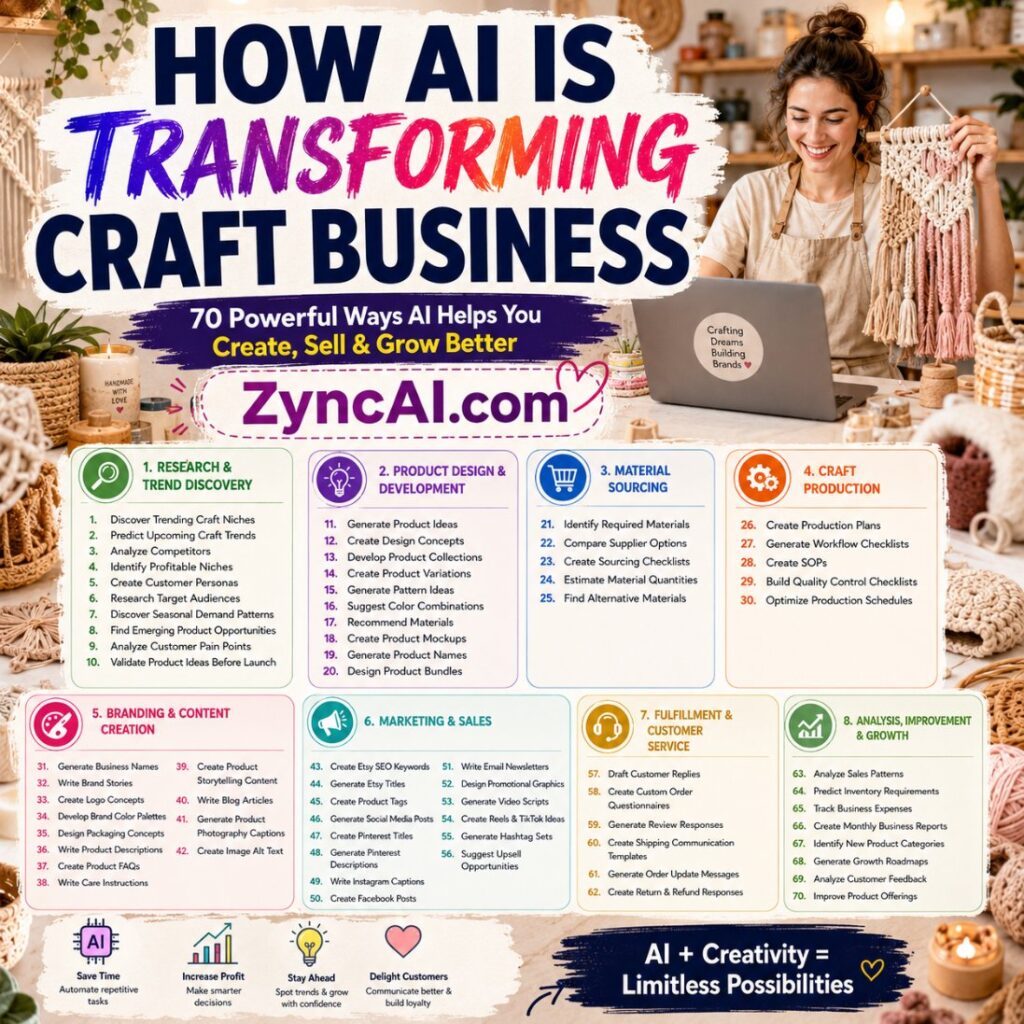
Let’s begin with the first stage of the value chain, where successful craft businesses are built long before a single product is created.
Research & Trend Discovery (10 Ways)
The most successful craft businesses do not begin with materials, tools, or production.
They begin with understanding the market.
Many makers spend weeks creating products they love, only to discover there is little customer demand. Others enter highly competitive niches where gaining visibility becomes extremely difficult.
AI helps reduce this uncertainty.
Instead of relying on guesswork, AI can help craft business owners uncover trends, understand customers, identify opportunities, and validate ideas before investing significant time and money.
This first stage of the craft business value chain focuses on helping you answer some of the most important business questions:
- What should I sell?
- Who should I sell to?
- What products are growing in popularity?
- What problems do customers want solved?
- Which opportunities have the highest potential?
Let’s explore the ten ways AI can help during the Research & Trend Discovery stage.
1. Discover Trending Craft Niches
The Problem
Many craft entrepreneurs spend weeks creating products only to discover there is little demand.
Without market research, it is easy to enter crowded categories or invest time in products customers are no longer actively searching for.
How AI Helps
AI can analyze large amounts of trend data from search engines, marketplaces, and social platforms to identify growing opportunities.
Instead of manually researching hundreds of products, AI can quickly uncover:
- Fast-growing craft categories
- Emerging customer interests
- Popular gift ideas
- New décor trends
- Underserved niches
For example, AI may identify increasing demand for eco-friendly gifts, personalized pet accessories, handmade wedding décor, or nature-inspired home products before they become saturated markets.
Example Prompt
“Analyze current handmade product trends and identify 10 growing craft niches with strong demand and moderate competition for small business owners.”
Recommended Free AI Tools
- Perplexity
- Google Gemini
- Claude
- AnswerThePublic
- ChatGPT
- Google Trends
- Pinterest Trends
- Microsoft Copilot
- Exploding Topics
- Google AI Studio
Expected Business Benefits
- Better product selection
- Reduced business risk
- Faster market validation
- Improved sales potential
- More strategic business decisions
2. Predict Upcoming Craft Trends
The Problem
By the time a trend becomes obvious, thousands of sellers may already be competing in that space.
Entering a trend too late often results in lower visibility and reduced profit margins.
How AI Helps
AI excels at identifying patterns before they become mainstream.
By analyzing:
- Search behavior
- Pinterest saves
- Consumer discussions
- Product searches
- Emerging keywords
AI can help predict future trends before they reach peak popularity.
Imagine discovering a growing demand for handmade mushroom-themed décor, sustainable gift boxes, or personalized nursery products six months before competitors notice.
That insight can significantly improve your market position.
Example Prompt
“Based on current search and consumer behavior patterns, predict handmade product categories likely to experience significant growth over the next 12 months.”
Recommended Free AI Tools
- Google Trends
- Trend Hunter
- Pinterest Trends
- Exploding Topics
- Gemini
- Claude
- Perplexity
- Copilot
- ChatGPT
- Think with Google
Expected Business Benefits
- First-mover advantage
- Reduced competition
- Stronger product visibility
- Better inventory planning
- Higher long-term profitability
3. Analyze Competitors
The Problem
Most craft business owners know who their competitors are.
However, they often struggle to understand why those competitors are successful.
Manually reviewing dozens of Etsy shops, websites, and social media profiles can take hours.
How AI Helps
AI can quickly evaluate competitor information and identify patterns.
It can help uncover:
- Best-selling products
- Pricing strategies
- Popular keywords
- Customer engagement tactics
- Branding approaches
- Product positioning
You can even perform SWOT analyses to identify strengths, weaknesses, opportunities, and threats.
Example Prompt
“Analyze these top Etsy competitors and identify their strongest products, pricing strategies, customer appeal factors, and opportunities where a new seller could differentiate.”
Recommended Free AI Tools
- NotebookLM
- Google AI Studio
- Claude
- Poe
- You.com
- ChatGPT
- Gemini
- Perplexity
- Copilot
- Notion AI
Expected Business Benefits
- Faster competitive research
- Better positioning
- Improved product differentiation
- Smarter pricing decisions
- More effective marketing
4. Identify Profitable Niches
The Problem
Popularity does not always equal profitability.
Some niches have strong demand but intense competition.
Others may attract customers but generate low profit margins.
How AI Helps
AI can evaluate multiple business factors simultaneously.
These include:
- Demand
- Competition
- Average product pricing
- Customer demographics
- Production complexity
- Seasonal trends
- Profit potential
This allows you to focus on opportunities with the greatest business potential.
Example Prompt
“Compare personalized gifts, crochet products, handmade candles, resin crafts, and wooden home décor. Which niche offers the best balance of demand, competition, and profitability?”
Recommended Free AI Tools
- Exploding Topics
- Ahrefs Free Tools
- Semrush Free Tools
- ChatGPT
- Gemini
- Claude
- Perplexity
- Copilot
- Google Trends
- Pinterest Trends
Expected Business Benefits
- Improved profitability
- Better niche selection
- Reduced business risk
- Higher return on investment
- More sustainable growth
5. Create Customer Personas
The Problem
Trying to market to everyone often results in weak messaging and poor sales.
Successful craft businesses understand exactly who they are serving.
How AI Helps
AI can create highly detailed customer personas based on your niche and products.
It can define:
- Age ranges
- Interests
- Income levels
- Shopping habits
- Preferred social platforms
- Buying motivations
- Common frustrations
These insights help you create products and marketing that resonate with your ideal customers.
Example Prompt
“Create three detailed customer personas for a handmade candle business focused on eco-friendly home décor.”
Recommended Free AI Tools
- Notion AI
- Google AI Studio
- NotebookLM
- Poe
- Character AI
- Claude
- Gemini
- Copilot
- Perplexity
- ChatGPT
Expected Business Benefits
- More targeted marketing
- Better product decisions
- Higher conversion rates
- Improved customer satisfaction
- Increased repeat purchases
6. Research Target Audiences
The Problem
Many business owners know who their customers are but do not fully understand what those customers actually care about.
How AI Helps
AI can analyze audience interests, behaviors, motivations, and purchasing habits.
It can reveal:
- Popular hobbies
- Lifestyle preferences
- Purchase triggers
- Social media usage
- Product expectations
These insights help create products and marketing content that feel more relevant and personal.
Example Prompt
“Analyze the interests, motivations, and purchasing behaviors of customers who buy handmade home décor products.”
Recommended Free AI Tools
- Google Trends
- Pinterest Trends
- NotebookLM
- Perplexity
- AnswerThePublic
- Reddit Search
- ChatGPT
- Claude
- Gemini
- Copilot
Expected Business Benefits
- Better customer understanding
- Improved marketing effectiveness
- Stronger customer relationships
- Higher engagement
- Increased sales
7. Discover Seasonal Demand Patterns
The Problem
Many craft businesses experience sales spikes and slow periods throughout the year.
Without planning, this can create inventory shortages or excess stock.
How AI Helps
AI can identify recurring seasonal trends and buying behaviors.
It can reveal demand around:
- Christmas
- Valentine’s Day
- Mother’s Day
- Weddings
- Back-to-school periods
- Summer travel seasons
Knowing these patterns helps business owners prepare months in advance.
Example Prompt
“Identify seasonal demand patterns for handmade gifts and suggest the best times to launch new product collections.”
Recommended Free AI Tools
- Copilot
- Exploding Topics
- Trend Hunter
- Think with Google
- Google Trends
- Pinterest Trends
- ChatGPT
- Gemini
- Claude
- Perplexity
Expected Business Benefits
- Better inventory planning
- Increased holiday sales
- Improved production scheduling
- Reduced stock shortages
- Better cash flow management
8. Find Emerging Product Opportunities
The Problem
Many craft sellers compete in the same crowded product categories.
Finding untapped opportunities can be difficult.
How AI Helps
AI can identify market gaps by analyzing:
- Customer searches
- Competitor offerings
- Consumer complaints
- Emerging interests
This helps uncover opportunities others may not have noticed.
For example, customers may be searching for personalized pet memorial gifts or sustainable wedding favors with limited seller competition.
Example Prompt
“Identify underserved handmade product categories where customer demand appears to exceed available supply.”
Recommended Free AI Tools
- Perplexity
- Copilot
- Exploding Topics
- Google Trends
- Pinterest Trends
- Trend Hunter
- Glimpse
- ChatGPT
- Gemini
- Claude
Expected Business Benefits
- Reduced competition
- Faster growth opportunities
- Better market positioning
- Increased profitability
- Stronger differentiation
9. Analyze Customer Pain Points
The Problem
Customers buy products because they solve problems, fulfill desires, or improve experiences.
Many sellers fail to identify these underlying motivations.
How AI Helps
AI can analyze reviews, comments, forums, and customer feedback to identify recurring frustrations and unmet needs.
For example:
Customers may complain that:
- Gift packaging is unattractive
- Personalized products take too long
- Product instructions are unclear
- Existing products lack customization
These insights can inspire better products.
Example Prompt
“Analyze customer reviews for handmade candles and identify the most common complaints, frustrations, and unmet needs.”
Recommended Free AI Tools
- NotebookLM
- Perplexity
- Google AI Studio
- Notion AI
- Poe
- You.com
- ChatGPT
- Claude
- Gemini
- Copilot
Expected Business Benefits
- Better product development
- Higher customer satisfaction
- Improved reviews
- Stronger differentiation
- More repeat customers
10. Validate Product Ideas Before Launch
The Problem
Creating a new product requires time, money, and effort.
Launching without validation increases risk.
How AI Helps
AI can help evaluate product ideas before production begins.
It can assess:
- Potential demand
- Customer appeal
- Competitive landscape
- Pricing opportunities
- Market fit
While AI cannot guarantee success, it can significantly reduce uncertainty.
Example Prompt
“Evaluate the business potential of personalized wooden recipe boards. Analyze customer demand, competition, target audience, pricing opportunities, and potential challenges.”
Recommended Free AI Tools
- Pinterest Trends
- Exploding Topics
- NotebookLM
- Google AI Studio
- ChatGPT
- Claude
- Gemini
- Copilot
- Perplexity
- Google Trends
Expected Business Benefits
- Better product launch decisions
- Reduced financial risk
- Faster validation
- Improved confidence
- Higher success rates
Product Design & Development (10 Ways)
Once you’ve identified promising opportunities through research, the next step is transforming those insights into products customers will actually want to buy.
This is where many craft business owners spend most of their time.
Designing products can be exciting, but it can also be challenging. Creative blocks, uncertainty about customer preferences, and the pressure to constantly introduce new products can make product development feel overwhelming.
AI can act as a creative partner throughout this stage of the value chain.
It can help generate ideas, explore design directions, create collections, develop variations, and even assist with product presentation before production begins.
Rather than replacing creativity, AI helps expand it by providing inspiration, structure, and new perspectives that can accelerate product development.
11. Generate Product Ideas
The Problem
Many craft business owners eventually run into creative blocks.
After creating products for months or years, generating fresh ideas becomes increasingly difficult.
Relying solely on inspiration can result in inconsistent product development and missed opportunities.
How AI Helps
AI can generate hundreds of product ideas based on:
- Current trends
- Customer interests
- Seasonal demand
- Existing product lines
- Emerging market opportunities
You can use AI to brainstorm entirely new products or expand existing collections.
For example, a candle maker could ask AI to suggest unique candle concepts inspired by travel destinations, seasonal scents, or wellness themes.
Example Workflow
Trend Research → AI Idea Generation → Product Evaluation → Prototype Creation
Example Prompt
“Generate 50 unique handmade candle product ideas targeting customers interested in self-care, wellness, and home décor.”
Recommended Free AI Tools
- Poe
- Notion AI
- NotebookLM
- Character AI
- ChatGPT
- Google Gemini
- Claude
- Microsoft Copilot
- Perplexity
- Google AI Studio
Results Expected
- More product ideas
- Reduced creative blocks
- Faster product development
- Increased innovation
- Expanded product catalog
12. Create Design Concepts
The Problem
Having a product idea is only the beginning.
Turning that idea into a compelling design often requires experimentation and multiple iterations.
How AI Helps
AI image generation tools can help visualize concepts before creating physical prototypes.
Instead of spending hours sketching possibilities, you can generate numerous design directions in minutes.
Examples include:
- Jewelry concepts
- Candle label designs
- Home décor styles
- Personalized gift ideas
- Seasonal collections
Example Workflow
Product Idea → AI Concept Generation → Design Selection → Prototype Development
Example Prompt
“Create design concepts for a rustic farmhouse-style handmade candle collection using neutral colors and botanical elements.”
Recommended Free AI Tools
- Microsoft Designer
- Ideogram
- Bing Image Creator
- Recraft
- Playground AI
- Canva AI
- Adobe Express AI
- Leonardo AI
- ChatGPT
- Gemini
Results Expected
- Faster concept development
- Reduced design costs
- Improved creative exploration
- Better product visualization
- More refined products
13. Develop Product Collections
The Problem
Many sellers create products individually rather than strategically building collections.
As a result, product catalogs can appear disconnected and inconsistent.
How AI Helps
AI can help create cohesive collections based on themes, seasons, lifestyles, or customer interests.
Examples include:
- Spring collection
- Coastal collection
- Cottagecore collection
- Wedding collection
- Holiday collection
AI can suggest matching products, naming conventions, color palettes, and product relationships.
Example Workflow
Choose Theme → AI Collection Planning → Product Selection → Collection Launch
Example Prompt
“Create a complete cottagecore-inspired product collection for a handmade home décor business including product ideas, themes, and collection names.”
Recommended Free AI Tools
- Canva AI
- Notion AI
- NotebookLM
- Google AI Studio
- Poe
- ChatGPT
- Claude
- Gemini
- Copilot
- Perplexity
Results Expected
- More professional product catalogs
- Higher average order values
- Better brand consistency
- Improved customer experience
- Increased cross-selling opportunities
14. Create Product Variations
The Problem
Customers often want options.
Creating variations manually can be time-consuming and difficult to scale.
How AI Helps
AI can suggest numerous product variations based on:
- Colors
- Themes
- Sizes
- Materials
- Seasonal adaptations
- Personalization opportunities
A successful product can quickly be expanded into multiple versions.
For example, a popular mug design could be adapted for teachers, pet lovers, mothers, travelers, or holiday shoppers.
Example Workflow
Identify Best Seller → Generate Variations → Select Top Concepts → Create New Listings
Example Prompt
“Generate 30 personalized product variations for a handmade wooden sign business.”
Recommended Free AI Tools
- Perplexity
- Google AI Studio
- Poe
- Notion AI
- NotebookLM
- Character AI
- ChatGPT
- Gemini
- Claude
- Copilot
Results Expected
- Expanded product range
- Increased sales opportunities
- Better market coverage
- More personalized offerings
- Improved customer appeal
15. Generate Pattern Ideas
The Problem
Creating original patterns can be time-intensive for makers working with textiles, paper crafts, laser-cut products, and digital products.
How AI Helps
AI can generate inspiration for:
- Floral patterns
- Geometric patterns
- Seasonal patterns
- Nature-inspired designs
- Vintage aesthetics
These ideas can then be refined and customized into original products.
Example Workflow
Choose Theme → Generate Pattern Ideas → Customize Pattern → Product Creation
Example Prompt
“Generate pattern ideas inspired by wildflowers, nature, and cottagecore aesthetics for printable craft products.”
Recommended Free AI Tools
- Leonardo AI
- Canva AI
- Adobe Express AI
- Bing Image Creator
- Microsoft Designer
- Gemini
- Ideogram
- Recraft
- Playground AI
- ChatGPT
Results Expected
- Faster pattern development
- More creative inspiration
- Unique product offerings
- Expanded product variety
- Improved design efficiency
16. Suggest Color Combinations
The Problem
Color selection can significantly influence customer perception and purchasing decisions.
Choosing effective color palettes is not always easy.
How AI Helps
AI can recommend color palettes based on:
- Current trends
- Brand identity
- Product themes
- Seasonal preferences
- Target audiences
For example, AI might recommend earthy greens, warm terracotta, and soft beige for a sustainable home décor collection.
Example Workflow
Select Theme → Generate Color Palettes → Evaluate Options → Apply to Products
Example Prompt
“Suggest 20 color palettes for a handmade candle brand focused on natural wellness and relaxation.”
Recommended Free AI Tools
- Coolors
- Khroma
- Recraft
- Canva AI
- Adobe Express AI
- Gemini
- Claude
- Microsoft Designer
- Leonardo AI
Results Expected
- Stronger product appeal
- Better visual consistency
- Improved branding
- More professional designs
- Higher customer engagement
17. Recommend Materials
The Problem
Choosing materials often involves balancing quality, durability, sustainability, availability, and cost.
How AI Helps
AI can compare materials and recommend options based on product goals.
Examples include:
- Eco-friendly alternatives
- Budget-friendly substitutes
- Premium material upgrades
- Durable options for specific products
Example Workflow
Define Product Requirements → AI Material Analysis → Supplier Research → Product Development
Example Prompt
“Recommend the best sustainable materials for handmade gift boxes designed for premium customers.”
Recommended Free AI Tools
- Notion AI
- Poe
- You.com
- Gemini
- Claude
- Copilot
- Perplexity
- Google AI Studio
- NotebookLM
Results Expected
- Better material decisions
- Improved product quality
- Reduced costs
- Increased sustainability
- Enhanced customer satisfaction
18. Create Product Mockups
The Problem
Professional mockups can be expensive and time-consuming to create.
Yet customers often need to visualize products before making purchasing decisions.
How AI Helps
AI can generate realistic product mockups that showcase products in attractive settings.
Examples include:
- Candles in living rooms
- Jewelry on models
- Wall art in home interiors
- Gift boxes on decorated tables
Example Workflow
Product Design → AI Mockup Creation → Listing Development → Marketing Use
Example Prompt
“Create a realistic lifestyle mockup of a handmade soy candle displayed in a modern Scandinavian living room.”
Recommended Free AI Tools
- Canva AI
- Recraft
- Bing Image Creator
- Ideogram
- Playground AI
- Adobe Express AI
- Leonardo AI
- Microsoft Designer
Results Expected
- Improved product presentation
- Higher conversion rates
- Reduced photography costs
- Faster listing creation
- More professional branding
19. Generate Product Names
The Problem
Naming products can be surprisingly difficult.
Generic names often fail to create emotional connections with customers.
How AI Helps
AI can generate memorable product names aligned with:
- Brand identity
- Product themes
- Customer interests
- Seasonal campaigns
For example, instead of “Lavender Candle,” AI may suggest:
- Lavender Escape
- Evening Calm
- Moonlit Lavender
- Serenity Bloom
Example Workflow
Define Product Theme → Generate Names → Evaluate Options → Launch Product
Example Prompt
“Generate 50 premium product names for a lavender-scented handmade candle collection.”
Recommended Free AI Tools
- ChatGPT
- Claude
- Gemini
- Copilot
- Perplexity
- Notion AI
- Poe
- Google AI Studio
- NotebookLM
- Character AI
Results Expected
- Stronger branding
- More memorable products
- Better customer engagement
- Improved perceived value
- Enhanced marketing effectiveness
20. Design Product Bundles
The Problem
Many craft businesses miss opportunities to increase order value by selling products individually.
How AI Helps
AI can identify logical product combinations and create attractive bundles.
Examples include:
- Self-care gift sets
- Holiday gift bundles
- Wedding packages
- New homeowner collections
- Seasonal décor kits
AI can also recommend pricing strategies and bundle positioning.
Example Workflow
Analyze Products → Generate Bundle Ideas → Create Bundle Offers → Promote Bundles
Example Prompt
“Suggest profitable product bundle ideas for a handmade candle and home décor business.”
Recommended Free AI Tools
- NotebookLM
- Notion AI
- Poe
- You.com
- Claude
- Copilot
- Perplexity
- Google AI Studio
Results Expected
- Higher average order value
- Increased revenue
- Improved customer experience
- Better inventory movement
- More effective cross-selling
Material Sourcing (5 Ways)
Once product designs are finalized, the next step in the craft business value chain is acquiring the materials needed to bring those products to life.
Material sourcing has a significant impact on profitability, product quality, customer satisfaction, and production efficiency.
Many craft business owners spend countless hours researching suppliers, comparing materials, estimating quantities, and trying to balance quality with cost.
AI can simplify many of these decisions.
Instead of manually researching dozens of websites and spreadsheets, AI can help identify suitable materials, compare sourcing options, estimate purchasing needs, and uncover alternatives that may improve profitability.
Let’s explore five practical ways AI can support the material sourcing process.
21. Identify Required Materials
The Problem
Many makers underestimate the number of materials required for a product.
Missing components can delay production, increase costs, and create fulfillment issues.
This becomes even more challenging when launching new product lines.
How AI Helps
AI can break down product concepts and generate comprehensive material lists.
It can identify:
- Primary materials
- Supporting materials
- Packaging supplies
- Decorative elements
- Tools and accessories
- Safety requirements
For example, a maker launching handmade soy candles may receive a complete materials list including wax, wicks, fragrance oils, containers, warning labels, packaging materials, and shipping supplies.
Example Workflow
Product Design → AI Material Analysis → Material List Creation → Supplier Research
Example Prompt
“Create a complete materials list for a handmade soy candle business including production materials, packaging supplies, and shipping materials.”
Recommended Free AI Tools
- Copilot
- Perplexity
- Google AI Studio
- NotebookLM
- Notion AI
- Gemini
- Claude
- Poe
- You.com
Results Expected
- More complete sourcing plans
- Reduced purchasing errors
- Faster product launches
- Better production readiness
- Improved organization
22. Compare Supplier Options
The Problem
Choosing suppliers often involves balancing:
- Cost
- Quality
- Reliability
- Shipping times
- Minimum order quantities
Evaluating multiple suppliers manually can be time-consuming.
How AI Helps
AI can organize supplier information into easy-to-compare summaries.
It can evaluate:
- Pricing structures
- Shipping costs
- Customer reviews
- Lead times
- Product quality indicators
- Risk factors
This makes supplier selection more objective and efficient.
Example Workflow
Gather Supplier Information → AI Comparison Analysis → Evaluate Trade-Offs → Select Supplier
Example Prompt
“Compare these three packaging suppliers and identify which offers the best balance of quality, pricing, shipping speed, and scalability for a small handmade business.”
Recommended Free AI Tools
- ChatGPT
- Claude
- Gemini
- Copilot
- Perplexity
- NotebookLM
- Google AI Studio
- Notion AI
- Poe
- You.com
Results Expected
- Better supplier decisions
- Lower sourcing costs
- Reduced business risk
- Improved quality control
- Stronger supplier relationships
23. Create Sourcing Checklists
The Problem
As product catalogs grow, sourcing becomes increasingly complex.
Many business owners forget items, reorder supplies late, or struggle to maintain consistency.
How AI Helps
AI can generate detailed sourcing checklists customized to each product line.
These checklists may include:
- Raw materials
- Packaging supplies
- Inventory thresholds
- Supplier contacts
- Reorder schedules
- Quality inspection points
The result is a more organized procurement process.
Example Workflow
Product Review → AI Checklist Creation → Purchasing Schedule → Inventory Management
Example Prompt
“Create a sourcing checklist for a handmade jewelry business that includes raw materials, packaging supplies, inventory tracking, and reorder reminders.”
Recommended Free AI Tools
- Google AI Studio
- NotebookLM
- Perplexity
- ClickUp AI
- Microsoft Loop AI
- Copilot
- Notion AI
Results Expected
- Improved organization
- Fewer stock shortages
- Better purchasing consistency
- Reduced production delays
- Easier inventory management
24. Estimate Material Quantities
The Problem
Ordering too little material can delay production.
Ordering too much can tie up valuable cash and storage space.
Many makers struggle to accurately forecast material requirements.
How AI Helps
AI can estimate material needs based on:
- Product dimensions
- Sales forecasts
- Seasonal demand
- Historical sales data
- Production goals
For example, AI can estimate how much wax, fragrance oil, and packaging will be needed to fulfill projected holiday sales.
Example Workflow
Sales Forecast → AI Material Calculation → Purchasing Plan → Production Preparation
Example Prompt
“Estimate the material requirements for producing 500 handmade candles during the holiday season, including wax, wicks, fragrance oils, jars, and packaging materials.”
Recommended Free AI Tools
- Google Sheets AI Features
- Google AI Studio
- Microsoft Excel Copilot
- ChatGPT
- Gemini
- Claude
- Copilot
- Perplexity
- NotebookLM
- Notion AI
Results Expected
- Better inventory planning
- Reduced waste
- Improved cash flow
- Lower storage costs
- Increased operational efficiency
25. Find Alternative Materials
The Problem
Supply shortages, rising costs, and discontinued products can disrupt production.
Depending on a single material source creates risk.
How AI Helps
AI can suggest alternative materials based on:
- Product requirements
- Sustainability goals
- Budget constraints
- Customer preferences
- Availability
For example, AI may recommend eco-friendly alternatives to plastic packaging or identify substitute materials when a supplier is out of stock.
Example Workflow
Identify Material Challenge → AI Alternative Research → Evaluate Options → Implement Replacement
Example Prompt
“Suggest sustainable alternatives to plastic packaging for handmade gift products while maintaining a premium appearance.”
Recommended Free AI Tools
- Copilot
- Claude
- Perplexity
- ChatGPT
- Gemini
- Google AI Studio
- NotebookLM
- Notion AI
- Poe
- You.com
Results Expected
- Reduced supply chain risk
- Greater flexibility
- Improved sustainability
- Lower costs
- Stronger business resilience
Craft Production (5 Ways)
After sourcing materials, the next step is turning those materials into finished products.
For many craft business owners, production is where the majority of time is spent.
As order volume increases, maintaining consistency, quality, and efficiency becomes increasingly difficult.
AI can help structure production processes, improve workflows, reduce mistakes, and support growth without sacrificing craftsmanship.
The goal is not to replace handmade work.
The goal is to help makers spend less time managing production and more time creating exceptional products.
26. Create Production Plans
The Problem
Many small craft businesses operate without structured production plans.
This often leads to missed deadlines, inefficient workflows, and unnecessary stress.
How AI Helps
AI can create production schedules based on:
- Order volume
- Product complexity
- Available labor
- Production capacity
- Seasonal demand
This creates a clearer roadmap for daily and weekly production activities.
Example Workflow
Order Forecast → AI Production Planning → Schedule Creation → Production Execution
Example Prompt
“Create a weekly production plan for a handmade candle business producing 300 candles per week across five product lines.”
Recommended Free AI Tools
- Notion AI
- ClickUp AI
- Gemini
- Google AI Studio
- NotebookLM
- ChatGPT
- Claude
- Copilot
- Microsoft Loop AI
- Perplexity
Results Expected
- Improved productivity
- Better scheduling
- Fewer missed deadlines
- Reduced stress
- Increased production efficiency
27. Generate Workflow Checklists
The Problem
As production grows, small mistakes become more common.
Missing steps can impact product quality and customer satisfaction.
How AI Helps
AI can create step-by-step workflow checklists tailored to each product.
Examples include:
- Material preparation
- Assembly steps
- Finishing tasks
- Packaging requirements
- Quality inspections
These checklists help ensure consistency across every product.
Example Workflow
Product Analysis → AI Checklist Generation → Team Implementation → Production Monitoring
Example Prompt
“Create a detailed production workflow checklist for handmade resin jewelry from material preparation to final packaging.”
Recommended Free AI Tools
- Microsoft Loop AI
- Perplexity
- Claude
- Copilot
- Notion AI
- ClickUp AI
- Google AI Studio
- NotebookLM
Results Expected
- Greater consistency
- Reduced errors
- Faster training
- Improved quality
- Better workflow management
28. Create SOPs (Standard Operating Procedures)
The Problem
Many handmade businesses rely on informal knowledge and memory.
As the business grows, maintaining consistency becomes difficult.
How AI Helps
AI can convert production processes into professional SOP documents.
These SOPs can include:
- Step-by-step instructions
- Material requirements
- Quality standards
- Safety procedures
- Troubleshooting guidance
This creates repeatable systems that support growth.
Example Workflow
Document Process → AI SOP Creation → Team Training → Process Standardization
Example Prompt
“Create a detailed SOP for producing handmade soy candles including preparation, pouring, curing, labeling, and packaging.”
Recommended Free AI Tools
- Google AI Studio
- NotebookLM
- ClickUp AI
- Microsoft Loop AI
- Perplexity
- ChatGPT
- Gemini
- Claude
- Copilot
- Notion AI
Results Expected
- More consistent production
- Easier employee training
- Improved quality control
- Better scalability
- Reduced operational risk
29. Build Quality Control Checklists
The Problem
Even minor defects can result in negative reviews, returns, and damaged brand reputation.
Many makers perform quality checks inconsistently.
How AI Helps
AI can generate product-specific quality control frameworks.
These may include checks for:
- Appearance
- Dimensions
- Packaging
- Personalization accuracy
- Functionality
- Durability
This ensures every product meets established standards before shipping.
Example Workflow
Product Review → AI Quality Framework → Inspection Process → Shipment Approval
Example Prompt
“Create a quality control checklist for handmade wooden signs including craftsmanship, finish quality, personalization accuracy, and packaging inspection.”
Recommended Free AI Tools
- ClickUp AI
- Microsoft Loop AI
- Perplexity
- Claude
- Copilot
- ChatGPT
- Gemini
- Notion AI
- NotebookLM
- Google AI Studio
Results Expected
- Better product quality
- Fewer returns
- Improved reviews
- Greater customer satisfaction
- Stronger brand reputation
30. Optimize Production Schedules
The Problem
As order volume grows, scheduling becomes more complex.
Without proper planning, bottlenecks can develop that slow fulfillment and reduce productivity.
How AI Helps
AI can analyze production capacity and recommend optimized schedules.
It can help prioritize:
- High-demand products
- Seasonal inventory
- Custom orders
- Bulk orders
- Production batches
This improves efficiency while reducing wasted time.
Example Workflow
Review Production Data → AI Scheduling Optimization → Resource Allocation → Production Execution
Example Prompt
“Optimize the production schedule for a handmade business managing custom orders, seasonal products, and wholesale orders simultaneously.”
Recommended Free AI Tools
- Claude
- Copilot
- ClickUp AI
- Notion AI
- Google AI Studio
- NotebookLM
- Microsoft Loop AI
- Perplexity
Results Expected
- Increased production capacity
- Faster fulfillment
- Reduced bottlenecks
- Better resource utilization
- Improved profitability
Branding & Content Creation (12 Ways)
You might create an incredible handmade product, use premium materials, and deliver exceptional craftsmanship, but customers still need a reason to notice, trust, and remember your brand.
That is where branding and content creation become critical.
In today’s marketplace, customers are not only buying products. They are buying stories, experiences, values, and emotional connections.
Strong branding helps your craft business stand out from thousands of competitors. High-quality content helps customers discover your products, understand their value, and feel confident purchasing from you.
The challenge is that branding and content creation require significant time and creativity.
AI can dramatically reduce this workload while helping maintain consistency across your brand.
From naming your business and writing your brand story to creating product descriptions and blog content, AI can support nearly every aspect of brand building.
Let’s explore how.
31. Generate Business Names
The Problem
Finding the perfect business name can be surprisingly difficult.
Many names are either too generic, difficult to remember, or already being used by competitors.
A weak business name can make branding more challenging in the future.
How AI Helps
AI can generate hundreds of name ideas based on:
- Your niche
- Brand personality
- Target audience
- Product category
- Desired style
For example, a handmade candle business may want names that evoke relaxation, nature, luxury, or wellness.
AI can quickly generate options that align with those goals.
Example Workflow
Define Brand Vision → Generate Name Ideas → Shortlist Options → Verify Availability
Example Prompt
“Generate 100 memorable business names for a handmade candle brand focused on wellness, relaxation, and natural living.”
Recommended Free AI Tools
- Notion AI
- Character AI
- Gemini
- Copilot
- ChatGPT
- Claude
- Perplexity
- Namelix
- Google AI Studio
- Poe
Results Expected
- More creative name options
- Faster branding decisions
- Better brand memorability
- Stronger market positioning
- Improved brand recognition
32. Write Brand Stories
The Problem
Many craft business owners know why they started their business but struggle to communicate that story effectively.
Customers connect emotionally with stories, not product features alone.
How AI Helps
AI can help transform your journey, mission, and values into compelling brand narratives.
A strong brand story can communicate:
- Why you started
- What inspires your products
- Your values
- Your craftsmanship
- Your mission
This helps build trust and emotional connections with customers.
Example Workflow
Share Business Background → AI Story Development → Refine Messaging → Publish Across Channels
Example Prompt
“Write a compelling brand story for a handmade pottery business inspired by nature, sustainability, and slow living.”
Recommended Free AI Tools
- Poe
- Character AI
- NotebookLM
- ChatGPT
- Claude
- Gemini
- Copilot
- Perplexity
- Notion AI
- Google AI Studio
Results Expected
- Stronger emotional connections
- Better customer trust
- Improved brand differentiation
- Increased customer loyalty
- More memorable brand identity
33. Create Logo Concepts
The Problem
Professional logo design can be expensive for new businesses.
Many makers struggle to visualize how their brand should look.
How AI Helps
AI image generation tools can create logo concepts based on:
- Brand values
- Product categories
- Design preferences
- Visual styles
These concepts can serve as inspiration for future refinement.
Example Workflow
Define Brand Identity → Generate Logo Concepts → Select Direction → Finalize Design
Example Prompt
“Create logo concepts for a handmade jewelry brand that combines elegance, minimalism, and nature-inspired design.”
Recommended Free AI Tools
- Canva AI
- Adobe Express AI
- Microsoft Designer
- Leonardo AI
- Ideogram
- Recraft
- Bing Image Creator
- Playground AI
Results Expected
- Faster logo development
- Reduced design costs
- Better brand visualization
- Improved creative direction
- More professional branding
34. Develop Brand Color Palettes
The Problem
Colors influence how customers perceive your brand.
Random color choices can create inconsistency and weaken brand recognition.
How AI Helps
AI can recommend color palettes that align with:
- Brand personality
- Product categories
- Customer demographics
- Industry trends
For example:
A sustainable craft brand may benefit from earthy greens and warm neutrals, while a luxury gift brand may lean toward black, gold, and cream.
Example Workflow
Define Brand Personality → Generate Color Palettes → Evaluate Options → Apply Across Brand Assets
Example Prompt
“Suggest five color palettes for a handmade home décor brand focused on natural materials and modern rustic aesthetics.”
Recommended Free AI Tools
- Recraft
- Leonardo AI
- Canva AI
- Adobe Express AI
- Coolors
- Khroma
- Gemini
- Claude
- Microsoft Designer
Results Expected
- Better visual consistency
- Stronger brand recognition
- Improved customer perception
- More professional branding
- Increased brand memorability
35. Design Packaging Concepts
The Problem
Packaging plays a major role in customer experience.
However, many small businesses struggle to create packaging that feels both attractive and memorable.
How AI Helps
AI can generate packaging concepts based on:
- Brand identity
- Customer expectations
- Product type
- Seasonal campaigns
AI can suggest:
- Box designs
- Label concepts
- Packaging inserts
- Unboxing experiences
- Sustainability improvements
Example Workflow
Define Packaging Goals → Generate Concepts → Select Designs → Implement Packaging
Example Prompt
“Generate premium packaging ideas for a handmade candle brand focused on gifting and eco-friendly presentation.”
Recommended Free AI Tools
- Microsoft Designer
- Bing Image Creator
- Playground AI
- Canva AI
- Adobe Express AI
- Leonardo AI
- Recraft
- Ideogram
- ChatGPT
- Gemini
Results Expected
- Enhanced customer experience
- Better unboxing moments
- Increased perceived value
- More social sharing
- Stronger customer loyalty
36. Write Product Descriptions
The Problem
Writing compelling product descriptions for dozens or hundreds of products can be extremely time-consuming.
Many sellers also struggle to balance SEO and persuasive writing.
How AI Helps
AI can generate descriptions that highlight:
- Product benefits
- Features
- Materials
- Use cases
- Emotional appeal
It can also incorporate relevant keywords naturally.
Example Workflow
Provide Product Information → Generate Description → Refine Brand Voice → Publish Listing
Example Prompt
“Write an Etsy product description for a handmade lavender soy candle targeting customers seeking relaxation and self-care.”
Recommended Free AI Tools
- Gemini
- ChatGPT
- Claude
- Copilot
- Perplexity
- Notion AI
- Google AI Studio
- Poe
- Jasper Free Trial
- NotebookLM
Results Expected
- Faster listing creation
- Improved SEO
- Higher conversion rates
- Better product communication
- More professional listings
37. Create Product FAQs
The Problem
Customers often ask the same questions repeatedly.
Responding individually can consume valuable time.
How AI Helps
AI can generate comprehensive FAQ sections covering:
- Product dimensions
- Materials
- Shipping information
- Customization options
- Care requirements
This improves customer confidence while reducing support requests.
Example Workflow
Review Customer Questions → Generate FAQs → Publish Listings → Reduce Support Load
Example Prompt
“Create a comprehensive FAQ section for handmade personalized wooden signs.”
Recommended Free AI Tools
- Copilot
- Perplexity
- NotebookLM
- Google AI Studio
- Notion AI
- ChatGPT
- Gemini
- Claude
- Poe
- You.com
Results Expected
- Reduced customer inquiries
- Faster purchasing decisions
- Improved customer confidence
- Better shopping experience
- Lower support workload
38. Write Care Instructions
The Problem
Customers may misuse products if proper care instructions are not provided.
This can lead to dissatisfaction, damage, and negative reviews.
How AI Helps
AI can generate clear care instructions tailored to specific materials and product types.
Examples include:
- Candle care
- Jewelry maintenance
- Textile cleaning
- Wood care
- Pottery handling
Example Workflow
Identify Product Materials → Generate Care Instructions → Review Accuracy → Include with Product
Example Prompt
“Create customer-friendly care instructions for handmade sterling silver jewelry.”
Recommended Free AI Tools
- Perplexity
- Google AI Studio
- NotebookLM
- Notion AI
- Poe
- ChatGPT
- Claude
- Gemini
- Copilot
- You.com
Results Expected
- Better customer experiences
- Reduced product misuse
- Fewer complaints
- Improved product longevity
- Higher customer satisfaction
39. Create Product Storytelling Content
The Problem
Many listings focus only on features and specifications.
Features alone rarely create emotional connections.
How AI Helps
AI can transform products into stories by highlighting:
- Inspiration
- Craftsmanship
- Materials
- Meaning
- Customer outcomes
For example, a handmade mug becomes more than pottery when customers learn it was inspired by morning rituals and slow living.
Example Workflow
Share Product Background → Generate Story → Refine Voice → Publish Across Marketing Channels
Example Prompt
“Create a storytelling-focused product narrative for a handmade ceramic mug inspired by slow mornings and mindful living.”
Recommended Free AI Tools
- Notion AI
- Character AI
- Google AI Studio
- ChatGPT
- Claude
- Gemini
- Copilot
- Perplexity
- Poe
- NotebookLM
Results Expected
- Stronger emotional appeal
- Better engagement
- Improved conversion rates
- Increased perceived value
- Enhanced brand loyalty
40. Write Blog Articles
The Problem
Blogging can drive traffic and improve SEO, but consistently creating quality content requires significant effort.
How AI Helps
AI can help generate:
- Blog outlines
- Draft articles
- Topic ideas
- Keyword suggestions
- Content updates
For example, a candle business could publish articles about home fragrance, wellness, self-care, and gift ideas.
Example Workflow
Keyword Research → AI Outline Creation → Draft Generation → Editing → Publishing
Example Prompt
“Create a detailed blog post outline about the benefits of natural soy candles for home wellness.”
Recommended Free AI Tools
- Notion AI
- Poe
- Jasper Free Trial
- ChatGPT
- Claude
- Gemini
- Copilot
- Perplexity
- NotebookLM
- Google AI Studio
Results Expected
- Increased website traffic
- Better SEO visibility
- More authority
- Improved customer trust
- Additional sales opportunities
41. Generate Product Photography Captions
The Problem
Posting product photos without engaging captions limits their effectiveness.
Many makers struggle to consistently write compelling social media copy.
How AI Helps
AI can generate captions that:
- Tell stories
- Highlight benefits
- Encourage engagement
- Support brand voice
- Include calls to action
Example Workflow
Upload Product Image → Generate Caption Options → Select Best Version → Publish
Example Prompt
“Write five Instagram captions for a handmade eucalyptus soy candle targeting customers interested in relaxation and self-care.”
Recommended Free AI Tools
- Perplexity
- Notion AI
- Google AI Studio
- Poe
- Character AI
- NotebookLM
- Gemini
- Copilot
Results Expected
- Higher engagement
- More social shares
- Increased brand visibility
- Better customer interaction
- Stronger social presence
42. Create Image Alt Text
The Problem
Many online sellers overlook alt text.
This reduces accessibility and limits SEO opportunities.
How AI Helps
AI can generate descriptive alt text that improves:
- Accessibility
- Search visibility
- User experience
Well-written alt text helps search engines better understand product images.
Example Workflow
Upload Image → Generate Alt Text → Review → Publish
Example Prompt
“Generate SEO-friendly alt text for a product image showing a handmade lavender soy candle in a glass jar surrounded by dried flowers.”
Recommended Free AI Tools
- Claude
- Gemini
- Copilot
- Google AI Studio
- NotebookLM
- Notion AI
- Perplexity
- Poe
- Microsoft Designer
Results Expected
- Improved accessibility
- Better image SEO
- Increased organic visibility
- Enhanced user experience
- More discoverable product listings
Marketing & Sales (14 Ways)
Creating a great handmade product is only half the battle.
Customers need to discover your products before they can buy them.
Many craft business owners struggle with marketing because it requires a completely different skill set than creating products. Writing social media posts, optimizing Etsy listings, building an audience, creating videos, and running promotions can quickly become overwhelming.
This is where AI can become one of the most valuable tools in your business.
AI can help generate content, improve search visibility, create marketing campaigns, identify sales opportunities, and significantly reduce the time required to attract customers.
Instead of spending hours creating content from scratch, you can use AI to accelerate the entire marketing and sales process.
Let’s explore how.
43. Create Etsy SEO Keywords
The Problem
Many Etsy sellers create excellent products but struggle to get found in search results.
Without the right keywords, potential customers may never discover your listings.
How AI Helps
AI can identify keyword opportunities by analyzing:
- Customer search intent
- Product attributes
- Competitor listings
- Seasonal demand
- Long-tail search phrases
Instead of targeting broad terms such as “candle,” AI may suggest more specific phrases such as:
- Lavender soy candle gift
- Handmade relaxation candle
- Natural aromatherapy candle
These targeted keywords often have higher conversion potential.
Example Workflow
Analyze Product → Generate Keywords → Optimize Listing → Monitor Results
Example Prompt
“Generate 50 Etsy SEO keywords for handmade soy candles targeting customers looking for self-care gifts and home décor.”
Recommended Free AI Tools
- ChatGPT
- Pinterest Trends
- Keyword Tool
- Google AI Studio
- Ahrefs Free Keyword Generator
- Gemini
- Claude
- Copilot
- Perplexity
- Google Trends
Results Expected
- Improved Etsy visibility
- Higher search rankings
- More listing traffic
- Better discoverability
- Increased sales opportunities
44. Generate Etsy Titles
The Problem
Many Etsy titles are either too short, too generic, or poorly optimized.
A weak title can significantly reduce visibility.
How AI Helps
AI can generate keyword-rich titles that balance:
- Search optimization
- Readability
- Customer appeal
It can create multiple versions for testing and improvement.
Example Workflow
Generate Keywords → AI Title Creation → Optimize Title → Publish Listing
Example Prompt
“Create 20 Etsy title variations for a handmade lavender soy candle optimized for search visibility and buyer appeal.”
Recommended Free AI Tools
- Copilot
- Perplexity
- Google AI Studio
- ChatGPT
- Gemini
- Claude
- NotebookLM
- Notion AI
- Poe
- Keyword Tool
Results Expected
- Better search performance
- Improved click-through rates
- Higher listing visibility
- More customer engagement
- Increased traffic
45. Create Product Tags
The Problem
Many sellers fail to maximize available tags or choose ineffective tag combinations.
This can limit search visibility.
How AI Helps
AI can generate optimized tags based on:
- Product attributes
- Customer search behavior
- Seasonal opportunities
- Related keywords
This helps broaden visibility across multiple search terms.
Example Workflow
Analyze Product → Generate Tags → Optimize Listing → Track Performance
Example Prompt
“Generate 30 Etsy tags for personalized wooden signs targeting wedding gifts and home décor buyers.”
Recommended Free AI Tools
- Perplexity
- Claude
- ChatGPT
- Gemini
- Copilot
- Google Trends
- Pinterest Trends
- Keyword Tool
- Ahrefs Free Tools
- Google AI Studio
Results Expected
- Improved search coverage
- Better discoverability
- Increased listing traffic
- Higher product visibility
- More sales opportunities
46. Generate Social Media Posts
The Problem
Consistently creating social media content is one of the biggest challenges for craft business owners.
Many run out of ideas or struggle to post regularly.
How AI Helps
AI can generate content for:
- Product launches
- Behind-the-scenes content
- Educational posts
- Customer stories
- Seasonal promotions
It can also tailor content for different platforms.
Example Workflow
Choose Content Theme → Generate Post Ideas → Create Content → Publish
Example Prompt
“Generate 30 social media post ideas for a handmade candle business focused on wellness and self-care.”
Recommended Free AI Tools
- Canva AI
- Adobe Express AI
- Notion AI
- ChatGPT
- Gemini
- Claude
- Copilot
- Google AI Studio
- Poe
- Perplexity
Results Expected
- More consistent posting
- Increased engagement
- Better audience growth
- Reduced content creation time
- Stronger brand visibility
47. Create Pinterest Titles
The Problem
Pinterest is a powerful traffic source, but many creators use weak pin titles that fail to attract clicks.
How AI Helps
AI can create Pinterest-friendly titles that combine:
- Keywords
- Curiosity
- Search intent
- Audience interests
This improves both visibility and click-through rates.
Example Workflow
Choose Topic → Generate Titles → Create Pin → Publish
Example Prompt
“Generate 25 Pinterest titles for handmade gift ideas targeting women looking for unique birthday presents.”
Recommended Free AI Tools
- Notion AI
- Google AI Studio
- ChatGPT
- Gemini
- Claude
- Copilot
- Pinterest Trends
- Perplexity
- Google Trends
- Poe
Results Expected
- Increased Pinterest traffic
- Better pin visibility
- More website visitors
- Improved content reach
- Higher engagement
48. Generate Pinterest Descriptions
The Problem
Many Pinterest descriptions are too short or lack relevant keywords.
This limits discoverability.
How AI Helps
AI can create optimized descriptions that improve:
- Search visibility
- User engagement
- Click-through rates
Descriptions can naturally include target keywords while remaining readable.
Example Workflow
Select Pin Topic → Generate Description → Add Keywords → Publish
Example Prompt
“Write Pinterest descriptions for handmade wedding gift ideas that include relevant keywords and encourage clicks.”
Recommended Free AI Tools
- Perplexity
- Google AI Studio
- ChatGPT
- Gemini
- Claude
- Copilot
- Pinterest Trends
- Notion AI
- Poe
- Google Trends
Results Expected
- Better Pinterest SEO
- Increased impressions
- More clicks
- Higher website traffic
- Greater content reach
49. Write Instagram Captions
The Problem
Many product photos receive limited engagement because captions fail to connect with audiences.
How AI Helps
AI can generate captions that:
- Tell stories
- Build emotional connections
- Encourage comments
- Support brand voice
- Include calls to action
Example Workflow
Choose Product → Generate Captions → Customize → Publish
Example Prompt
“Write 10 Instagram captions for a handmade ceramic mug collection inspired by slow mornings and mindful living.”
Recommended Free AI Tools
- Copilot
- Perplexity
- Notion AI
- Character AI
- ChatGPT
- Gemini
- Claude
- Google AI Studio
- Poe
- Canva AI
Results Expected
- Higher engagement
- More comments
- Improved audience relationships
- Increased social reach
- Better brand awareness
50. Create Facebook Posts
The Problem
Facebook audiences often respond differently than audiences on other platforms.
Reusing content may not produce the best results.
How AI Helps
AI can adapt content specifically for Facebook by focusing on:
- Storytelling
- Community engagement
- Promotions
- Product launches
- Customer experiences
Example Workflow
Select Campaign → Generate Facebook Content → Publish → Engage Audience
Example Prompt
“Create Facebook post ideas promoting a new handmade holiday candle collection.”
Recommended Free AI Tools
- Poe
- Character AI
- Perplexity
- Notion AI
- ChatGPT
- Gemini
- Claude
- Copilot
- Canva AI
- Google AI Studio
Results Expected
- Increased engagement
- Stronger community building
- Better promotion results
- More customer interaction
- Improved brand awareness
51. Write Email Newsletters
The Problem
Email marketing remains one of the highest-converting marketing channels, but creating newsletters consistently takes time.
How AI Helps
AI can generate:
- Product announcements
- Seasonal promotions
- Educational content
- Customer stories
- Abandoned cart emails
Example Workflow
Choose Campaign → Generate Newsletter → Personalize Content → Send Email
Example Prompt
“Write an email newsletter introducing a new collection of handmade autumn candles.”
Recommended Free AI Tools
- Mailchimp AI Features
- Brevo AI Features
- Notion AI
- Google AI Studio
- ChatGPT
- Gemini
- Claude
- Copilot
- Poe
- Perplexity
Results Expected
- Increased customer retention
- More repeat purchases
- Better campaign performance
- Higher email engagement
- Increased revenue
52. Design Promotional Graphics
The Problem
Creating professional marketing graphics can be expensive and time-consuming.
How AI Helps
AI design tools can generate:
- Social media graphics
- Sale banners
- Product promotions
- Pinterest pins
- Email graphics
These designs can be customized to match your brand.
Example Workflow
Define Campaign → Generate Designs → Customize → Publish
Example Prompt
“Create promotional graphic concepts for a handmade Valentine’s Day gift collection using soft romantic colors.”
Recommended Free AI Tools
- Canva AI
- Adobe Express AI
- Microsoft Designer
- Leonardo AI
- Recraft
- Ideogram
- Bing Image Creator
- Playground AI
Results Expected
- Faster design creation
- Reduced design costs
- More professional marketing
- Increased engagement
- Improved campaign performance
53. Generate Video Scripts
The Problem
Short-form video content performs exceptionally well, but many makers struggle with script writing.
How AI Helps
AI can create scripts for:
- Product showcases
- Tutorials
- Behind-the-scenes videos
- Storytelling content
- Customer education
Example Workflow
Choose Video Topic → Generate Script → Record Video → Publish
Example Prompt
“Write a 60-second video script showcasing the making process behind handmade soy candles.”
Recommended Free AI Tools
- Notion AI
- Poe
- Character AI
- NotebookLM
- ChatGPT
- Gemini
- Claude
- Copilot
- Perplexity
- Google AI Studio
Results Expected
- Faster video creation
- More engaging content
- Increased audience reach
- Better storytelling
- Improved marketing performance
54. Create Reels & TikTok Ideas
The Problem
Many creators struggle to consistently develop fresh short-form video ideas.
How AI Helps
AI can generate content concepts based on:
- Trends
- Customer interests
- Product categories
- Educational opportunities
- Behind-the-scenes content
Example Workflow
Analyze Audience → Generate Ideas → Create Videos → Track Performance
Example Prompt
“Generate 50 Instagram Reels and TikTok content ideas for a handmade jewelry business.”
Recommended Free AI Tools
- TikTok Creative Center
- Google AI Studio
- Notion AI
- Poe
- NotebookLM
- ChatGPT
- Gemini
- Claude
- Copilot
- Perplexity
Results Expected
- More content ideas
- Better engagement
- Faster content planning
- Increased visibility
- Audience growth
55. Generate Hashtag Sets
The Problem
Choosing hashtags manually can be inconsistent and ineffective.
How AI Helps
AI can generate hashtag groups based on:
- Product type
- Audience interests
- Platform trends
- Seasonal opportunities
This improves discoverability across social platforms.
Example Workflow
Analyze Content → Generate Hashtags → Publish → Monitor Results
Example Prompt
“Generate Instagram hashtag sets for handmade candles targeting self-care, home décor, and wellness audiences.”
Recommended Free AI Tools
- Copilot
- Perplexity
- Instagram Search
- TikTok Creative Center
- Google Trends
- ChatGPT
- Gemini
- Claude
- Google AI Studio
- Poe
Results Expected
- Improved discoverability
- Higher engagement
- Better audience targeting
- Increased content reach
- Stronger brand visibility
56. Suggest Upsell Opportunities
The Problem
Many businesses focus solely on acquiring customers while missing opportunities to increase order value.
How AI Helps
AI can analyze products and recommend complementary offers.
Examples include:
- Gift wrapping
- Matching products
- Product bundles
- Premium upgrades
- Personalized add-ons
Example Workflow
Analyze Product Catalog → Generate Upsell Ideas → Implement Offers → Track Revenue
Example Prompt
“Suggest upsell and cross-sell opportunities for a handmade candle business.”
Recommended Free AI Tools
- NotebookLM
- Notion AI
- Poe
- You.com
- ChatGPT
- Gemini
- Claude
- Copilot
- Perplexity
- Google AI Studio
Results Expected
- Higher average order value
- Increased revenue
- Better customer experience
- More effective product positioning
- Improved profitability
Fulfillment & Customer Service (6 Ways)
The sale is not the end of the customer journey.
In many ways, it is only the beginning.
How you communicate with customers, fulfill orders, handle questions, and respond to problems can have a major impact on reviews, repeat purchases, referrals, and long-term business growth.
Many craft business owners underestimate the amount of time customer service requires.
As sales increase, so do customer inquiries, custom order requests, shipping questions, and review management responsibilities.
AI can help streamline many of these interactions while still allowing you to maintain a personal and authentic customer experience.
Rather than replacing human communication, AI helps you respond faster, communicate more clearly, and deliver a more professional customer experience.
Let’s explore how AI can support the fulfillment and customer service stage of the craft business value chain.
57. Draft Customer Replies
The Problem
Responding to customer messages can consume a significant amount of time.
Many inquiries involve similar questions about shipping, customization, materials, sizing, or product availability.
Writing every response from scratch can become repetitive and inefficient.
How AI Helps
AI can quickly draft professional responses to common customer inquiries.
It can help create responses for:
- Product questions
- Shipping inquiries
- Order status requests
- Customization discussions
- Product recommendations
You can then personalize the response before sending it.
This significantly reduces response time while maintaining customer satisfaction.
Example Workflow
Receive Inquiry → AI Draft Generation → Personal Review → Send Response
Example Prompt
“Draft a friendly response to a customer asking if a personalized wooden sign can be customized with a family name and established date.”
Recommended Free AI Tools
- Perplexity
- Google AI Studio
- Notion AI
- NotebookLM
- Poe
- Character AI
Results Expected
- Faster response times
- Improved customer satisfaction
- Reduced support workload
- More professional communication
- Better customer relationships
58. Create Custom Order Questionnaires
The Problem
Custom orders often require gathering detailed information from customers.
Incomplete information can result in delays, misunderstandings, and mistakes.
How AI Helps
AI can create structured questionnaires tailored to specific product types.
Examples include:
- Personalized gifts
- Wedding products
- Custom jewelry
- Engraved items
- Commission-based artwork
These questionnaires help ensure all necessary information is collected upfront.
Example Workflow
Identify Product Type → Generate Questionnaire → Send to Customer → Collect Details
Example Prompt
“Create a customer questionnaire for personalized wedding signs that collects all information needed before production begins.”
Recommended Free AI Tools
- Notion AI
- NotebookLM
- Perplexity
- Poe
- ChatGPT
- Gemini
- Claude
- Copilot
- Google AI Studio
- Microsoft Loop AI
Results Expected
- Fewer order errors
- Better customer communication
- Faster production approval
- Improved workflow efficiency
- Higher customer satisfaction
59. Generate Review Responses
The Problem
Customer reviews influence purchasing decisions and brand reputation.
However, responding thoughtfully to every review can be time-consuming.
Many sellers either ignore reviews or provide generic responses.
How AI Helps
AI can generate personalized responses for:
- Positive reviews
- Neutral reviews
- Constructive feedback
- Customer compliments
It can help maintain a professional and appreciative tone while saving time.
For positive reviews, AI can help strengthen customer relationships.
For critical reviews, AI can help create diplomatic and solution-focused responses.
Example Workflow
Receive Review → Generate Response → Personalize Message → Publish Reply
Example Prompt
“Write a professional response to a customer who praised the quality of a handmade candle but mentioned shipping took longer than expected.”
Recommended Free AI Tools
- ChatGPT
- Gemini
- Claude
- Copilot
- Perplexity
- Google AI Studio
- Notion AI
- NotebookLM
- Poe
- Character AI
Results Expected
- Improved customer engagement
- Stronger reputation management
- Increased trust
- Better public perception
- Enhanced customer loyalty
60. Create Shipping Communication Templates
The Problem
Customers frequently ask questions about shipping timelines and delivery expectations.
Without clear communication, customers may become anxious or frustrated.
How AI Helps
AI can generate shipping communication templates for:
- Order confirmations
- Shipping notifications
- Delivery updates
- Delay notifications
- International shipping information
Having these templates ready improves consistency and reduces support requests.
Example Workflow
Identify Shipping Stage → Generate Template → Customize → Send Customer Update
Example Prompt
“Create a shipping notification template for handmade products that explains processing times, shipping expectations, and tracking information.”
Recommended Free AI Tools
- Claude
- Copilot
- Perplexity
- Google AI Studio
- Notion AI
- ChatGPT
- Gemini
- NotebookLM
- Poe
- Microsoft Loop AI
Results Expected
- Reduced customer inquiries
- Better customer confidence
- Improved communication
- Fewer shipping misunderstandings
- Higher customer satisfaction
61. Generate Order Update Messages
The Problem
Customers appreciate knowing the status of their orders, especially for handmade and personalized products that require longer production times.
Many businesses fail to provide proactive updates.
How AI Helps
AI can create update messages for various production stages.
Examples include:
- Order received
- Production started
- Personalization completed
- Quality inspection finished
- Packaging completed
- Order shipped
Regular updates help reduce customer anxiety and improve the overall buying experience.
Example Workflow
Track Production Stage → Generate Update → Personalize Message → Send Notification
Example Prompt
“Write an order update message informing a customer that their personalized wooden sign has completed production and is now being packaged.”
Recommended Free AI Tools
- Claude
- Copilot
- Google AI Studio
- ChatGPT
- Gemini
- Notion AI
- NotebookLM
- Perplexity
- Poe
- Microsoft Loop AI
Results Expected
- Better customer experience
- Fewer support requests
- Improved trust
- Increased customer satisfaction
- Stronger brand reputation
62. Create Return & Refund Responses
The Problem
Returns and refund requests can be difficult to handle.
Responding emotionally or inconsistently can damage customer relationships.
How AI Helps
AI can draft professional and empathetic responses that balance:
- Customer satisfaction
- Business policies
- Brand reputation
- Problem resolution
AI can help create responses for:
- Return requests
- Refund inquiries
- Damaged products
- Shipping issues
- Replacement requests
These templates can then be customized to the specific situation.
Example Workflow
Receive Request → Generate Response → Review Policy Compliance → Send Reply
Example Prompt
“Write a professional response to a customer requesting a replacement for a handmade item that arrived damaged during shipping.”
Recommended Free AI Tools
- Poe
- Character AI
- Copilot
- Gemini
- Claude
- Perplexity
- Google AI Studio
- Notion AI
- NotebookLM
Results Expected
- Better conflict resolution
- Improved customer retention
- More professional communication
- Stronger reputation management
- Increased customer trust
Analysis, Improvement & Growth (8 Ways)
Many craft business owners spend most of their time creating products, fulfilling orders, and managing day-to-day operations.
Unfortunately, this often leaves little time to step back and evaluate what is actually working.
The businesses that grow consistently are not necessarily the ones with the best products.
They are often the ones that continuously learn, adapt, improve, and make data-driven decisions.
This final stage of the craft business value chain focuses on transforming information into action.
AI can help uncover patterns, identify opportunities, predict future demand, analyze customer behavior, and create growth strategies that would normally require hours of manual analysis.
Instead of making decisions based on assumptions, AI can help you make decisions based on evidence.
Let’s explore how.
63. Analyze Sales Patterns
The Problem
Many craft business owners collect sales data but never fully analyze it.
As a result, important trends often go unnoticed.
You may not realize:
- Which products generate the most profit
- Which seasons drive the most sales
- Which products sell together
- Which products are declining
Without these insights, it becomes difficult to make informed business decisions.
How AI Helps
AI can analyze sales reports and identify patterns that would otherwise be difficult to spot.
It can reveal:
- Top-performing products
- Seasonal sales trends
- Revenue drivers
- Customer purchasing behavior
- Growth opportunities
AI can also summarize large amounts of data into easy-to-understand insights.
Example Workflow
Export Sales Data → AI Analysis → Pattern Identification → Strategic Decisions
Example Prompt
“Analyze this sales data and identify my best-performing products, seasonal trends, and opportunities for revenue growth.”
Recommended Free AI Tools
- Google Sheets AI Features
- Microsoft Excel Copilot
- NotebookLM
- ChatGPT
- Gemini
- Claude
- Copilot
- Perplexity
- Google AI Studio
- Notion AI
Results Expected
- Better business visibility
- Improved decision-making
- More accurate planning
- Increased profitability
- Stronger growth opportunities
64. Predict Inventory Requirements
The Problem
Inventory mistakes can be expensive.
Ordering too little inventory may result in missed sales.
Ordering too much inventory can tie up cash and storage space.
Many craft business owners struggle to find the right balance.
How AI Helps
AI can analyze:
- Historical sales
- Seasonal demand
- Growth trends
- Product popularity
- Upcoming events
Using these insights, AI can estimate future inventory requirements.
This helps reduce both shortages and overstock situations.
Example Workflow
Review Historical Sales → AI Forecasting → Inventory Planning → Purchasing Decisions
Example Prompt
“Based on these sales figures, estimate inventory requirements for the next three months including seasonal demand adjustments.”
Recommended Free AI Tools
- Microsoft Excel Copilot
- NotebookLM
- Google AI Studio
- Perplexity
- ChatGPT
- Gemini
- Claude
- Copilot
- Google Sheets AI Features
- Notion AI
Results Expected
- Better inventory management
- Reduced stock shortages
- Lower inventory costs
- Improved cash flow
- Increased sales opportunities
65. Track Business Expenses
The Problem
Many makers focus heavily on sales while paying less attention to expenses.
Without proper expense tracking, profits can be difficult to understand.
Material costs, packaging expenses, advertising spend, software subscriptions, and shipping fees can quickly add up.
How AI Helps
AI can categorize and summarize expenses automatically.
It can help identify:
- Major cost drivers
- Unnecessary spending
- Profitability concerns
- Cost reduction opportunities
AI can also create visual summaries that make financial information easier to understand.
Example Workflow
Import Expense Data → AI Categorization → Financial Review → Cost Optimization
Example Prompt
“Analyze my monthly business expenses and identify areas where costs could potentially be reduced.”
Recommended Free AI Tools
- NotebookLM
- Google AI Studio
- Notion AI
- Perplexity
- ChatGPT
- Gemini
- Claude
- Copilot
- Google Sheets AI Features
- Microsoft Excel Copilot
Results Expected
- Better financial visibility
- Improved profitability
- Smarter budgeting
- Reduced unnecessary expenses
- Stronger financial planning
66. Create Monthly Business Reports
The Problem
Many small business owners know they should review performance regularly but struggle to create reports.
Important information often remains buried inside spreadsheets.
How AI Helps
AI can transform raw data into easy-to-read business summaries.
Reports may include:
- Revenue performance
- Sales growth
- Product performance
- Marketing results
- Customer insights
- Business recommendations
This helps business owners understand what happened and what actions to take next.
Example Workflow
Collect Data → AI Report Generation → Review Insights → Plan Improvements
Example Prompt
“Create a monthly business performance report summarizing revenue, sales trends, customer behavior, and growth opportunities.”
Recommended Free AI Tools
- Microsoft Excel Copilot
- NotebookLM
- Google AI Studio
- ChatGPT
- Gemini
- Claude
- Copilot
- Google Sheets AI Features
- Perplexity
- Notion AI
Results Expected
- Better business awareness
- Faster reporting
- More informed decisions
- Improved planning
- Stronger accountability
67. Identify New Product Categories
The Problem
Eventually, most craft businesses need to expand beyond their initial product offerings.
The challenge is determining which categories are worth pursuing.
Launching the wrong product line can waste significant time and resources.
How AI Helps
AI can analyze:
- Customer interests
- Market trends
- Search demand
- Competitor activity
- Existing purchasing patterns
It can identify product categories that align with your current audience and brand.
For example, a candle business may discover opportunities in wax melts, room sprays, gift boxes, or home décor products.
Example Workflow
Analyze Existing Customers → AI Opportunity Discovery → Product Evaluation → Expansion Planning
Example Prompt
“Identify new product categories that would complement a handmade candle business and appeal to existing customers.”
Recommended Free AI Tools
- Perplexity
- Exploding Topics
- NotebookLM
- Google AI Studio
- Gemini
- Claude
- Copilot
- Google Trends
- Pinterest Trends
Results Expected
- More growth opportunities
- Better product diversification
- Increased revenue streams
- Reduced business risk
- Stronger market position
68. Generate Growth Roadmaps
The Problem
Many business owners have goals but lack a structured plan to achieve them.
Growth often becomes reactive rather than intentional.
How AI Helps
AI can help create step-by-step growth plans based on:
- Business goals
- Current resources
- Market opportunities
- Sales performance
- Expansion objectives
Roadmaps may include:
- Revenue targets
- Product launches
- Marketing initiatives
- Operational improvements
- Hiring plans
Example Workflow
Define Growth Goals → AI Strategic Planning → Create Roadmap → Execute Plan
Example Prompt
“Create a 12-month growth roadmap for a handmade home décor business seeking to double annual revenue.”
Recommended Free AI Tools
- Notion AI
- NotebookLM
- Claude
- Copilot
- Perplexity
- Google AI Studio
- Poe
- Microsoft Loop AI
- ChatGPT
- Gemini
Results Expected
- Clear business direction
- Better goal achievement
- Improved prioritization
- Faster growth
- Increased confidence
69. Analyze Customer Feedback
The Problem
Customer reviews and feedback contain valuable information, but manually analyzing large volumes of comments can be difficult.
Important insights often get overlooked.
How AI Helps
AI can review customer feedback and identify recurring themes.
It can highlight:
- Common compliments
- Frequent complaints
- Product improvement opportunities
- Customer expectations
- Emerging needs
These insights can guide future product development and service improvements.
Example Workflow
Collect Feedback → AI Analysis → Identify Themes → Implement Improvements
Example Prompt
“Analyze these customer reviews and identify the most common positive comments, complaints, and improvement opportunities.”
Recommended Free AI Tools
- Google AI Studio
- Notion AI
- Perplexity
- Poe
- You.com
- ChatGPT
- Gemini
- Claude
- Copilot
- NotebookLM
Results Expected
- Better customer understanding
- Improved products
- Higher customer satisfaction
- Reduced complaints
- Stronger customer loyalty
70. Improve Product Offerings
The Problem
Markets evolve continuously.
Products that performed well last year may not perform as well today.
Businesses that fail to adapt can gradually lose relevance.
How AI Helps
AI can combine information from:
- Customer feedback
- Sales data
- Competitor research
- Trend analysis
- Market opportunities
It can then suggest specific improvements to existing products.
Examples include:
- New designs
- Additional features
- Better materials
- Improved packaging
- Expanded customization options
Example Workflow
Gather Business Data → AI Improvement Analysis → Prioritize Changes → Launch Updates
Example Prompt
“Review my product line and suggest improvements that could increase customer satisfaction, differentiation, and sales.”
Recommended Free AI Tools
- Google AI Studio
- NotebookLM
- Notion AI
- Poe
- You.com
- ChatGPT
- Gemini
- Copilot
Results Expected
- Stronger products
- Increased customer satisfaction
- Improved competitiveness
- Higher sales
- Long-term business growth
AI Tools Every Craft Business Owner Should Know
Many craft business owners struggle to determine which ones are actually worth using, with hundreds of AI tools now available.
The good news is that you do not need dozens of expensive subscriptions to benefit from AI. In fact, many of the most useful tools offer generous free plans that can support nearly every stage of the craft business value chain.
The tools below were selected because they can help with research, product development, content creation, marketing, customer service, productivity, design, and business growth.
Rather than trying to use every tool, start by selecting a few that align with your biggest challenges. As your business grows, you can gradually expand your AI toolkit.
| # | Tool | Best For | Tips | Not Good For |
|---|---|---|---|---|
| 1 | Claude | Long-form writing and analysis | Excellent for large documents | Graphic design tasks |
| 2 | Google Gemini | Research and brainstorming | Great for Google ecosystem users | Advanced image design |
| 3 | ChatGPT | Content creation, research, marketing | Use detailed prompts for better results | Real-time trend data without verification |
| 4 | Microsoft Copilot | Productivity and business tasks | Works well with Microsoft tools | Specialized craft design |
| 5 | Perplexity | Research and fact-finding | Great for finding sources quickly | Graphic creation |
| 6 | Google AI Studio | Advanced prompting and experimentation | Useful for structured workflows | Beginner-friendly design |
| 7 | NotebookLM | Research organization | Upload notes and documents | Social media design |
| 8 | Notion AI | Business planning and organization | Great for SOPs and workflows | Visual content creation |
| 9 | Poe | Access multiple AI models | Compare outputs from different models | Graphic-heavy work |
| 10 | Character AI | Persona-based brainstorming | Useful for customer persona simulations | Business analytics |
| 11 | Canva AI | Graphics and marketing assets | Ideal for social media content | Deep market research |
| 12 | Adobe Express AI | Branding and visual content | Great for quick promotional designs | Long-form writing |
| 13 | Microsoft Designer | Marketing graphics | Fast social media image generation | SEO optimization |
| 14 | Leonardo AI | Product concepts and mockups | Excellent for creative visuals | Data analysis |
| 15 | Ideogram | Text-heavy image creation | Great for poster-style graphics | Complex business planning |
| 16 | Recraft | Branding visuals and icons | Useful for logos and packaging concepts | Market research |
| 17 | Playground AI | Creative image generation | Experiment with multiple styles | Business reporting |
| 18 | Bing Image Creator | Quick concept visualization | Easy for beginners | Professional editing workflows |
| 19 | Figma AI | Design workflows | Useful for packaging and layouts | Content writing |
| 20 | Remove.bg | Product photo editing | Quickly remove backgrounds | Graphic design creation |
| 21 | Google Trends | Trend discovery | Check demand before creating products | Content generation |
| 22 | Pinterest Trends | Product trend research | Excellent for handmade niches | Financial analysis |
| 23 | Exploding Topics | Early trend detection | Spot opportunities before competitors | Product photography |
| 24 | AnswerThePublic | Customer research | Find customer questions | Graphic creation |
| 25 | Think with Google | Consumer insights | Excellent market intelligence | Design tasks |
| 26 | Glimpse | Trend forecasting | Useful for niche validation | Content writing |
| 27 | Trend Hunter | Innovation research | Explore future product ideas | Daily operations |
| 28 | Google Keyword Planner | Keyword research | Helpful for search demand analysis | Graphic design |
| 29 | Ahrefs Free Tools | SEO research | Great for keyword opportunities | Social media content |
| 30 | Semrush Free Tools | Competitive research | Useful for content planning | Image generation |
| 31 | Keyword Tool | Etsy and SEO keywords | Helpful for marketplace optimization | Product mockups |
| 32 | Mailchimp AI | Email marketing | Create campaigns faster | Product design |
| 33 | Brevo AI | Email automation | Great for newsletters | Market research |
| 34 | Grammarly AI | Editing and proofreading | Improve writing quality | Graphic creation |
| 35 | Wordtune | Rewriting content | Refine AI-generated copy | Design tasks |
| 36 | QuillBot | Content refinement | Excellent for rewriting drafts | Image generation |
| 37 | Jasper | Marketing content | Strong copywriting workflows | Detailed data analysis |
| 38 | Copy.ai | Sales and marketing copy | Great for product descriptions | Graphic design |
| 39 | Writesonic | Content marketing | Useful for blogs and ads | Product photography |
| 40 | Buffer AI Assistant | Social media planning | Create content calendars | Research analysis |
| 41 | Hootsuite AI | Social media management | Schedule and optimize content | Product design |
| 42 | Metricool AI | Social analytics | Helpful for performance tracking | Creative design |
| 43 | ClickUp AI | Project management | Manage workflows efficiently | Visual branding |
| 44 | Microsoft Loop AI | Collaboration and planning | Great for teams and workflows | Product visualization |
| 45 | Trello AI | Task management | Organize production processes | Content creation |
| 46 | Google Sheets AI Features | Data analysis | Analyze sales and inventory | Graphic design |
| 47 | Microsoft Excel Copilot | Business reporting | Powerful spreadsheet analysis | Content writing |
| 48 | Zapier AI | Automation | Connect business systems | Design creation |
| 49 | Otter AI | Meeting notes and ideas | Capture brainstorming sessions | Product design |
| 50 | Fireflies AI | Conversation summaries | Useful for supplier and client discussions | Visual content creation |
How to Build Your AI Toolkit as a Craft Business Owner
Instead of trying all 50 tools at once, start with a simple stack:
Research & Trend Discovery
- ChatGPT
- Google Trends
- Pinterest Trends
- Perplexity
- Exploding Topics
Product Design & Branding
- Canva AI
- Leonardo AI
- Adobe Express AI
- Ideogram
- Recraft
Marketing & Sales
- ChatGPT
- Canva AI
- Mailchimp AI
- Buffer AI Assistant
- Keyword Tool
Business Growth & Analysis
- Google Sheets AI Features
- Excel Copilot
- NotebookLM
- Notion AI
- ClickUp AI
For most craft business owners, just five to ten well-chosen AI tools can automate dozens of tasks and provide support across the entire craft business value chain.
Sample AI Workflows for Craft Business Owners
One of the biggest reasons many craft business owners struggle to adopt AI is that they view AI as a collection of separate tools rather than a complete business system.
The real power of AI emerges when multiple tools work together as part of a workflow.
Instead of using AI for isolated tasks, successful craft business owners use AI throughout an entire process—from idea generation to product launch and beyond.
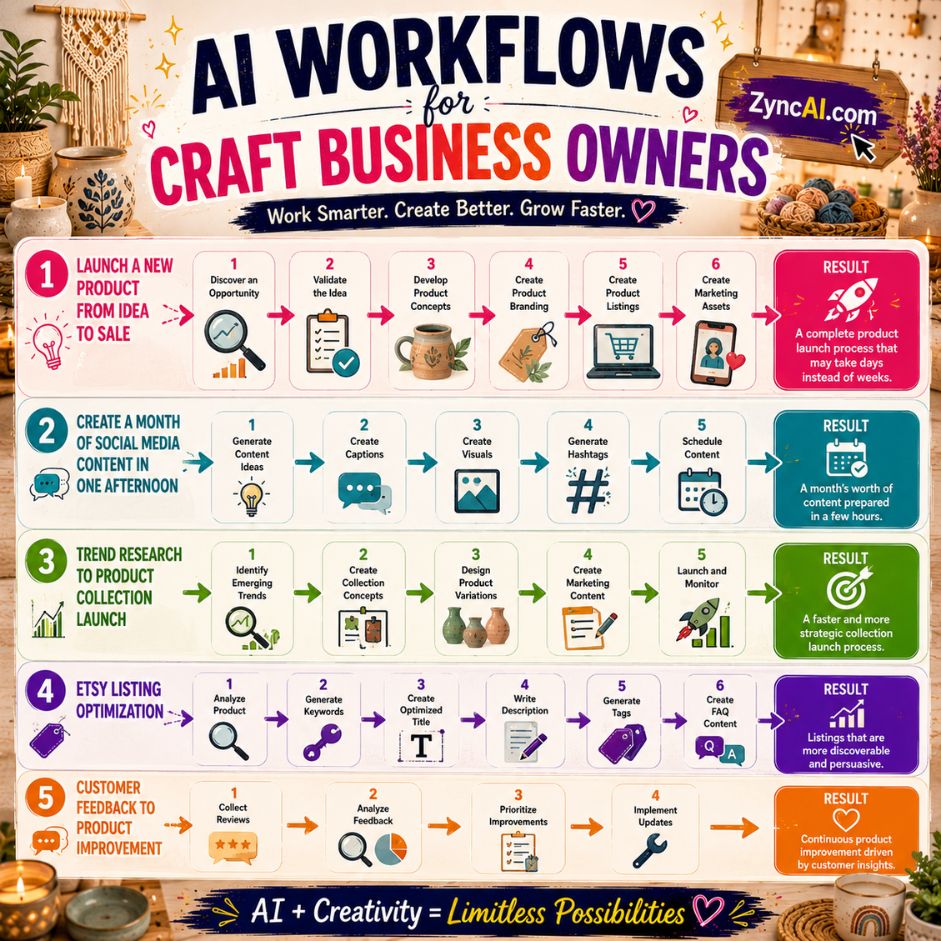
The following workflows demonstrate how AI can support real-world craft business activities.
Workflow 1: Launch a New Product From Idea to Sale
This workflow helps transform a product idea into a market-ready offering.
Step 1: Discover an Opportunity
Use AI research tools to identify trends and customer demand.
Tools
- ChatGPT
- Google Trends
- Pinterest Trends
- Perplexity
Prompt Example
“Identify emerging handmade home décor trends with growing demand and moderate competition.”
Step 2: Validate the Idea
Before investing time and materials, evaluate market potential.
Tools
- ChatGPT
- Gemini
- Perplexity
Prompt Example
“Evaluate the business potential of personalized ceramic plant pots.”
Step 3: Develop Product Concepts
Generate product ideas, variations, and collections.
Tools
- ChatGPT
- Leonardo AI
- Canva AI
Prompt Example
“Create 20 design concepts for a modern rustic ceramic planter collection.”
Step 4: Create Product Branding
Develop names, descriptions, and brand messaging.
Tools
- ChatGPT
- Claude
- Canva AI
Step 5: Create Product Listings
Generate:
- Titles
- Keywords
- Descriptions
- FAQs
- Tags
Step 6: Create Marketing Assets
Generate:
- Pinterest pins
- Instagram posts
- Product videos
- Email campaigns
Result
A complete product launch process that may take days instead of weeks.
Workflow 2: Create a Month of Social Media Content in One Afternoon
Many craft business owners spend hours every week trying to figure out what to post.
AI can help create an entire month’s worth of content in a single session.
Step 1: Generate Content Ideas
Ask AI to create:
- Educational posts
- Product highlights
- Behind-the-scenes content
- Customer stories
- Seasonal posts
Prompt Example
“Generate 30 social media post ideas for a handmade candle business.”
Step 2: Create Captions
Generate multiple caption options for each post.
Step 3: Create Visuals
Use AI design tools to create:
- Graphics
- Story templates
- Promotional images
Step 4: Generate Hashtags
Create platform-specific hashtag sets.
Step 5: Schedule Content
Upload everything to a scheduling platform.
Recommended Tools
- ChatGPT
- Canva AI
- Adobe Express AI
- Buffer AI Assistant
Result
A month’s worth of content prepared in a few hours.
Workflow 3: Trend Research to Product Collection Launch
This workflow is ideal for businesses launching seasonal collections.
Step 1: Identify Emerging Trends
Research:
- Pinterest trends
- Search demand
- Consumer interests
Step 2: Create Collection Concepts
Generate:
- Themes
- Product ideas
- Color palettes
- Packaging concepts
Step 3: Design Product Variations
Use AI to expand ideas into a full collection.
Step 4: Create Marketing Content
Generate:
- Product stories
- Social content
- Blog articles
- Email campaigns
Step 5: Launch and Monitor
Track performance and gather feedback.
Result
A faster and more strategic collection launch process.
Workflow 4: Etsy Listing Optimization
This workflow focuses on improving visibility and conversions.
Step 1: Analyze Product
Provide AI with product details.
Step 2: Generate Keywords
Create:
- Primary keywords
- Long-tail keywords
- Seasonal keywords
Step 3: Create Optimized Title
Generate multiple title options.
Step 4: Write Description
Focus on:
- Benefits
- Features
- Storytelling
- SEO
Step 5: Generate Tags
Create highly relevant tag combinations.
Step 6: Create FAQ Content
Address common customer concerns.
Result
Listings that are more discoverable and persuasive.
Workflow 5: Customer Feedback to Product Improvement
This workflow helps transform reviews into growth opportunities.
Step 1: Collect Reviews
Gather:
- Etsy reviews
- Website reviews
- Social comments
- Customer emails
Step 2: Analyze Feedback
Ask AI to identify:
- Complaints
- Praise
- Feature requests
- Product weaknesses
Step 3: Prioritize Improvements
Determine which changes will have the greatest impact.
Step 4: Implement Updates
Improve:
- Products
- Packaging
- Instructions
- Customer experience
Result
Continuous product improvement driven by customer insights.
The Future of AI in the Craft Business Industry
Many craft business owners still see AI as a tool for generating content or writing product descriptions.
In reality, we are only at the beginning.
Over the next several years, AI is likely to become deeply integrated into every stage of the craft business value chain.
The businesses that embrace these changes early will have a significant advantage.
1. AI-Powered Trend Forecasting
Future AI systems will become increasingly effective at predicting customer demand.
Instead of reacting to trends, businesses will be able to anticipate them.
AI will identify:
- Emerging aesthetics
- New product categories
- Consumer preference shifts
- Seasonal opportunities
Months before they become mainstream.
2. Hyper-Personalized Products
Customers increasingly want products that feel unique.
AI will make personalization easier than ever.
Examples may include:
- Personalized artwork
- Custom gift products
- Tailored home décor
- Individualized packaging
Customers will expect products designed specifically for them.
3. AI-Assisted Product Design
AI design tools will continue improving rapidly.
Future systems may generate:
- Product concepts
- Manufacturing suggestions
- Packaging ideas
- Collection plans
Within minutes.
Craft business owners will still provide creativity and vision, but AI will accelerate execution.
4. Smarter Inventory Forecasting
Inventory planning is often one of the biggest challenges for makers.
Future AI systems will analyze:
- Historical sales
- Economic trends
- Weather patterns
- Social media behavior
- Search trends
To create highly accurate inventory forecasts.
5. Automated Marketing Ecosystems
Future AI platforms may automatically create:
- Blog posts
- Social media campaigns
- Pinterest pins
- Email sequences
- Ad creatives
Based on new product launches.
This could significantly reduce marketing workload.
6. AI-Powered Customer Experiences
Customers increasingly expect faster responses and personalized interactions.
Future AI systems may provide:
- Instant customer support
- Product recommendations
- Personalized shopping experiences
- Automated order updates
While maintaining a human feel.
AI Will Not Replace Craftsmanship
Despite all these advancements, one thing remains true.
People buy handmade products because they value:
- Creativity
- Authenticity
- Human stories
- Individual craftsmanship
AI can enhance these strengths.
It cannot replace them.
The future belongs to craft businesses that combine human creativity with AI-powered efficiency.
Common AI Mistakes Craft Business Owners Should Avoid
AI can be incredibly powerful.
However, using it incorrectly can lead to poor results.
Avoiding these common mistakes will help you gain more value from AI while protecting your brand.
1. Using AI Without a Clear Goal
Many people start using AI simply because it is popular.
Instead, begin with a specific problem.
Examples:
- Improve Etsy SEO
- Save time creating content
- Research trends faster
- Generate product ideas
Clear goals produce better results.
2. Copying AI Output Without Editing
AI-generated content should rarely be published exactly as written.
Always review and improve:
- Product descriptions
- Social media posts
- Emails
- Blog articles
Your brand should still sound like you.
3. Ignoring Brand Voice
Consistency matters.
If your brand is friendly, artistic, luxurious, or playful, your AI-generated content should reflect that personality.
Provide AI with examples of your preferred style.
4. Over-Automating Customer Communication
Customers buy handmade products partly because they value personal connections.
Avoid making customer interactions feel robotic.
Use AI to draft responses, then personalize them.
5. Using Too Many AI Tools
Many business owners become overwhelmed trying dozens of tools.
Start small.
Master a few tools before expanding your toolkit.
6. Expecting Perfect Results
AI is not magic.
It works best as a collaborative partner.
The highest-quality results usually come from:
Human Creativity + AI Assistance
Not AI alone.
7. Failing to Verify Information
AI occasionally makes mistakes.
Always verify:
- Product facts
- Legal information
- Supplier recommendations
- Financial calculations
Treat AI as a helpful assistant, not an infallible expert.
8. Neglecting Creativity
AI should support creativity, not replace it.
The most successful craft businesses continue to emphasize originality, storytelling, and craftsmanship.
Getting Started: A 30-Day AI Adoption Plan for Craft Business Owners
Many business owners feel overwhelmed by AI because they try to learn everything at once.
The best approach is gradual adoption.
This 30-day plan helps you integrate AI into your business without feeling overwhelmed.
Week 1: Research & Discovery
Goal: Learn how AI can help you understand your market.
Activities
- Create a ChatGPT account
- Explore Google Trends
- Explore Pinterest Trends
- Research competitors
- Create customer personas
- Identify trend opportunities
Outcomes
By the end of Week 1, you should have:
- A clearer target audience
- New product ideas
- Better market understanding
Week 2: Product Development & Content Creation
Goal: Use AI to accelerate creativity.
Activities
- Generate product ideas
- Create product collections
- Develop brand stories
- Write product descriptions
- Create FAQs
- Generate photography captions
Outcomes
By the end of Week 2, you should have:
- New products to explore
- Stronger branding
- Improved product content
Week 3: Marketing & Sales
Goal: Improve visibility and customer acquisition.
Activities
- Generate Etsy keywords
- Optimize product listings
- Create Pinterest content
- Write social media posts
- Build an email newsletter
- Generate promotional graphics
Outcomes
By the end of Week 3, you should have:
- Improved SEO
- More content
- Better marketing systems
Week 4: Analysis & Optimization
Goal: Use AI to improve performance.
Activities
- Analyze sales data
- Review customer feedback
- Improve products
- Forecast inventory
- Build growth plans
- Create monthly reporting templates
Outcomes
By the end of Week 4, you should have:
- Better business insights
- Improved decision-making
- Clear growth priorities
Your Next Step
You don’t need to implement all 70 AI use cases immediately.
Choose one area of your business that consumes the most time or causes the most frustration.
Start there.
Once you experience the benefits, gradually expand AI into other stages of your craft business value chain.
Small improvements compound over time.
A few minutes saved every day can translate into hundreds of hours saved each year—time that can be reinvested into creating better products, serving customers, and growing a thriving craft business.
Frequently Asked Questions (FAQs)
Q1. What is AI for craft business owners?
A1. AI refers to artificial intelligence tools that can help craft business owners automate tasks, generate ideas, create content, conduct research, analyze data, improve customer service, and make better business decisions.
Q2. Do I need technical skills to use AI tools?
A2. No. Most modern AI tools are designed for beginners and use simple text prompts. Many craft business owners start using AI effectively without any technical background.
Q3. Can AI replace my creativity?
A3. No. AI works best as a creative assistant. It can generate ideas and suggestions, but your creativity, craftsmanship, and unique style remain the most important factors in your business.
Q4. Are free AI tools good enough for a craft business?
A4. Yes. Many free AI tools provide enough functionality for research, content creation, marketing, customer service, and product development, especially for small and growing craft businesses.
Q5. Which AI tool should beginners start with?
A5. ChatGPT is often the best starting point because it can assist with research, product descriptions, social media content, customer responses, and business planning.
Q6. Can AI help me find profitable craft niches?
A6. Yes. AI can analyze trends, customer interests, search behavior, and market demand to help identify profitable opportunities.
Q7. How can AI help with Etsy selling?
A7. AI can generate keywords, titles, tags, descriptions, FAQs, customer responses, social media content, and marketing ideas to improve Etsy performance.
Q8. Can AI predict future craft trends?
A8. AI can identify emerging patterns and trend signals, helping craft business owners spot opportunities earlier than traditional research methods.
Q9. Is AI useful for handmade businesses specifically?
A9. Absolutely. AI can support every stage of a handmade business, from idea generation and product development to marketing, customer service, and growth planning.
Q10. Can AI help create new product ideas?
A10. Yes. AI can generate hundreds of product concepts, variations, seasonal ideas, and collection themes based on your niche and target audience.
Q11. How accurate are AI-generated product ideas?
A11. AI-generated ideas should be viewed as inspiration rather than guarantees. It is always important to validate ideas using market research and customer feedback.
Q12. Can AI help me understand my customers better?
A12. Yes. AI can create customer personas, analyze reviews, identify customer pain points, and uncover purchasing motivations.
Q13. How can AI improve product descriptions?
A13. AI can write persuasive, SEO-friendly descriptions that highlight product benefits, materials, craftsmanship, and customer outcomes.
Q14. Can AI create product names?
A14. Yes. AI can generate creative, memorable, and brand-aligned product names for individual products or entire collections.
Q15. Is AI useful for creating craft collections?
A15. Yes. AI can suggest themes, matching products, color palettes, collection names, and seasonal product groupings.
Q16. Can AI help with product pricing?
A16. AI can assist with pricing analysis by evaluating competitors, perceived value, production costs, and market positioning.
Q17. Can AI help me choose materials?
A17. Yes. AI can recommend suitable materials based on durability, sustainability, appearance, customer preferences, and budget requirements.
Q18. How can AI improve inventory planning?
A18. AI can analyze sales patterns and forecast future demand to help reduce stock shortages and overstock situations.
Q19. Can AI create product mockups?
A19. Yes. AI image generation tools can create realistic mockups that help visualize products before production or photography.
Q20. Can AI design logos for my craft business?
A20. AI can generate logo concepts and design ideas that can be refined into a final brand identity.
Q21. How can AI help with branding?
A21. AI can assist with business names, brand stories, color palettes, packaging concepts, messaging, and visual identity development.
Q22. Can AI write a brand story?
A22. Yes. AI can transform your mission, values, and business journey into a compelling narrative that resonates with customers.
Q23. Can AI help create packaging ideas?
A23. Yes. AI can generate packaging concepts, unboxing experiences, label ideas, and sustainability improvements.
Q24. How can AI help with blog writing?
A24. AI can generate blog ideas, outlines, first drafts, SEO recommendations, and content updates.
Q25. Can AI improve SEO for my craft website?
A25. Yes. AI can help identify keywords, optimize content, generate meta descriptions, and improve search visibility.
Q26. Can AI create social media content?
A26. Yes. AI can generate captions, post ideas, content calendars, hashtags, and campaign concepts.
Q27. How can AI help with Pinterest marketing?
A27. AI can generate Pinterest titles, descriptions, content ideas, and keyword strategies to improve visibility and traffic.
Q28. Can AI write Instagram captions?
A28. Yes. AI can create captions that support storytelling, engagement, brand voice, and calls to action.
Q29. Can AI generate video content ideas?
A29. Yes. AI can create video scripts, content concepts, tutorial ideas, and short-form video strategies.
Q30. Can AI help create email newsletters?
A30. Yes. AI can generate newsletter content, promotional emails, product announcements, and customer engagement campaigns.
Q31. How can AI improve customer service?
A31. AI can draft customer responses, create FAQs, generate order updates, and streamline communication.
Q32. Can AI handle customer inquiries automatically?
A32. AI can assist with automated responses, but human review is recommended for maintaining a personal customer experience.
Q33. Can AI help with custom orders?
A33. Yes. AI can generate questionnaires, customer communication templates, and order management workflows.
Q34. How can AI help manage reviews?
A34. AI can draft professional responses to positive reviews, complaints, and customer feedback.
Q35. Can AI help reduce business costs?
A35. Yes. AI can reduce the time spent on content creation, research, design concepts, customer support, and administrative tasks.
Q36. Can AI help me compete with larger brands?
A36. Yes. AI provides small businesses with access to tools and capabilities that were once available only to larger companies.
Q37. Is AI useful for solo craft business owners?
A37. AI can be especially valuable for solo entrepreneurs because it helps manage multiple responsibilities more efficiently.
Q38. Can AI improve productivity?
A38. Yes. AI can automate repetitive tasks, accelerate workflows, and reduce manual effort across many business activities.
Q39. Can AI analyze customer reviews?
A39. Yes. AI can identify common compliments, complaints, feature requests, and improvement opportunities.
Q40. Can AI help identify new product categories?
A40. Yes. AI can analyze customer interests, trends, and market opportunities to suggest logical business expansions.
Q41. How can AI support long-term business growth?
A41. AI can assist with strategic planning, forecasting, market research, customer analysis, and growth roadmaps.
Q42. Are AI-generated images suitable for marketing?
A42. Yes. Many businesses use AI-generated graphics, mockups, and promotional visuals as part of their marketing strategy.
Q43. Can AI replace product photography?
A43. AI can supplement product photography with mockups and concept images, but authentic product photos remain important for customer trust.
Q44. What is the biggest benefit of AI for craft business owners?
A44. The biggest benefit is often time savings, allowing business owners to focus more on creating products and growing their business.
Q45. What is the biggest mistake people make when using AI?
A45. Publishing AI-generated content without reviewing, editing, and adapting it to their brand voice.
Q46. Should I trust everything AI tells me?
A46. No. AI-generated information should always be reviewed and verified, especially for business, financial, legal, or technical decisions.
Q47. How many AI tools do I need?
A47. Most craft business owners can achieve excellent results with five to ten carefully selected AI tools.
Q48. Will AI become more important for craft businesses in the future?
A48. Yes. AI is expected to play an increasingly important role in trend forecasting, marketing, personalization, customer service, and business planning.
Q49. Can AI help me scale my craft business?
A49. Yes. AI can streamline operations, improve efficiency, automate routine tasks, and support strategic growth initiatives.
Q50. What is the best way to start using AI today?
A50. Start with one challenge that consumes the most time in your business—such as content creation, product descriptions, customer service, or market research—and use a single AI tool to solve that problem before expanding into other areas.