How Health, Wellness & Fitness Coaches Can Use AI – 25 Practical Ways To Grow Business
You became a health, wellness, or fitness coach to help people transform their lives,, not to spend your evenings writing social media posts, replying to endless emails, updating client records, or figuring out what to post next.
Yet that is the reality many coaches face.
As your business grows, so do the demands on your time. Marketing, content creation, client communication, scheduling, and administrative work can easily consume hours that you would rather spend coaching clients and growing your impact.
That is why more coaches are turning to AI..
AI is not here to replace the personal connection, expertise, and motivation that make you a great coach. Instead, it is a powerful tool that helps you work smarter. AI can help you run a more efficient and profitable business without sacrificing the quality of your coaching, from creating content and attracting new clients to automating routine tasks and delivering more personalized experiences.
The coaches who learn to use AI effectively are not just saving time, they are creating better client experiences, building stronger brands, and scaling their businesses faster than ever before.
In this guide, you will discover how AI can strengthen every part of your coaching business and explore 25 practical ways to use it to save time, attract more clients, and grow your health, wellness, or fitness coaching business.
How Health, Wellness & Fitness Coaching Businesses Create Value (Key Stages)
Before implementing AI, it is important to understand how value is created within a coaching business.
Every successful coaching business follows a series of activities that transform strangers into loyal clients and advocates.
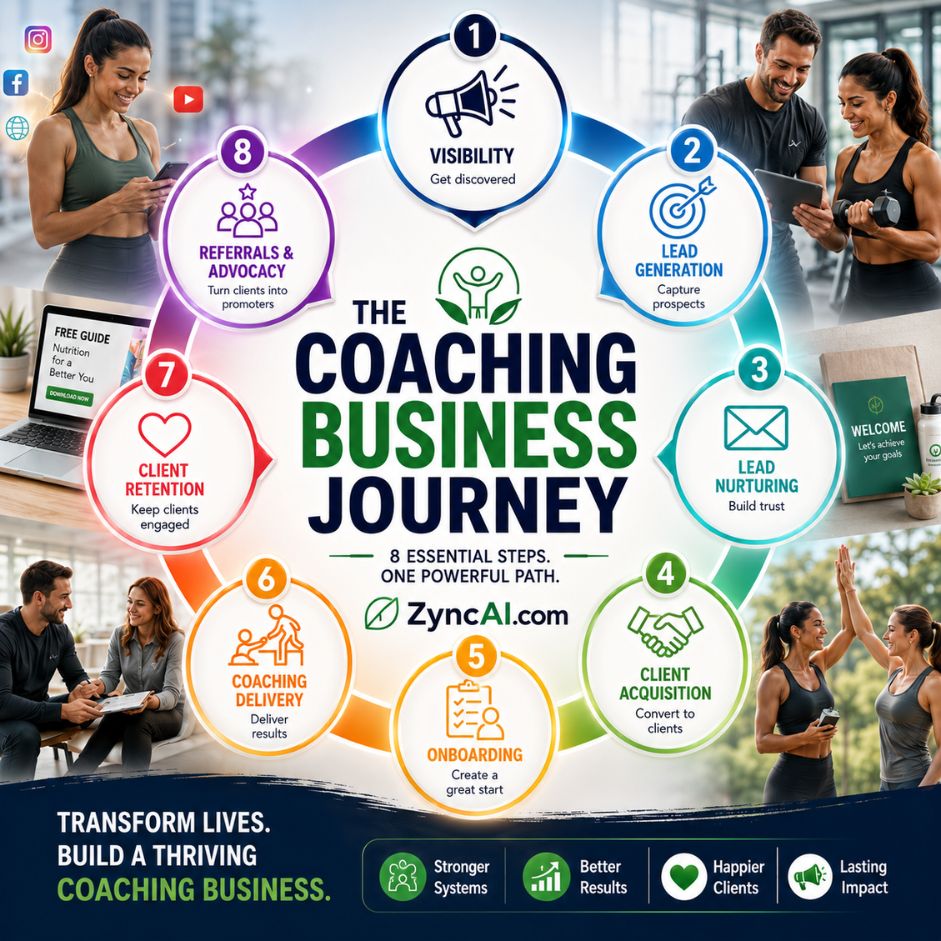
Following is the Value Chain (Also Known As “Key Stage”) in a Coaching Business,
1. Brand Building & Visibility
This stage focuses on creating awareness and establishing credibility in your niche. The goal is to attract the attention of potential clients, build trust, and position yourself as an expert before prospects ever contact you. Consistent visibility helps keep your brand top-of-mind when people are ready to seek coaching support.
Activities include:
- Social media marketing
- Blogging
- Video creation
- Podcast appearances
- Community engagement
- SEO
2. Lead Generation
Once people discover your brand, the next step is encouraging them to share their contact information and express interest in your services. Effective lead generation creates a steady pipeline of potential clients who can be nurtured toward becoming paying customers.
Activities include:
- Lead magnets
- Email signups
- Free consultations
- Webinars
- Challenges
3. Lead Nurturing
Most prospects do not make a buying decision immediately. Lead nurturing helps build trust, demonstrate expertise, address concerns, and keep potential clients engaged until they are ready to invest in your coaching programs.
Activities include:
- Email campaigns
- Educational content
- Follow-up sequences
- Success stories
4. Sales & Client Acquisition
This stage focuses on converting interested prospects into paying clients. Clear communication, personalized conversations, and compelling offers help prospects understand the value of your coaching and confidently move forward.
Activities include:
- Discovery calls
- Program presentations
- Sales pages
- Proposal creation
5. Client Onboarding
A strong onboarding experience sets the foundation for client success. It ensures new clients feel welcomed, understand the coaching process, and have a clear plan for achieving their goals from the very beginning.
Activities include:
- Intake forms
- Assessments
- Goal setting
- Welcome materials
6. Coaching Delivery
This is where the core value of your business is delivered. Through coaching sessions, guidance, accountability, and personalized support, clients work toward meaningful health, wellness, or fitness outcomes.
Activities include:
- Coaching sessions
- Progress tracking
- Program adjustments
- Accountability systems
7. Client Retention
Retaining clients is often more profitable than constantly acquiring new ones. This stage focuses on maintaining engagement, supporting continued progress, and creating long-term relationships that extend beyond the initial coaching program.
Activities include:
- Follow-up support
- Progress reviews
- Community access
- Ongoing education
8. Referrals & Advocacy
Satisfied clients can become one of your most powerful growth channels. By encouraging referrals, testimonials, and success stories, you can turn positive client experiences into a sustainable source of new business opportunities.
Activities include:
- Testimonials
- Reviews
- Referral programs
- Case studies
How AI Improves Every Stage of the Coaching Value Chain
One of AI’s biggest advantages is its ability to improve the entire coaching business, not just individual tasks. Instead of spending hours on marketing, administration, client communication, and follow-ups, smart coaches can use AI to streamline workflows and focus more on delivering results to clients.
AI helps eliminate repetitive work while creating more personalized experiences ranging from attracting new prospects to retaining existing clients. This allows health, wellness, and fitness coaches to serve more clients, improve consistency, and scale their businesses without significantly increasing their workload.
I becomes a growth tool that enhances efficiency, improves client satisfaction, and creates more opportunities for long-term business growth when applied across the coaching value chain.
For example, AI can help,
- Generate content that attracts new leads
- Create social media posts, blogs, and video scripts
- Build lead magnets and landing page copy
- Personalize email nurturing campaigns
- Automate appointment scheduling and onboarding
- Summarize coaching sessions and generate action plans
- Track client progress and identify trends
- Create personalized resources and recommendations
- Collect testimonials and client feedback
- Run referral and client retention campaigns
- Re-engage inactive clients with automated follow-ups
- Analyze business performance and marketing results
25 Practical Ways Health, Wellness & Fitness Coaches Can Use AI
AI for Marketing & Brand Visibility
1. Generate Blog Topics Based on Client Pain Points
Coming up with fresh content ideas can be challenging, especially when you are focused on serving clients. AI can analyze common questions, trends, and audience interests to suggest blog topics that directly address the problems your ideal clients are trying to solve. This helps you create content that attracts relevant traffic and positions you as an expert.
AI can analyze common questions from clients and generate dozens of blog topics focused on:
- Weight loss
- Mental wellness
- Stress management
- Nutrition
- Fitness goals
- Habit building
This helps maintain a consistent publishing schedule while targeting topics your audience actively searches for.
2. Write SEO-Optimized Blog Posts
Writing detailed blog posts takes time, but AI can help speed up the process while maintaining quality. It can assist with research, structure, keyword placement, and content drafting, making it easier to publish consistent content that ranks in search engines and attracts potential clients.
AI can help:
- Create outlines
- Suggest headings
- Draft sections
- Improve readability
- Generate FAQs
This significantly reduces writing time while improving search visibility.
3. Create Social Media Posts Faster
Maintaining an active social media presence is essential for visibility, but creating daily content can become overwhelming. AI can turn your coaching insights, client success stories, and educational content into engaging social posts tailored for multiple platforms.
Instead of spending hours brainstorming captions, coaches can use AI to generate:
- Instagram posts
- LinkedIn content
- Facebook updates
- X posts
- Pinterest descriptions
One coaching insight can be transformed into multiple social posts within minutes.
4. Repurpose Content Across Platforms
One of the easiest ways to increase content output is by repurposing what you already create. AI can transform a single piece of content into multiple formats, helping you maximize reach without constantly creating new material from scratch.
A single blog post can become:
- 10 social posts
- 5 email newsletters
- 3 video scripts
- A webinar outline
- A downloadable guide
AI makes content repurposing simple and scalable.
5. Create Short Video Scripts
Video content is one of the most effective ways to build trust and engagement. AI can help generate concise, engaging scripts that communicate your expertise clearly while reducing the time spent planning and scripting content.
AI can generate:
- Reels scripts
- TikTok scripts
- YouTube Shorts content
- Educational videos
- Promotional videos
This helps coaches produce video content consistently.
6. Improve Pinterest Marketing
Pinterest can be a powerful traffic source for wellness and fitness businesses. AI can help identify keywords, generate optimized titles and descriptions, and create content ideas that increase the visibility of your pins and drive visitors to your website.
AI can help generate:
- Pin titles
- Pin descriptions
- Content clusters
- Keyword ideas
This can significantly increase organic website traffic.
7. Write Email Newsletters
Regular email communication helps nurture relationships and keep your audience engaged. AI can assist in creating valuable newsletters that educate, inspire, and promote your services while reducing the effort required to maintain consistency.
AI can assist with:
- Weekly newsletters
- Educational emails
- Client updates
- Promotional campaigns
Consistent email communication helps nurture relationships and increase conversions.
AI for Lead Generation
8. Create Lead Magnets Faster
Lead magnets are valuable resources that encourage potential clients to join your email list. AI can help draft and organize these resources quickly, allowing you to build your audience without spending weeks creating downloadable content.
Popular lead magnets include:
- Meal plans
- Fitness guides
- Habit trackers
- Wellness checklists
- Meditation guides
AI can draft these resources quickly, reducing creation time dramatically.
9. Generate High-Converting Landing Pages
A well-written landing page can significantly improve lead generation and sales. AI can help craft compelling messaging that clearly communicates benefits and encourages visitors to take action.
AI can help create:
- Headlines
- Benefit sections
- Calls-to-action
- FAQ sections
This helps improve conversion rates for lead generation campaigns.
10. Improve Website SEO
Search engine optimization helps potential clients find your business online. AI can streamline many SEO tasks, making it easier to optimize content and improve your website’s visibility in search results.
AI can assist with:
- Keyword research
- Content optimization
- Meta descriptions
- Internal linking suggestions
Better SEO leads to increased organic traffic.
11. Build Webinar Content
Webinars are an excellent way to educate prospects and showcase your expertise. AI can assist in planning and structuring webinars that provide value while naturally leading participants toward your coaching programs.
AI can help create:
- Webinar titles
- Presentation outlines
- Slide content
- Audience engagement questions
12. Personalize Lead Nurturing
Not every lead is ready to buy immediately. AI can help create personalized follow-up content that addresses individual interests and challenges, increasing trust and improving conversion rates over time.
AI can generate personalized email sequences based on:
- Goals
- Interests
- Challenges
- Previous interactions
This improves engagement and trust.
AI for Sales & Client Acquisition
13. Create Discovery Call Frameworks
Discovery calls are crucial for understanding client needs and determining whether your coaching services are a good fit. AI can help design structured conversations that uncover important information and improve sales outcomes.
AI can generate customized discovery call questions that uncover:
- Goals
- Obstacles
- Motivations
- Readiness to change
14. Generate Coaching Proposals
Professional proposals help prospects understand your services and the value you provide. AI can create customized proposals quickly, allowing you to respond faster and maintain a polished client experience.
- Program overview
- Goals and outcomes
- Pricing details
- Next steps
15. Write Sales Pages
A strong sales page can significantly influence buying decisions. AI can help create persuasive copy that communicates the transformation clients can expect while addressing their concerns and motivations.
AI can help structure persuasive sales pages that clearly communicate:
- Benefits
- Outcomes
- Testimonials
- Pricing
- Calls-to-action
16. Handle Common Objections
Potential clients often have concerns before making a commitment. AI can help prepare thoughtful responses that address these concerns, making sales conversations smoother and more effective.
AI can help prepare responses to common concerns such as:
- Pricing
- Time commitment
- Program suitability
- Expected results
AI for Client Onboarding
17. Create Welcome Packages
A strong onboarding experience helps clients feel confident and motivated from the start. AI can help create professional welcome materials that set expectations and provide clarity about the coaching journey.
AI can generate:
- Welcome guides
- Program overviews
- Success roadmaps
- Client expectations
18. Build Assessments and Intake Forms
Understanding a client’s current situation is essential for delivering personalized coaching. AI can help create comprehensive assessments that gather relevant information efficiently and consistently.
AI can help create questionnaires covering:
- Lifestyle
- Nutrition
- Fitness habits
- Goals
- Challenges
19. Generate Personalized Goal Plans
Every client has unique objectives and circumstances. AI can assist in creating structured goal plans that align with individual needs, helping clients stay focused and accountable.
- Short-term goals
- Long-term goals
- Milestones
- Action steps
AI for Coaching Delivery
20. Summarize Coaching Sessions
Taking notes during or after sessions can be time-consuming. AI-powered transcription and summarization tools can capture key insights and action items automatically, allowing you to focus more on coaching.
AI meeting assistants can summarize:
- Key discussions
- Action items
- Progress updates
- Follow-up tasks
This saves significant administrative time.
21. Create Personalized Action Plans
Clients achieve better results when they leave each session with clear next steps. AI can help organize recommendations into actionable plans that are easy to understand and follow.
22. Build Habit Tracking Systems
Behavior change is often the foundation of health and fitness success. AI can help design personalized tracking systems that encourage consistency and provide valuable progress insights.
AI can help design customized habit trackers for:
- Nutrition
- Sleep
- Exercise
- Stress management
- Hydration
23. Create Educational Resources
Providing educational materials enhances the coaching experience and empowers clients to make informed decisions. AI can help create a variety of resources that reinforce your coaching methods.
Coaches can use AI to create:
- Guides
- Worksheets
- Checklists
- Learning materials
This improves client understanding and outcomes.
24. Automate Client Check-Ins
Regular communication keeps clients engaged and accountable between sessions. AI can help automate routine check-ins while maintaining a personalized feel, improving retention and results.
AI can generate:
- Weekly progress emails
- Accountability messages
- Milestone celebrations
- Motivation reminders
This helps maintain engagement between sessions.
25. Generate Testimonials and Referral Campaigns
Satisfied clients can become one of your most effective marketing channels. AI can help create systems that encourage reviews, referrals, and success stories, helping you attract more clients through social proof.
AI can help create:
- Testimonial request emails
- Success story templates
- Referral program communications
Satisfied clients become a powerful growth engine.
Best AI Tools for Health, Wellness & Fitness Coaches
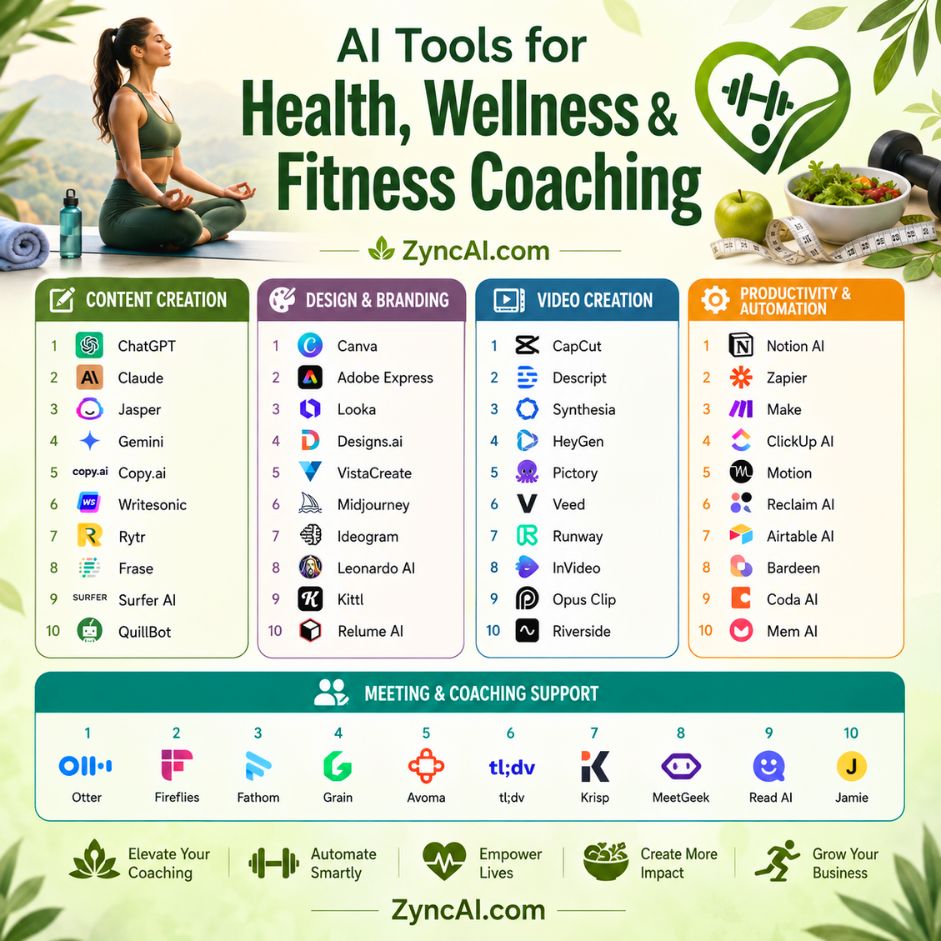
1. Content Creation
1.1 ChatGPT
AI assistant for writing, brainstorming, content planning, and marketing.
Best for:
- Blog writing
- Social media content
- Email marketing
- Client resources
Not good for:
- Real-time data
- Specialized medical advice
Tip: Create a custom prompt library for recurring content tasks.
1.2 Claude
AI writing assistant known for producing natural, human-like content.
Best for:
- Long-form articles
- Coaching guides
- Client education materials
Not good for:
- Graphic creation
- Video editing
Tip: Use Claude to draft detailed wellness programs and resources.
1.3 Jasper
Marketing-focused AI writing platform for businesses.
Best for:
- Marketing campaigns
- Website copy
- Sales content
Not good for:
- Deep technical coaching content
Tip: Build brand voice templates to maintain consistency.
1.4 Gemini
Google’s AI assistant for research, content generation, and idea development.
Best for:
- Content research
- Blog outlines
- YouTube scripts
Not good for:
- Highly customized brand messaging
Tip: Use Gemini to gather information before creating final content.
1.5 Copy.ai
AI platform designed for marketing and sales copy.
Best for:
- Social media captions
- Email campaigns
- Ad copy
Not good for:
- Educational long-form content
Tip: Generate multiple headline variations for lead magnets.
1.6 Writesonic
AI writing tool focused on SEO and content marketing.
Best for:
- Blog posts
- Landing pages
- SEO content
Not good for:
- Personalized coaching plans
Tip: Use target keywords when generating articles.
1.7 Rytr
Affordable AI content writer for short-form content.
Best for:
- Social media posts
- Quick content drafts
- Newsletters
Not good for:
- In-depth articles
Tip: Generate content variations to test engagement.
1.8 Frase
AI content optimization and research platform.
Best for:
- SEO research
- Content briefs
- Blog planning
Not good for:
- Graphic design
Tip: Analyze top-ranking articles before creating content.
1.9 Surfer AI
SEO-focused AI article generation platform.
Best for:
- Organic traffic growth
- Search-focused articles
Not good for:
- Personal storytelling
Tip: Add personal coaching experiences to improve authenticity.
1.10 QuillBot
AI-powered paraphrasing and rewriting tool.
Best for:
- Content repurposing
- Improving readability
Not good for:
- Original content creation
Tip: Turn blogs into newsletters and social posts.
2. Design & Branding
2.1 Canva
AI-powered graphic design platform for marketers and creators.
Best for:
- Social media graphics
- Presentations
- Workbooks
Not good for:
- Advanced professional design
Tip: Create reusable branded templates.
2.2 Adobe Express
Design and content creation platform with AI features.
Best for:
- Promotional graphics
- Social content
Not good for:
- Complex branding projects
Tip: Build visual assets for coaching programs.
2.3 Looka
AI logo and branding generator.
Best for:
- New coaching businesses
- Personal brands
Not good for:
- Enterprise-level branding
Tip: Use generated concepts as branding inspiration.
2.4 Designs.ai
AI design suite for logos, videos, and marketing assets.
Best for:
- Quick brand creation
- Marketing visuals
Not good for:
- Highly customized design work
Tip: Generate multiple concepts before selecting a direction.
2.5 VistaCreate
Graphic design platform similar to Canva.
Best for:
- Social media content
- Marketing materials
Not good for:
- Professional illustration
Tip: Create a month’s worth of social graphics in one session.
2.6 Midjourney
AI image generation platform producing high-quality visuals.
Best for:
- Website imagery
- Custom wellness visuals
Not good for:
- Text-heavy designs
Tip: Generate unique visuals instead of stock photos.
2.7 Ideogram
AI image generator known for excellent text rendering.
Best for:
- Pinterest graphics
- Marketing visuals
Not good for:
- Detailed photo editing
Tip: Create quote graphics with readable typography.
2.8 Leonardo AI
AI image creation and editing platform.
Best for:
- Fitness illustrations
- Social media visuals
Not good for:
- Brand identity systems
Tip: Generate custom visuals matching your coaching niche.
2.9 Kittl
Design platform with AI-powered creative tools.
Best for:
- Workbooks
- Merchandise
- Printable resources
Not good for:
- Video content
Tip: Design wellness journals and habit trackers.
2.10 Relume AI
AI website wireframing and design assistant.
Best for:
- Coaching websites
- Landing page planning
Not good for:
- Graphic design projects
Tip: Map website content before development begins.
3. Video Creation
3.1 CapCut
AI-powered video editing platform popular among creators.
Best for:
- Reels
- TikTok videos
- Short-form content
Not good for:
- Professional filmmaking
Tip: Use auto-captions to improve engagement.
3.2 Descript
Video and podcast editor powered by AI.
Best for:
- Coaching videos
- Podcasts
- Interviews
Not good for:
- Motion graphics
Tip: Edit videos by simply editing text transcripts.
3.3 Synthesia
AI avatar video creation platform.
Best for:
- Training videos
- Course content
Not good for:
- Personal brand storytelling
Tip: Create educational videos without recording yourself.
3.4 HeyGen
AI spokesperson and avatar video platform.
Best for:
- Marketing videos
- Multilingual content
Not good for:
- Highly personal coaching messages
Tip: Expand content into multiple languages.
3.5 Pictory
Converts text and articles into videos.
Best for:
- Blog repurposing
- Educational content
Not good for:
- Advanced editing
Tip: Turn blog posts into YouTube videos.
3.6 Veed
Online AI video editor with automation features.
Best for:
- Social media videos
- Coaching content
Not good for:
- Professional film production
Tip: Use AI subtitles for better accessibility.
3.7 Runway
Advanced AI video creation and editing platform.
Best for:
- Creative campaigns
- Marketing videos
Not good for:
- Beginners
Tip: Create attention-grabbing promotional videos.
3.8 InVideo
AI video creation platform from prompts and scripts.
Best for:
- Marketing videos
- Educational content
Not good for:
- Complex custom edits
Tip: Produce weekly content efficiently.
3.9 Opus Clip
AI tool for creating short clips from long videos.
Best for:
- YouTube Shorts
- Reels
- TikTok
Not good for:
- Full-length editing
Tip: Turn webinars into dozens of content pieces.
3.10 Riverside
Recording and editing platform with AI features.
Best for:
- Podcasts
- Expert interviews
Not good for:
- Animation-focused content
Tip: Record guest experts to increase authority.
4. Productivity & Automation
4.1 Notion AI
AI-enhanced workspace for notes, planning, and knowledge management.
Best for:
- Content planning
- SOPs
- Knowledge bases
Not good for:
- Complex automation
Tip: Create a centralized coaching business dashboard.
4.2 Zapier
No-code automation platform connecting thousands of apps.
Best for:
- Workflow automation
- Lead management
Not good for:
- Advanced custom logic
Tip: Automatically move leads into your CRM.
4.3 Make
Visual automation platform for complex workflows.
Best for:
- Business process automation
- Multi-step workflows
Not good for:
- Beginners
Tip: Automate client onboarding processes.
4.4 ClickUp AI
Project management platform with AI assistance.
Best for:
- Team management
- Task tracking
Not good for:
- Simple personal workflows
Tip: Automate recurring operational tasks.
4.5 Motion
AI-powered calendar and schedule optimizer.
Best for:
- Busy coaches
- Time management
Not good for:
- Team collaboration
Tip: Let AI prioritize your daily schedule.
4.6 Reclaim AI
AI scheduling assistant for productivity.
Best for:
- Time blocking
- Habit scheduling
Not good for:
- Project management
Tip: Protect dedicated content creation time.
4.7 Airtable AI
Database and workflow platform enhanced with AI.
Best for:
- Client tracking
- Content management
Not good for:
- Simple note-taking
Tip: Build a client progress management system.
4.8 Bardeen
AI browser automation tool.
Best for:
- Repetitive online tasks
- Lead research
Not good for:
- Enterprise workflows
Tip: Automate prospect research activities.
4.9 Coda AI
AI-powered document and workflow platform.
Best for:
- Operations management
- Documentation
Not good for:
- Lightweight task management
Tip: Build your coaching business operating manual.
4.10 Mem AI
AI note-taking and knowledge assistant.
Best for:
- Idea capture
- Coaching notes
Not good for:
- Large team collaboration
Tip: Save insights from coaching sessions for future content.
5. Meeting & Coaching Support
5.1 Otter
AI meeting transcription and note-taking platform.
Best for:
- Coaching calls
- Client meetings
Not good for:
- Detailed coaching analysis
Tip: Share summaries with clients after sessions.
5.2 Fireflies
AI meeting recorder and conversation assistant.
Best for:
- Online meetings
- Team collaboration
Not good for:
- In-person sessions
Tip: Create searchable records of coaching calls.
5.3 Fathom
AI meeting assistant for recording and summaries.
Best for:
- Coaching sessions
- Discovery calls
Not good for:
- Offline meetings
Tip: Automatically generate action items.
5.4 Grain
Meeting recording and insight extraction platform.
Best for:
- Client coaching calls
- Testimonials
Not good for:
- In-person coaching
Tip: Capture client success stories for marketing.
5.5 Avoma
AI meeting intelligence and conversation analysis platform.
Best for:
- Sales calls
- Consultation sessions
Not good for:
- Casual conversations
Tip: Identify patterns that improve conversion rates.
5.6 tl;dv
Meeting recording and AI summarization tool.
Best for:
- Zoom meetings
- Remote coaching
Not good for:
- Offline coaching
Tip: Review highlights instead of full recordings.
5.7 Krisp
AI noise cancellation and audio enhancement tool.
Best for:
- Virtual coaching
- Online workshops
Not good for:
- Session note-taking
Tip: Improve professionalism during client calls.
5.8 MeetGeek
AI meeting assistant with analytics and notes.
Best for:
- Team meetings
- Client sessions
Not good for:
- Simple note-taking
Tip: Build a searchable coaching knowledge base.
5.9 Read AI
Meeting assistant that tracks engagement and generates summaries.
Best for:
- Group coaching
- Team calls
Not good for:
- In-person events
Tip: Monitor engagement during workshops and webinars.
5.10 Jamie
Cross-platform AI meeting assistant and note taker.
Best for:
- Independent coaches
- Consultants
Not good for:
- Enterprise sales teams
Tip: Capture notes without adding bots to meetings.
A Simple AI Adoption Roadmap
Many health, wellness, and fitness coaches get excited about AI and immediately start experimenting with dozens of tools. While enthusiasm is great, trying to implement everything at once often creates confusion, wasted time, and abandoned projects. The most successful coaches take a gradual approach, focusing on one area of the business at a time before expanding to the next.
Think of AI adoption as building a strong foundation. Start with activities that generate visibility and leads, then improve how prospects become clients, and finally optimize the client experience. By following a structured roadmap, you can achieve quick wins, build confidence, and create sustainable improvements across your coaching business.
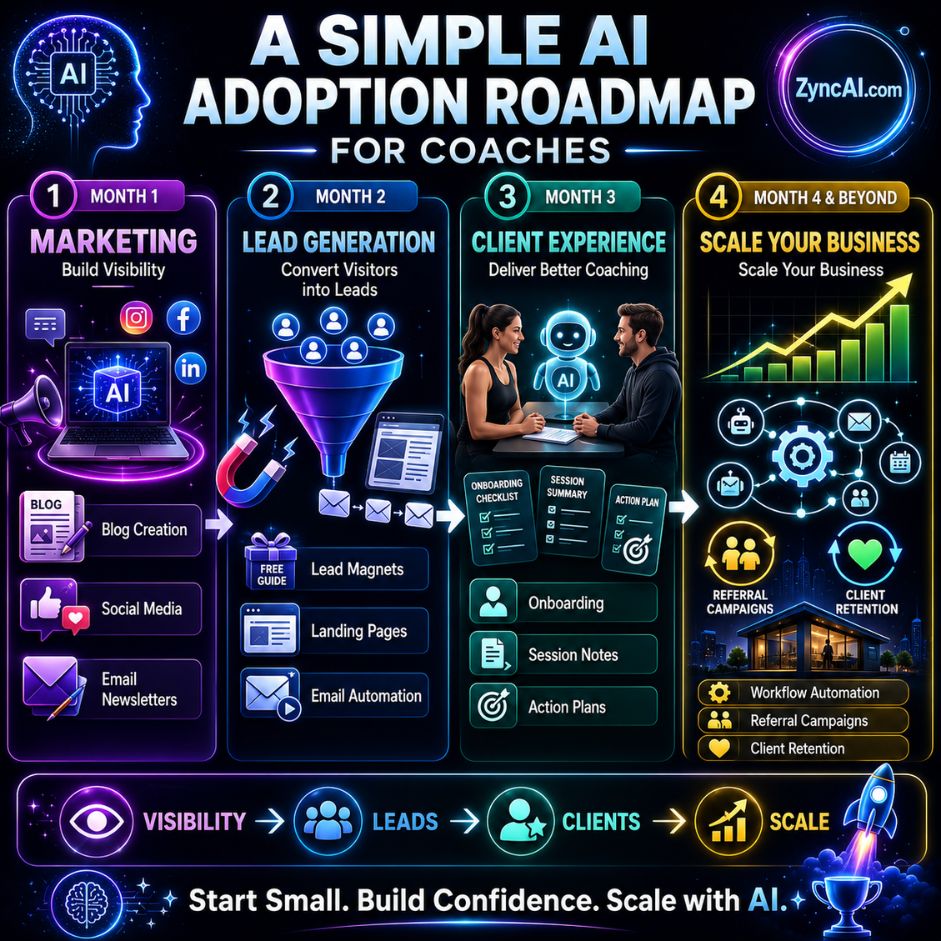
Month 1: Marketing
The first month should focus on increasing your visibility and content output. Marketing is often one of the most time-consuming activities for coaches, and AI can significantly reduce the hours spent creating content while maintaining consistency. The goal is to establish a steady flow of valuable content that attracts potential clients and keeps your brand visible across multiple channels.
Focus on:
- Blog creation
- Social media
- Email newsletters
Month 2: Lead Generation
Once your marketing efforts are creating awareness, the next step is converting visitors into leads. AI can help create compelling lead magnets, optimize landing pages, and automate follow-up sequences that nurture prospects. This allows you to build a predictable pipeline of potential clients without manually managing every interaction.
Implement:
- Lead magnets
- Landing pages
- Email automation
Month 3: Client Experience
After improving lead generation, focus on delivering an exceptional client experience. AI can streamline administrative work, reduce time spent on documentation, and help create personalized client resources. This allows you to spend more time coaching and less time handling repetitive tasks while improving the overall quality of your service.
Improve:
- Onboarding
- Session notes
- Action plans
Month 4 and Beyond
With marketing, lead generation, and client delivery systems in place, you can begin scaling your business more efficiently. AI becomes a powerful operational tool that helps automate workflows, increase referrals, and strengthen client retention. At this stage, you’re no longer using AI for isolated tasks—you’re using it to support the growth of your entire coaching business.
Scale through:
- Workflow automation
- Referral campaigns
- Client retention systems
The Key to Success: Progress Over Perfection
You don’t need to implement 25 AI strategies in a single month to see results. Even adopting one or two AI-powered improvements each month can save hours of work, increase client satisfaction, and create new revenue opportunities. Start with the areas causing the biggest bottlenecks in your business, measure the impact, and gradually expand your AI toolkit as your confidence and experience grow. Over time, these small improvements compound into a more efficient, scalable, and profitable coaching business.
FAQs
Q1. What is AI and how can it help health, wellness, and fitness coaches?
A1. Artificial intelligence (AI) refers to technology that can analyze information, generate content, automate tasks, and provide insights. For health, wellness, and fitness coaches, AI can help save time, improve client communication, automate administrative work, create marketing content, and support business growth.
Q2. Will AI replace health, wellness, and fitness coaches?
A2. No. AI can automate repetitive tasks and provide assistance, but it cannot replace the empathy, accountability, motivation, experience, and personal relationships that professional coaches provide to clients.
Q3. What are the biggest benefits of using AI in a coaching business?
A3. The biggest benefits include time savings, increased productivity, better client experiences, improved marketing efficiency, personalized communication, higher scalability, and the ability to focus more on coaching rather than administrative tasks.
Q4. How can AI help coaches attract more clients?
A4. AI can help create SEO content, social media posts, email campaigns, lead magnets, landing pages, webinars, and marketing strategies that increase visibility and generate more qualified leads.
Q5. Can AI improve client retention for coaching businesses?
A5. Yes. AI can automate follow-ups, create personalized check-ins, track progress, generate motivational messages, and identify signs of disengagement before clients drop out.
Q6. What are the best AI tools for health and wellness coaches?
A6. Popular tools include ChatGPT, Claude, Gemini, Jasper, Canva AI, Notion AI, Descript, CapCut, Fireflies, Fathom, Otter, Zapier, and Make.
Q7. How can AI help personal trainers save time?
A7. AI can assist with content creation, workout plan templates, session summaries, client communication, onboarding materials, progress reports, and marketing campaigns.
Q8. Is AI suitable for solo coaches and small coaching businesses?
A8. Yes. In fact, solo coaches often benefit the most because AI allows them to operate more efficiently without hiring additional staff.
Q9. Can AI create personalized coaching plans?
A9. AI can help draft personalized plans based on client information, but coaches should always review and customize recommendations to ensure they align with professional standards and client needs.
Q10. How can AI improve content marketing for coaches?
A10. AI can generate blog ideas, write articles, create social media content, develop email newsletters, suggest keywords, and repurpose content into multiple formats.
Q11. Can AI help health coaches create meal plans?
A11. AI can assist with meal plan drafts and nutritional content, but qualified professionals should review recommendations to ensure accuracy, safety, and suitability for individual clients.
Q12. How does AI support lead generation?
A12. AI can create lead magnets, optimize landing pages, generate email sequences, improve SEO, analyze audience behavior, and help convert website visitors into leads.
Q13. Can AI write sales pages for coaching programs?
A13. Yes. AI can help create compelling sales pages that communicate benefits, address objections, highlight transformations, and encourage conversions.
Q14. How can AI help coaches with email marketing?
A14. AI can generate newsletters, welcome sequences, nurture campaigns, promotional emails, segmentation strategies, and subject line variations.
Q15. Is AI useful for online fitness coaches?
A15. Yes. Online fitness coaches can use AI for content creation, client onboarding, progress tracking, workout documentation, and marketing automation.
Q16. How can AI improve discovery calls?
A16. AI can generate discovery call scripts, qualification questions, objection-handling frameworks, and post-call summaries.
Q17. Can AI help with client onboarding?
A17. Yes. AI can create welcome guides, intake forms, onboarding emails, goal-setting templates, and client education materials.
Q18. How can AI help create social media content consistently?
A18. AI can generate content calendars, captions, video ideas, carousel outlines, hashtags, and engagement-focused content strategies.
Q19. Can AI help coaches rank higher on Google?
A19. AI can support SEO by identifying keywords, optimizing content structure, creating topic clusters, improving metadata, and generating search-friendly content.
Q20. What coaching tasks should not be delegated entirely to AI?
A20. Coaches should personally handle relationship building, emotional support, ethical decisions, client accountability, professional judgment, and sensitive client conversations.
Q21. How can AI help wellness coaches build authority?
A21. AI can assist in publishing consistent thought leadership content, creating educational resources, producing videos, and maintaining a strong online presence.
Q22. Can AI automate client communication?
A22. AI can automate routine communication such as reminders, appointment confirmations, progress check-ins, and follow-up emails while maintaining personalization.
Q23. How can AI improve client engagement?
A23. AI can deliver timely reminders, personalized recommendations, milestone celebrations, educational content, and accountability prompts.
Q24. Can AI help coaches create digital products?
A24. Yes. AI can help create ebooks, guides, templates, worksheets, checklists, online course materials, and lead magnets.
Q25. How can AI support coaching business scalability?
A25. AI enables coaches to automate repetitive processes, serve more clients efficiently, improve workflows, and reduce operational bottlenecks.
Q26. What role does AI play in coaching business analytics?
A26. AI can analyze client data, marketing performance, sales funnels, retention rates, and business trends to support data-driven decisions.
Q27. Can AI identify client behavior patterns?
A27. Yes. AI can analyze engagement, attendance, progress tracking, and communication patterns to identify opportunities for intervention and support.
Q28. How can AI help improve coaching program design?
A28. AI can analyze feedback, identify content gaps, suggest curriculum improvements, and generate educational resources.
Q29. Can AI assist with habit formation coaching?
A29. Yes. AI can help create tracking systems, reminders, progress reports, and personalized accountability frameworks.
Q30. How can AI help coaches build recurring revenue streams?
A30. AI can support membership programs, subscription content, automated nurture sequences, community engagement, and upsell campaigns.
Q31. Can AI generate coaching worksheets and templates?
A31. Yes. AI can quickly create customized worksheets, assessments, reflection exercises, action plans, and progress trackers.
Q32. How can AI improve webinar performance?
A32. AI can help create presentations, audience engagement questions, promotional campaigns, follow-up sequences, and webinar summaries.
Q33. Can AI support client accountability programs?
A33. Yes. AI can automate reminders, progress tracking, milestone recognition, and regular accountability check-ins.
Q34. How can AI help coaches manage large amounts of content?
A34. AI can organize content libraries, repurpose materials, categorize resources, and identify opportunities for reuse.
Q35. What are the risks of relying too heavily on AI?
A35. Risks include inaccurate information, generic content, loss of personal voice, reduced authenticity, and over-automation of client relationships.
Q36. How can coaches maintain authenticity while using AI?
A36. Coaches should use AI as a drafting and productivity tool while adding personal experiences, expertise, opinions, and unique coaching perspectives.
Q37. Can AI help generate client success stories?
A37. Yes. AI can organize client outcomes into structured case studies, testimonials, and transformation stories while preserving authenticity.
Q38. How does AI improve coaching business operations?
A38. AI streamlines scheduling, documentation, communication, reporting, onboarding, marketing, and workflow management.
Q39. Can AI help coaches create online courses?
A39. Yes. AI can assist with curriculum development, lesson planning, quiz creation, workbook generation, and course marketing.
Q40. How can AI help improve coaching session preparation?
A40. AI can summarize previous sessions, review client notes, identify patterns, and suggest discussion topics before meetings.
Q41. What is the best way to start using AI as a coach?
A41. Begin with one high-impact area such as content creation, email marketing, or session summaries before expanding to additional business functions.
Q42. How can AI help with referral marketing?
A42. AI can automate referral requests, create referral campaigns, generate promotional materials, and track referral program performance.
Q43. Can AI improve client onboarding conversion rates?
A43. Yes. AI can create personalized onboarding experiences, automate communication, reduce friction, and improve first impressions.
Q44. How can AI help coaches understand their audience better?
A44. AI can analyze surveys, reviews, social media interactions, website behavior, and customer feedback to uncover audience insights.
Q45. Can AI help identify profitable coaching niches?
A45. Yes. AI can analyze search trends, audience demand, competition levels, and content performance to identify niche opportunities.
Q46. How can AI support long-term client success?
A46. AI can provide ongoing engagement, progress monitoring, habit tracking, personalized recommendations, and timely interventions.
Q47. What metrics should coaches track when implementing AI?
A47. Important metrics include time saved, lead generation rates, conversion rates, client retention, content output, website traffic, and revenue growth.
Q48. How can AI improve the entire coaching value chain?
A48. AI can enhance every stage of the business, from brand awareness and lead generation to onboarding, coaching delivery, retention, referrals, and business optimization.
Q49. What does an AI-powered coaching business look like in the future?
A49. An AI-powered coaching business combines human expertise with intelligent automation to deliver highly personalized experiences, scalable services, and efficient operations.
Q50. What is the single biggest advantage of AI for health, wellness, and fitness coaches?
A50. The greatest advantage is the ability to spend less time on repetitive administrative and marketing tasks while dedicating more time to helping clients achieve meaningful and lasting results.